
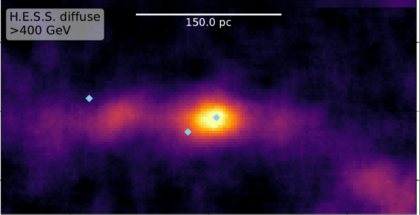
A spectral steepening in the Galactic Centre ridge spectrum
September 2026 The Galactic Centre is one of the richest regions in the Milky Way, harboring a large variety of potential particle accelerators such as supernova remnants, pulsar wind nebulae and young massive stellar…
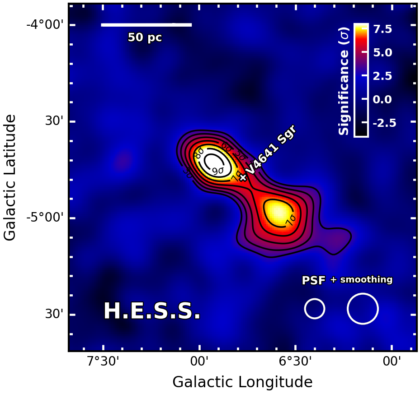
V4641 Sagittarii – the not-so-unremarkable microquasar
December 2025 For decades, we have sought to understand the origin of the most energetic particles in the Universe: cosmic rays. The energy range of cosmic rays arriving to Earth span more than ten…
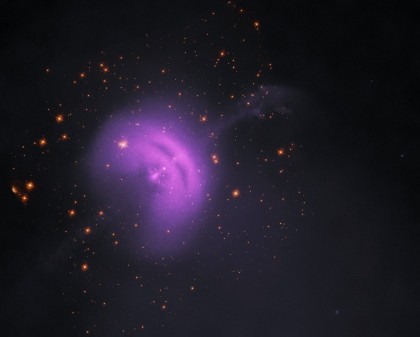
The Vela Pulsar – the most Highly Energetic Clock
November 2023 Pulsars, progeny of supernova explosions, are among the most fascinating beasts in the cosmic zoo. They are rapidly rotating objects exhibiting magnetic field intensities many orders of magnitude larger than what we…
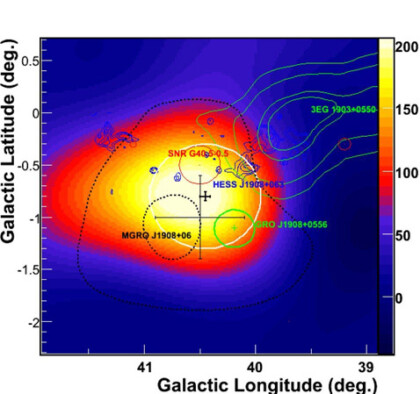
Confirming MGRO 1908+06
August 2007 Recently, the Milagro collaboration, operating a ground-based air shower detector based on the water Cherenkov technique, announced the detection of several new sources of very-high-energy gamma rays in the Galactic Plane (A.…
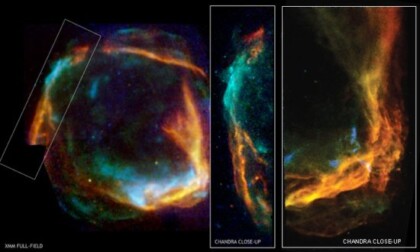
The Supernova Remnant RCW 86
July 2007 RCW 86 is a supernova remnant with a barrel-shaped shell, nicely visible in X-rays (top image), in the optical and in radio waves (Fig. 1). Concerning its age, two options are discussed…
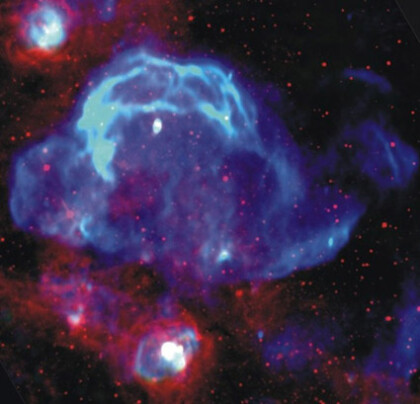
Gamma Rays from W28 – an Old Supernova Remnant and Molecular Clouds
April 2007 It is a long-held idea that supernova remnants are acceleration sites for nucleonic cosmic rays. Indeed supernova shells are clearly seen as sources of high energy gamma rays (SOM 2005/01, SOM 2005/03),…
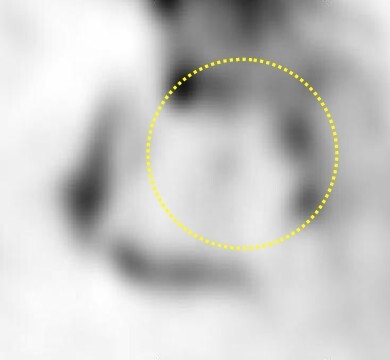
HESS J1640–465 – A Pulsar Wind Nebula?
March 2007 The gamma-ray source HESS J1640-465 (Fig. 1) was discovered during the survey of the Galactic plane; with a size of 0.045 degrees it is among the most compact sources in the survey,…
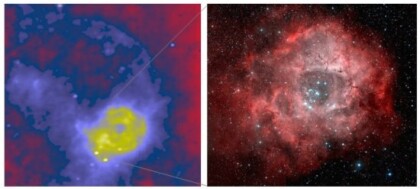
A Point-Like Gamma-Ray Source in Monoceros
February 2007 Previous H.E.S.S. results on the supernova remnants RX J1713.7-3946 and RX J0852.0-4622 have clearly demonstrated that supernova shock fronts are capable of accelerating particles to very high energies. Gamma rays are produced…
