
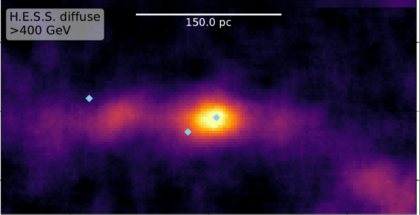
A spectral steepening in the Galactic Centre ridge spectrum
September 2026 The Galactic Centre is one of the richest regions in the Milky Way, harboring a large variety of potential particle accelerators such as supernova remnants, pulsar wind nebulae and young massive stellar…
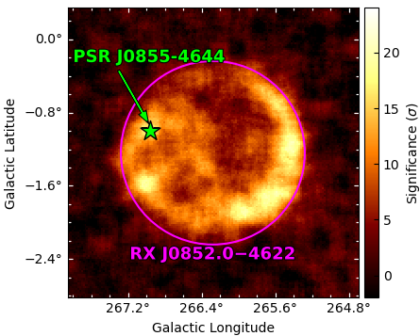
Hidden by the Shell – A Pulsar Wind Nebula Emerges in Vela Junior
March 2026 A pulsar is a highly magnetised, rapidly-rotating neutron star resulting from the collapse of the progenitor star’s compact core during a supernova explosion. This strong magnetic field then induces an electric field…
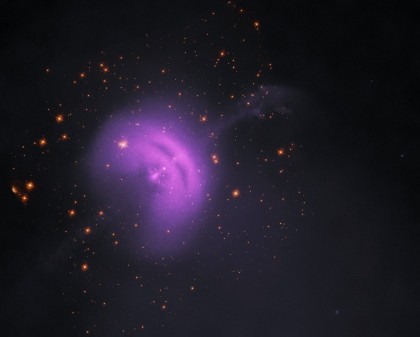
The Vela Pulsar – the most Highly Energetic Clock
November 2023 Pulsars, progeny of supernova explosions, are among the most fascinating beasts in the cosmic zoo. They are rapidly rotating objects exhibiting magnetic field intensities many orders of magnitude larger than what we…
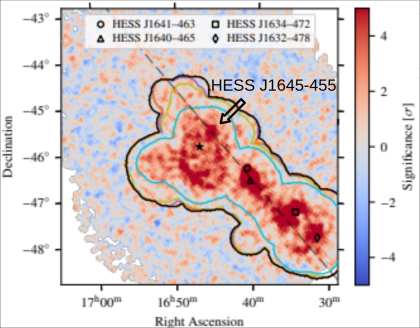
HESS J1645−455 – A gem on the ring?
October 2023 The brightest source of gamma-ray emission in any energy band is the Milky Way. It dominates the all-sky maps obtained with scanning or hemispheric detectors operating in space (e.g. the Fermi-LAT) or…
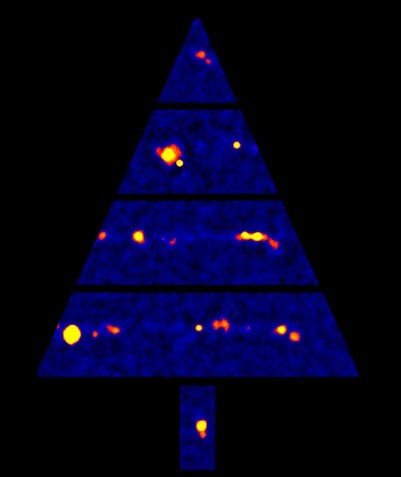
The Starry TeV Sky
December 2007 Coming close to the end of the year it seems the appropriate time to use this column for a look at the sky at tera electron volt (TeV) energies, and in particular…
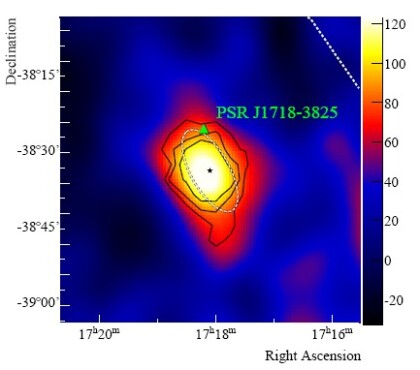
PWN Abundance – HESS J1718–385
June 2007 Pulsar wind nebulae – PWNe – are amongst the most abundant sources of very high energy gamma rays in our Galaxy. Rotational energy of the neutron star is converted – by some…
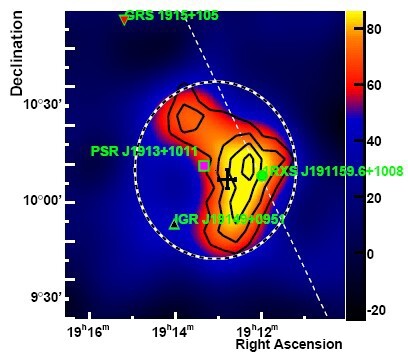
HESS J1912+101 – Yet Another Pulsar Wind Nebula?
May 2007 The H.E.S.S. survey of the Galactic Plane (Aharonian et al. 2005, 2006) initially covered the range from –30 degr. to +30 degr. Galactic longitude. More recently, the survey region was extended to…
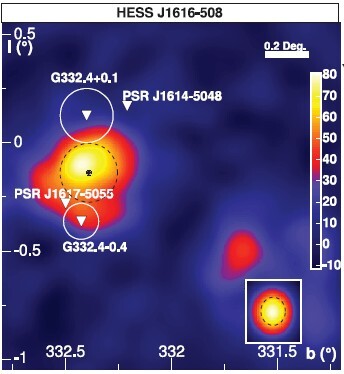
HESS J1616-508 – Evidence for a Dark Particle Accelerator
January 2007 HESS J1616–508 (Fig. 1) is one of the objects discovered in the H.E.S.S. survey of the Galactic Plane; it is an extended source with a size of about 8 arc min., a…
