June 2026
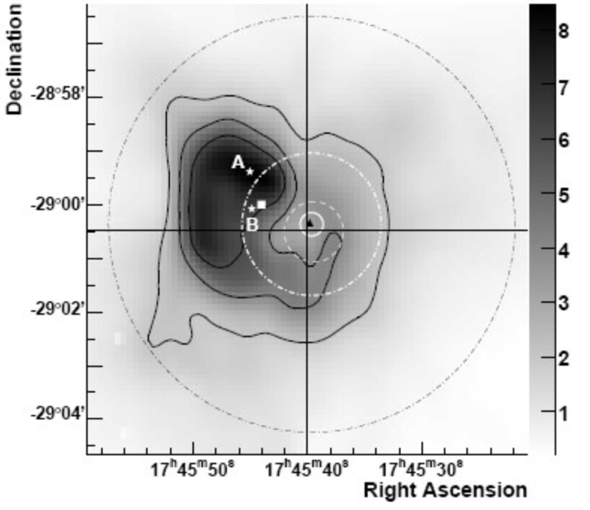
The latest H.E.S.S. study on the Galactic Centre (GC) takes us back to one of the most fascinating mysteries of very-high-energy astrophysics: what exactly powers the TeV source HESS J1745−290 at the heart of the Milky Way? Located within only a few arcseconds of the supermassive black hole Sgr A*, this compact, enigmatic gamma-ray source has puzzled the high-energy community for nearly two decades. Indeed, since its detection with H.E.S.S. [1], its origin has remained debated: the emission could arise, for instance, from particle acceleration in the immediate vicinity of Sgr A* or from the nearby pulsar wind nebula candidate G359.95−0.04 [3, 4, 5, 7] (see also Fig 1).
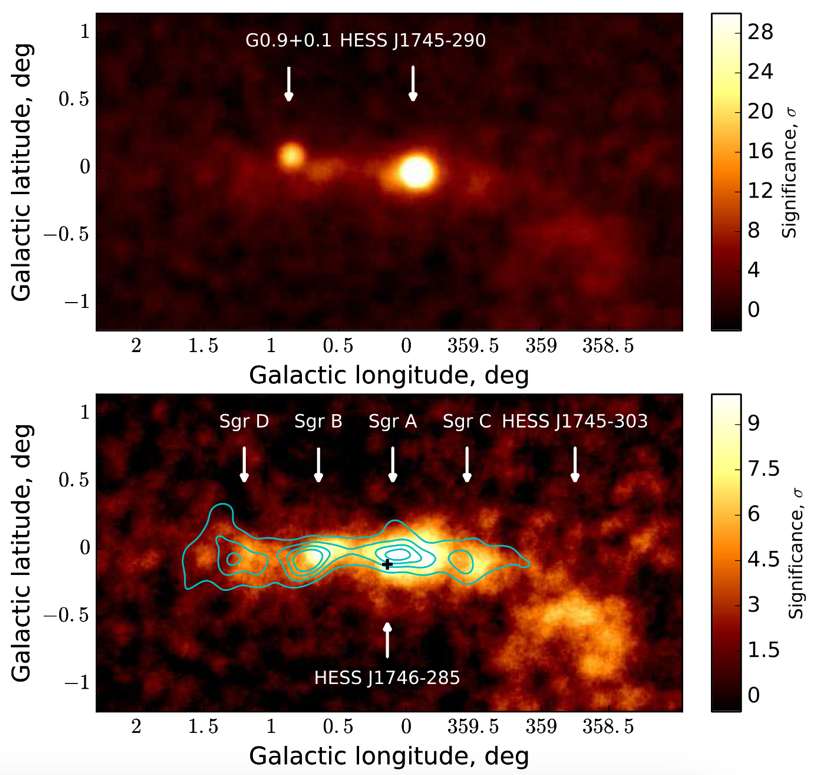
In addition to the central point-like source HESS J1745−290, H.E.S.S. also detected a bright diffuse TeV gamma-ray emission extending along the Central Molecular Zone (CMZ) [2, 8, 9, 14]. As seen in Figure 2, this large-scale “Galactic ridge” emission spatially correlates with the distribution of dense molecular gas, indicating that the gamma rays are produced via hadronic proton-proton collisions and neutral pion decay, due to the interaction between high-energy cosmic rays and the dense matter inside CMZ clouds. Analyses of H.E.S.S. data revealed that the cosmic-ray density increases strongly toward the Galactic Centre, following approximately a 1/r radial profile, which is naturally expected for particles continuously injected by a quasi-stationary accelerator located near the GC [8, 9, 14]. This result provided the first strong evidence that the source injecting cosmic rays at the GC acts as a steady accelerator. However, it remains unclear whether this quasi-stationary accelerator is physically linked to the compact source HESS J1745−290 itself, to the black hole Sgr A*, or to one or several other objects.
Given the frequent X-ray, radio and infrared flares of Sgr A*, the detection of rapid flux variability of HESS J1745−290 would appear as a smoking gun linking the TeV emission to particle acceleration occurring in the immediate vicinity of the black hole. That is why early studies of the GC in very-high-energy gamma rays have focused primarily on short-timescale variability, implementing several coordinated campaigns between H.E.S.S. and X-ray observatories such as Chandra and XMM-Newton [5]. These studies have searched for correlated flaring activity on timescales ranging from minutes to hours [5, 6], but found no convincing evidence for rapid TeV variability, suggesting that the gamma-ray emission is not directly tracing the instantaneous accretion state of the black hole.
While short-term variability studies test rapid changes in the accelerator, like flares or transient accretion events, investigations of long-term variability probe long-term state evolution of the accretion rate and particle injection and diffusion conditions in the surrounding environment of the black hole. However, studying long-term variability over many years of monitoring of HESS J1745−290 is challenging, mainly due to the complexity of the region including many sources and a large-scale diffuse emission. Additionally, time-dependent instrumental effects that vary over years of observation time require a detailed knowledge of the instrument systematics, at a level that is difficult to achieve.
In a new study [15], we have exploited a large set of archival H.E.S.S. observations, spanning sixteen years of observations between 2004 and 2019 – thus representing the longest TeV monitoring campaign ever performed on the GC. HESS J1745−290 is embedded in a highly complex environment dominated by diffuse gamma-ray emission extending over hundreds of parsecs along the Galactic plane, as well as nearby compact sources such as G0.9+0.1 and HESS J1746−285 [2, 9, 14]. To disentangle these overlapping components, we applied a sophisticated 3D spectro-morphological analysis implemented in the Gammapy Software [10], able to reconstruct the gamma-ray emission simultaneously in space and energy. The diffuse Galactic ridge emission – expected not to vary in time due to its large extent – was then used as an internal calibration source to correct for instrumental response and atmospheric variations.
After recalibration, the light curve showing the evolution of TeV flux of HESS J1745−290 over time, is fully compatible with a constant emission over the entire sixteen-year period (Fig 3). No significant spectral evolution or energy-dependent variability were detected. In particular, we searched for possible spectral changes associated with the passage of the G2 object near Sgr A* in 2013–2014, an event initially suspected to trigger enhanced accretion activity onto the black hole and possibly linked to increased X-ray flare rates observed by Chandra and XMM-Newton [11]. Yet no corresponding TeV counterpart was found. No long-term change is measurable either.
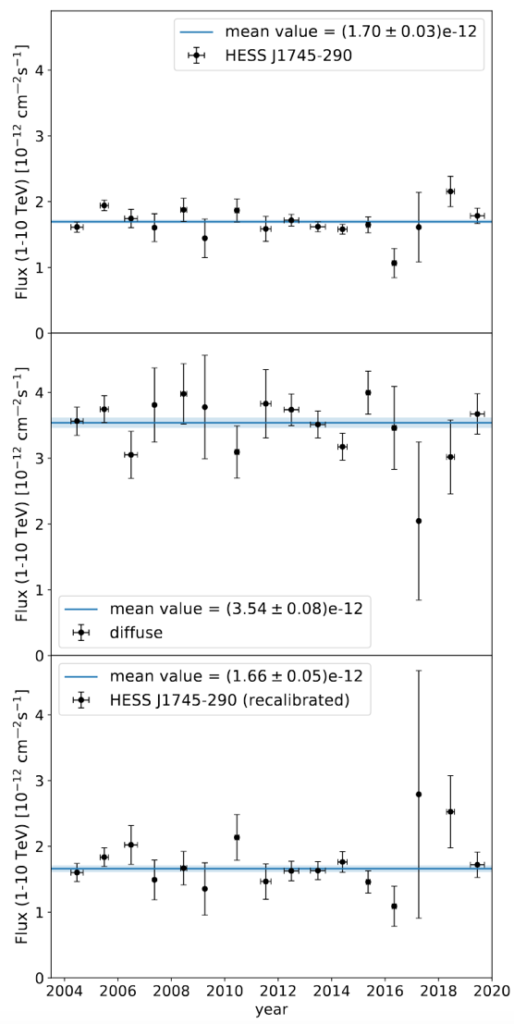
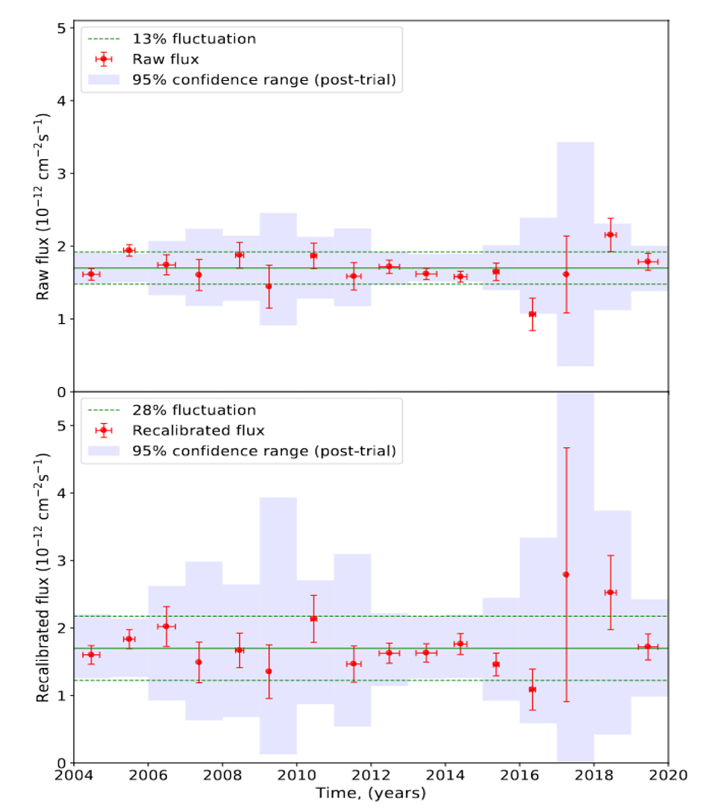
To assess how sensitive the dataset is to a possible variability, we performed thousands of Monte Carlo simulations, testing different variability scenarios. First, we adopted the hypothesis that the flux of HESS J1745-290 is constant over time and calculated the 95% confidence range of fluctuations expected from a constant source (Fig 4). The results show that, for the most sensitive years, a deviation from the long-term average of more than 28% can be excluded.
We then focused on the hypothesis that the flux of HESS J1745-290 decreases linearly with time, as expected if particles have been injected during past flares of Sgr A*. By simulating light-curves with various levels of flux decrease, we evaluated H.E.S.S.’s capability to detect such a diminution of the flux. The results are shown in Figure 5, where we can see that a total decrease larger than 28% over 16 years would be detected with a high probability. As a conclusion, the current H.E.S.S. dataset allows us to exclude a linear variation larger than 28% over the 16 years of monitoring.
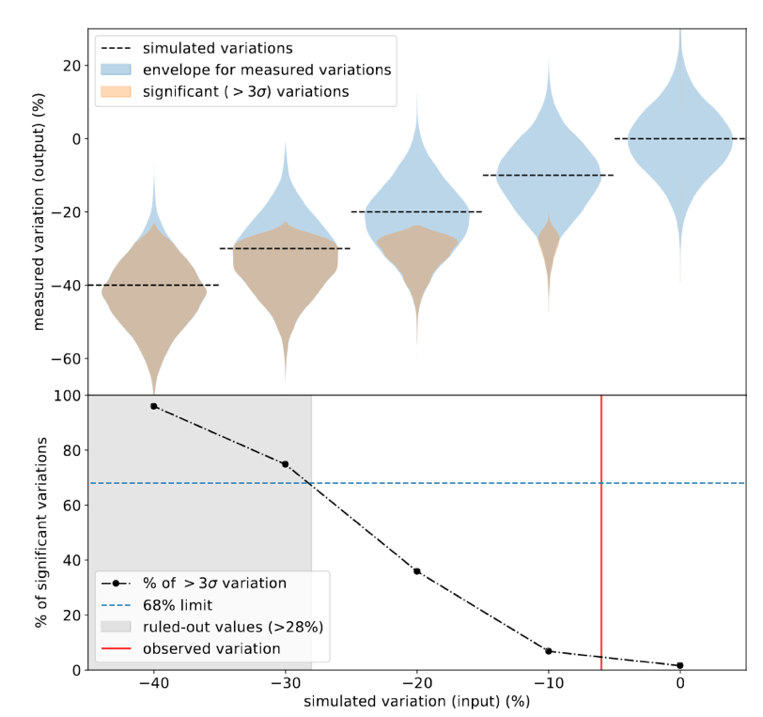
The analysis remains insufficiently sensitive, however, to detect smaller decreases of ~10–20% currently predicted by some diffusion scenarios [12, 13]. This study underlines that a long period of monitoring and the subsequent analysis of a large dataset allow the detection of smaller variations than those accessible with a year-by-year analysis [15].
Future observatories such as the Cherenkov Telescope Array Observatory (CTAO), with their improved sensitivity and better control of systematic uncertainties, combined with several additional decades of monitoring, will finally be able to determine whether the TeV source is truly steady or instead exhibits long-term variability. Such a detection would provide an important clue as to whether HESS J1745−290 is physically associated with Sgr A* or not.
References
[1] F. Aharonian et al. (H.E.S.S. collaboration), Very high energy gamma rays from the direction of Sagittarius A*, A&A 425, L13-L17 (2004).
[2] F. Aharonian et al. (H.E.S.S. collaboration), Discovery of very-high-energy γ-rays from the Galactic Centre ridge, Nature 439, 695-698 (2006).
[3] F. Aharonian et al. (H.E.S.S. Collaboration), H.E.S.S. observations of the Galactic Center region and their possible dark matter interpretation, PRL 97, 221102 (2006).
[4] Q. D. Wang et al., G359.95-0.04: an energetic pulsar candidate near Sgr A*. MNRAS 367, 937 (2006).
[5] F. Aharonian et al. (H.E.S.S. Collaboration), Simultaneous HESS and Chandra observations of Sagitarius A* during an X-ray flare, A&A 492, L25 (2008).
L25-L28 and arXiv:0812.3762
[6] F. Aharonian et al. (H.E.S.S. Collaboration), Spectrum and variability of the Galactic Center VHE gamma-ray source HESS J1745-290, A&A 503, 817 (2009).
[7] F. Acero et al. (H.E.S.S. Collaboration), Localizing the VHE gamma-ray source at the Galactic Centre, MNRAS 402, 1877 (2010).
[8] A. Abramowski et al. (H.E.S.S. Collaboration), Acceleration of petaelectronvolt protons in the Galactic Centre, Nature 531, 476-479 (2016).
[9] H. Abdalla et al. (H.E.S.S. Collaboration), Characterising the VHE diffuse emission in the central 200 parsecs of our Galaxy with H.E.S.S., A&A 612, A9 (2018).
[10] A. Donath et al., Gammapy: A Python package for gamma-ray astronomy, A&A 678, A157, (2023).
[11] A. Andrés et al., A Swift study of long-term changes in the X-ray flaring properties of Sagittarius A, MNRAS 510, 2851 (2022).
[12] F. Guo et al., Particle Acceleration and Plasma Dynamics during Magnetic Reconnection in the Magnetically Dominated Regime, ApJ 806, 167 (2015).
[13] M. Chernyakova et al., The High-energy, Arcminute-scale Galactic Center Gamma-ray Source. ApJ 726, 60 (2011).
[14] J. Devin, A. Lemière, K. Streil, R. Terrier, C. van Eldik (on behalf of the H.E.S.S. collaboration), On the cosmic-ray distribution in the Galactic Center region: New insights from H.E.S.S., Proceedings of Gamma 2024 conference.
https://arxiv.org/abs/2507.00132
[15] A. Acharyya et al. (H.E.S.S. Collaboration), Search for long-term variability of HESS J1745-290. A&A 709, A96 (2026).