May 2026
The initial phase of H.E.S.S., during which the array consisted of only the four 12-meter telescopes, lasted from 2004 until 2013, when the fifth telescope was added. Over the course of the 10 years of this initial phase, the H.E.S.S. observation program aimed to unravel the mysteries of the very high-energy sources in the Universe by increasing the number of known cosmic accelerators detected. For our Galaxy, this resulted in the publication of the legacy survey of the Milky Way by H.E.S.S. in 2018, which comprised 77 sources of very high-energy gamma rays [1]. Approximately the same amount of observation time was dedicated to observing targets outside of our Galaxy, leading to the discovery of more than 20 sources and thus significantly expanding the list of known extragalactic very high-energy sources. In a recent publication in Astronomy & Astrophysics [2], the H.E.S.S. collaboration has now taken the entire first decade of extragalactic observations and unified them into a single, consistent re-analysis for the very first time: the H.E.S.S. Extragalactic Sky Survey, or HEGS.
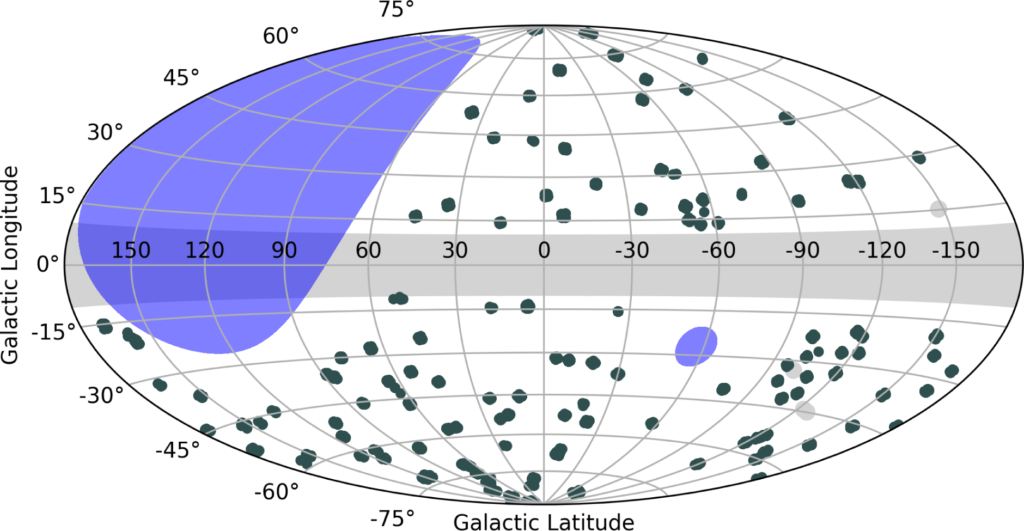
The observations selected in the publication were taken between 2004 and 2013 and sum up to a total of 2720 hours. They were taken in a variety of contexts — targeted campaigns on individual promising sources, rapid follow-ups of flaring events, and long monitoring programmes on the brightest blazars. They were not designed from the start to form a unified survey. The first major achievement of HEGS is the re-analysis of this heterogeneous dataset with a single set of tools, producing results that can be directly compared across sources and epochs. The observations collectively covered approximately 5.7% of the total sky and accounted for 6,500 observation runs. As illustrated on Figure 1, the H.E.S.S. observations were divided into 98 spatially separated fields, each analyzed independently to perform several studies.
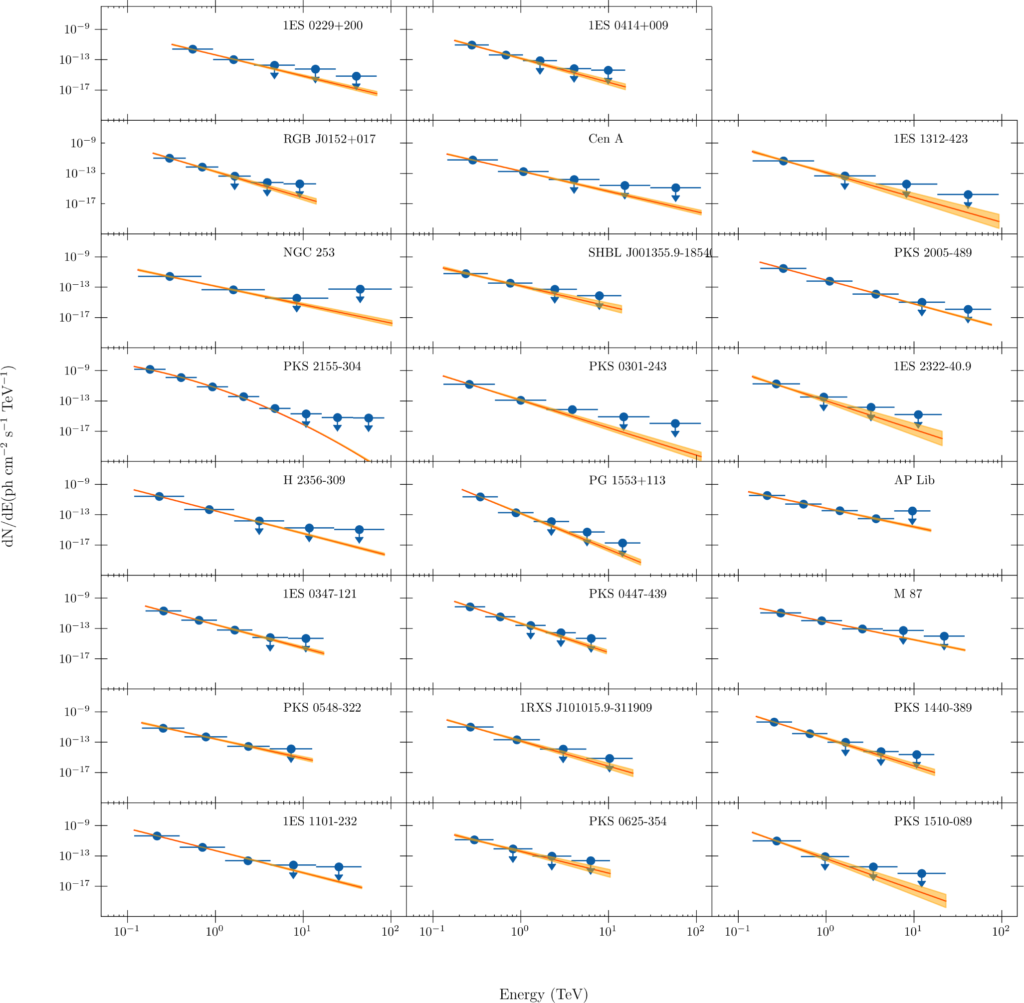
The HEGS analysis led to the detection of 23 sources, all of which were already identified VHE gamma-ray emitters. The vast majority – 18 out of 23 – are BL Lacertae objects (BL Lacs). Other detected source types include two radio galaxies (Centaurus A and M 87), one flat-spectrum radio quasar (PKS 1510-089), and one starburst galaxy (NGC 253). For one source (PKS 0625–354), the exact nature – BL Lac or Radio galaxy – is still under debate. The energy spectra of the detected sources are shown in Figure 2.
BL Lacs are a specific type of blazars: active galactic nuclei whose relativistic jet is pointed almost directly toward us, making them appear extraordinarily bright and rapidly variable. Their emission is produced in jets powered by accretion onto supermassive black holes, where particles are accelerated to very high energies. Because only the brightest sources can be detected individually, the H.E.S.S. observations provide a partial view of a much larger population. Interpreting the results therefore requires a statistical description of the underlying source population. To place the H.E.S.S. results in context, they are compared with measurements at lower gamma-ray energies obtained by the Fermi-LAT, which has detected a large number of blazars across the entire sky.
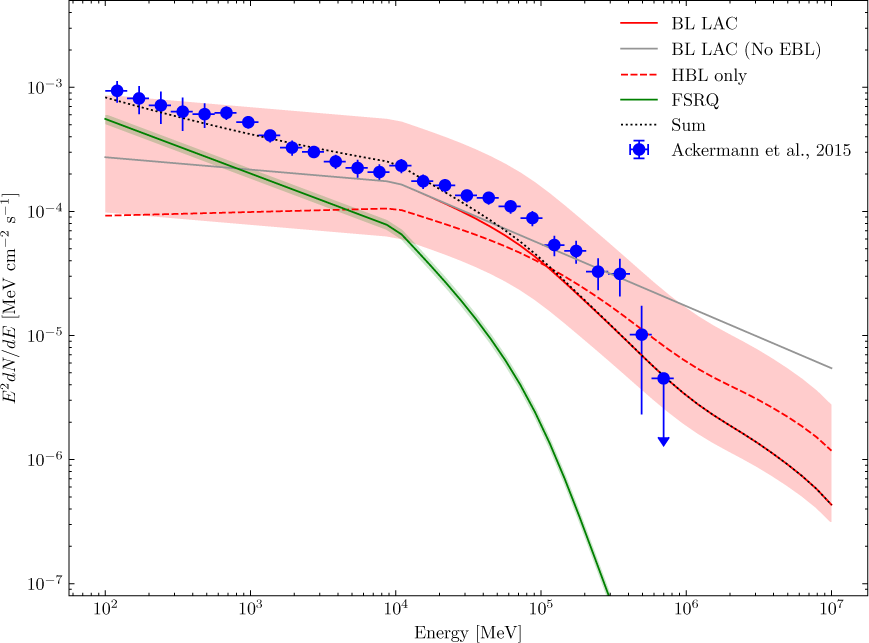
From these observations, it is possible to derive population models describing how many sources exist and how their luminosities are distributed. When extrapolated to higher energies, the models reproduce the number of sources detected by H.E.S.S. indicating that the H.E.S.S. sources correspond to the high-energy end of the same population identified at lower energies. It is worth noting that these models can only match the number of sources seen by H.E.S.S. if they include an intrinsic “break” in the energy spectrum, meaning the emission changes behaviour at higher energies. Such a break is confirmed by the HEGS measurements and their comparisons with the Fermi-LAT data. The same models can be used to estimate the contribution of unresolved sources to the diffuse gamma-ray emission observed across the sky. The results indicate that BL Lacs account for a significant fraction of the extragalactic gamma-ray background at very high energies (see Figure 3).
A multi-year dataset also opens a window on variability — how sources change in brightness over time. Seven sources are identified as variable within the HEGS dataset. Most of those were already known to be variable but the HEGS analysis revealed variability in sources where it had never been detected before (RGB J0152+017, 1ES 0347–121), or on timescales shorter than previously identified (H 2356–309).
This work establishes a consistent framework for interpreting extragalactic gamma-ray observations across a wide energy range. It connects targeted observations at TeV energies by H.E.S.S. with all-sky measurements at lower energies by Fermi-LAT and provides a benchmark for future studies. It also defines a reference for the next generation of instruments, in particular the Cherenkov Telescope Array Observatory (CTAO), which will extend these measurements to fainter sources and improved sensitivity.
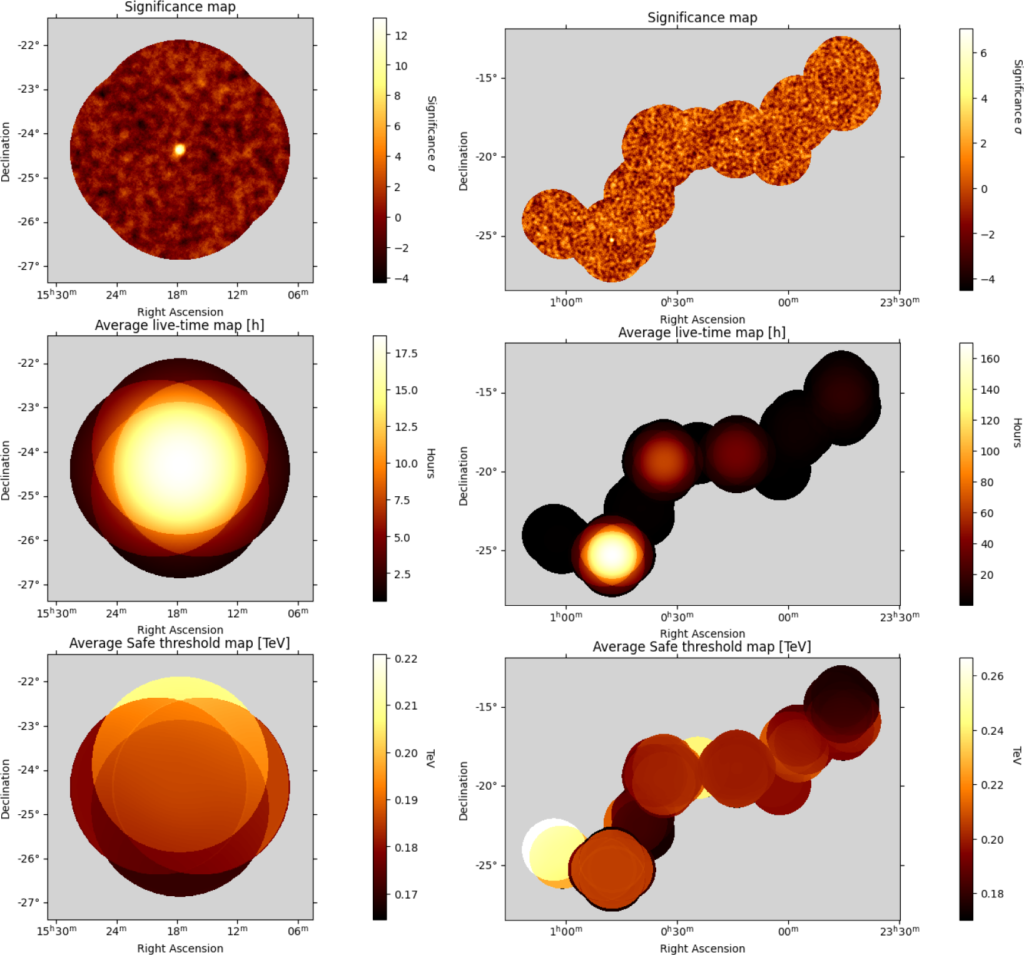
In addition to the scientific results, this work is accompanied by the release of high-level data products to the community [3]. The data are released in the form of FITS files, comprising a description of the observations, the catalogue of detected sources (including the lightcurves of the sources found to be variable) and sky maps (significance, livetime, average energy threshold, flux (+error), upper limits, sensitivity). Some of the maps released are shown on Figure 4. In addition, a set of python scripts to help with data exploration is also provided. This data release provides a reference dataset for extragalactic studies at very high energies and enables independent analyses by the broader astrophysics community. It also contributes to ongoing efforts to make gamma-ray astronomy data more accessible and reusable.
References
[1] The H.E.S.S. Galactic plane survey, A&A 612, A1 (2018) – https://www.aanda.org/articles/aa/full_html/2018/04/aa32098-17/aa32098-17.html
[2] The H.E.S.S. extragalactic sky survey with the first decade of observations, A&A 695, A261 (2025) – https://www.aanda.org/articles/aa/full_html/2025/03/aa52723-24/aa52723-24.html
[3] https://hess-experiment.eu/publications/2025/03/PUB27585/