
H.E.S.S. CollaborationH.E.S.S. Collaboration
  • Home
    • About H.E.S.S.
      • H.E.S.S. Science
      • H.E.S.S. Site
      • H.E.S.S. Telescopes
    • H.E.S.S. Collaboration
      • Organisation
    • H.E.S.S. Pictures
    • H.E.S.S. Prize
  • News
    • Announcements
    • Press releases
    • Blogs
  • Source of the Month
  • For scientists
    • Publications
      • Journals
      • Conferences
      • Astronomers Telegram
    • External Proposals
      • Visibility calculator
    • HESS GRB observations
      • Interactive Tool (Public)
      • Interactive Tool (Internal)
    • Public test data release
    • Telescope specifications
  • Contact
March 1, 2007 by H.E.S.S. Collaboration
Source of the Month

HESS J1640–465 – A Pulsar Wind Nebula?

HESS J1640–465 – A Pulsar Wind Nebula?
March 1, 2007 by H.E.S.S. Collaboration
Source of the Month

March 2007

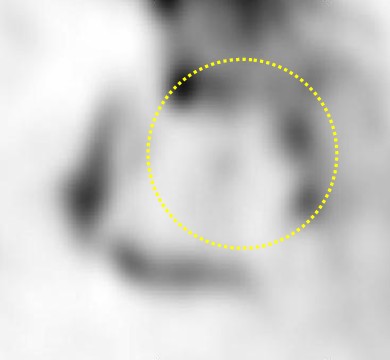
Radio image at 843 MHz of the supernova remnant G338.3-0.0, from the MOST supernova remnant catalog (see also Whiteoak and Green, 1996), showing a broken shell of about 8′ diameter. Based on its surface brightness, the distance to the remnant is estimated to about 9 kpc, with significant uncertainty. For this distance, the radius of the remnant is about 10 pc, implying an age between some 1000 and some 10000 years, depending on the density of ambient gas, which determines the speed of expansion. The yellow dashed line indicates the position and size of the VHE gamma-ray source HESS J1640-465.

The gamma-ray source HESS J1640-465 (Fig. 1) was discovered during the survey of the Galactic plane; with a size of 0.045 degrees it is among the most compact sources in the survey, and just recognized as an extended source. A possible identification of the object is based on radio and X-ray data. HESS J1640-465 roughly coincides with the supernova remnant G338.3-0.0, detected in radio observations at 843 MHz (Whiteoak and Green, 1996, see top figure). A faint ASCA X-ray source, AX J1640.7-4632 (Sugizaki et al. 2001), coincides with the position of the H.E.S.S. source and could be indicative of a pulsar created in the supernova explosion, although no pulsed radio emission has been detected from the region. At higher energies, INTEGRAL detected the source IGR J16393-4643 (Malizia et al. , 2004).
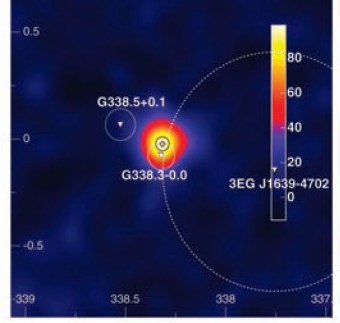
Fig. 1: The discovery plot for HESS J1640-465, from Aharonian et al. (2005). The location and size of the remnant G338.3-0.0 is indicated by the small circle. Note that this image is in Galactic coordinates. With a size of only 0.045 degr., the source is just recognized as extended object but details of its morphology cannot be resolved.

New constraints on the nature of the gamma-ray source come from sensitive X-ray observations with XMM-Newton (Funk et al. 2007): at the center of the H.E.S.S. source, an extended and slightly asymmetric X-ray source is found (Fig. 2), reminiscent of typical pulsar wind nebulae (PWN). In a PWN, a relativistic flow of electrons and positrons terminates in a shock, from where the a wide energy spectrum of particles emerges and feeds an extended nebula, visible in X-ray synchrotron radiation and in high-energy gamma rays resulting from upscattering of ambient low-energy photons such as the cosmic microwave background. However, the size of the X-ray source is significantly smaller than the H.E.S.S. gamma-ray source, and also the energy flux in X-rays is about an order of magnitude lower than the flux in gamma rays (Fig. 3). The latter observation is particularly surprising, since for typical interstellar magnetic fields one expects equal or higher energy flux in X-rays.
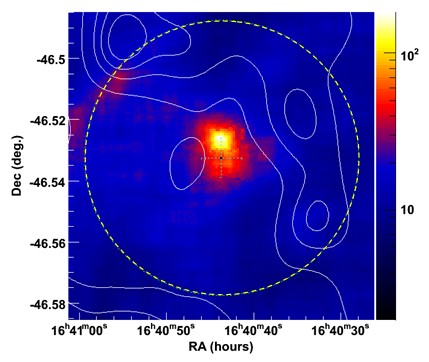
Fig. 2: Color scale: X-ray image from XMM-Newton showing the central region of HESS J1640-465, with an extended and asymmetric X-ray source at the center. Dashed yellow circle: location and approximate size of the H.E.S.S. gamma-ray source. White contours: MOST radio intensity tracing the supernova remnant, as shown in the top image. From Funk et al. (2007).

One possible interpretation is discussed by Funk et al. (2007), and serves to illustrate some of the mechanisms active in pulsar wind nebulae in general. The energy source of the nebulae is the is rotational energy of the pulsars; young pulsars rotate rapidly and radiate energy at high rate, whereas the energy flow decreases as the pulsar spins down, roughly as 1/age2. Therefore, most of the energy fed into the pulsar wind nebula can be attributed to the phase right after the birth of the pulsar. Unless magnetic fields in the nebula are strong, such “relic” electrons with energies up to several TeV survive some 10 kyears and are still around to generate gamma-rays by Inverse Compton upscattering (dotted line in Fig. 3). However, to generate synchrotron X-rays at keV energies in typical fields of some 5-10 micro-Gauss, much higher electron energies around 100 TeV and above are needed. Due to strong radiative energy losses, such electrons have much shorter lifetimes of a few 1000 years, and only “recently” generated electrons contribute. Since the current spin-down energy loss of the pulsar is small compared to that of the young pulsar, the number of such electrons and hence the X-ray flux is reduced. This model – also invoked for other sources such as HESS J1825-137 (Aharonian et al., 2006) – also explains the different source size; the “young” X-ray emitting electrons had much less time to propagate away from the pulsar than the “old” gamma-ray emitting electrons. However, another possible scenario cannot be ruled out at this moment: that the gamma-rays originate from particles accelerated in the supernova shell and are not directly related to the X-ray source connected to the pulsar.
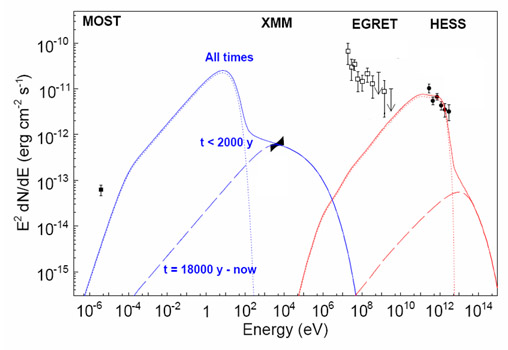
Fig. 3: Wide-band spectral energy distribution, with the very high energy gamma ray flux measured by H.E.S.S. and the X-ray flux from XMM-Newton. Also shown is the flux of an EGRET source which may or may not be related to HESS J1640-465 (big dotted circle in Fig. 1). The lines give the energy flux from a pulsar wind model, assuming a 20 kyr age of the pulsar. Very high energy gamma ray emission is dominated by the copious electrons from the birth phase of the pulsar (dotted lines) whereas X-rays are mainly generated by rather young electrons from the last 2 kyr (dashed lines). From Funk et al. (2007).

References:

The H.E.S.S. survey of the Inner Galaxy in very high-energy gamma-rays, H.E.S.S. collaboration, F. Aharonian et al., Astrophysical Journal 636 (2006) 777-797

galactic source pulsar wind nebula

Previous articleA Point-Like Gamma-Ray Source in MonocerosNext article Gamma Rays from W28 – an Old Supernova Remnant and Molecular Clouds

Source of the month

Each month a TeV gamma-ray source investigated with the H.E.S.S. telescopes is featured.

>> List of all sources

Latest sources

The flare that sweetened the lockdownOctober 1, 2026
A spectral steepening in the Galactic Centre ridge spectrumSeptember 1, 2026
Hunting dark matter in the Milky Way: constraints on spectral line features and the thermal HiggsinoAugust 1, 2026

Tags

Atmosphere (1) Axion-like particle (1) black holes (2) Blazar (7) Catalogue (1) Conference (1) Cosmic rays (1) Dark matter (3) Event (1) Extragalactic (10) Galactic Center (1) Galactic centre (1) galactic plane (8) galactic source (10) Gamma-ray binary (3) Gamma-ray burst (3) gamma-rays (4) IceCube (1) Meeting (2) microquasar (2) multi-messenger (1) neutrinos (4) nobelprize (1) Nova (1) publication (5) pulsar (1) pulsar wind nebula (5) Supernova remnant (3)

Contact

You can contact us for scientific queries and general information using:
contact.hess@hess-experiment.eu

Data Privacy Statement

https://www.mpi-hd.mpg.de/mpi/de/datenschutzhinweis
H.E.S.S. collaboration official website. Proudly Built By H.E.S.S. members.
(c) 2004-2026 by the H.E.S.S. collaboration.

Last sources of the month

The flare that sweetened the lockdownOctober 1, 2026
A spectral steepening in the Galactic Centre ridge spectrumSeptember 1, 2026
Hunting dark matter in the Milky Way: constraints on spectral line features and the thermal HiggsinoAugust 1, 2026

Internal

  • Log in
  • Entries feed
  • Comments feed
  • WordPress.org
H.E.S.S. Collaboration
Manage Consent
To provide the best experiences, we use technologies like cookies to store and/or access device information. Consenting to these technologies will allow us to process data such as browsing behavior or unique IDs on this site. Not consenting or withdrawing consent, may adversely affect certain features and functions.
Functional Always active
The technical storage or access is strictly necessary for the legitimate purpose of enabling the use of a specific service explicitly requested by the subscriber or user, or for the sole purpose of carrying out the transmission of a communication over an electronic communications network.
Preferences
The technical storage or access is necessary for the legitimate purpose of storing preferences that are not requested by the subscriber or user.
Statistics
The technical storage or access that is used exclusively for statistical purposes. The technical storage or access that is used exclusively for anonymous statistical purposes. Without a subpoena, voluntary compliance on the part of your Internet Service Provider, or additional records from a third party, information stored or retrieved for this purpose alone cannot usually be used to identify you.
Marketing
The technical storage or access is required to create user profiles to send advertising, or to track the user on a website or across several websites for similar marketing purposes.
  • Manage options
  • Manage services
  • Manage {vendor_count} vendors
  • Read more about these purposes
View preferences
  • {title}
  • {title}
  • {title}