
H.E.S.S. CollaborationH.E.S.S. Collaboration
  • Home
    • About H.E.S.S.
      • H.E.S.S. Science
      • H.E.S.S. Site
      • H.E.S.S. Telescopes
    • H.E.S.S. Collaboration
      • Organisation
    • H.E.S.S. Pictures
    • H.E.S.S. Prize
  • News
    • Announcements
    • Press releases
    • Blogs
  • Source of the Month
  • For scientists
    • Publications
      • Journals
      • Conferences
      • Astronomers Telegram
    • External Proposals
      • Visibility calculator
    • HESS GRB observations
      • Interactive Tool (Public)
      • Interactive Tool (Internal)
    • Public test data release
    • Telescope specifications
  • Contact
February 1, 2008 by H.E.S.S. Collaboration
Source of the Month

A New Companion for the Lonely Crab? Gamma Rays from G21.5–0.9

A New Companion for the Lonely Crab? Gamma Rays from G21.5–0.9
February 1, 2008 by H.E.S.S. Collaboration
Source of the Month

February 2008

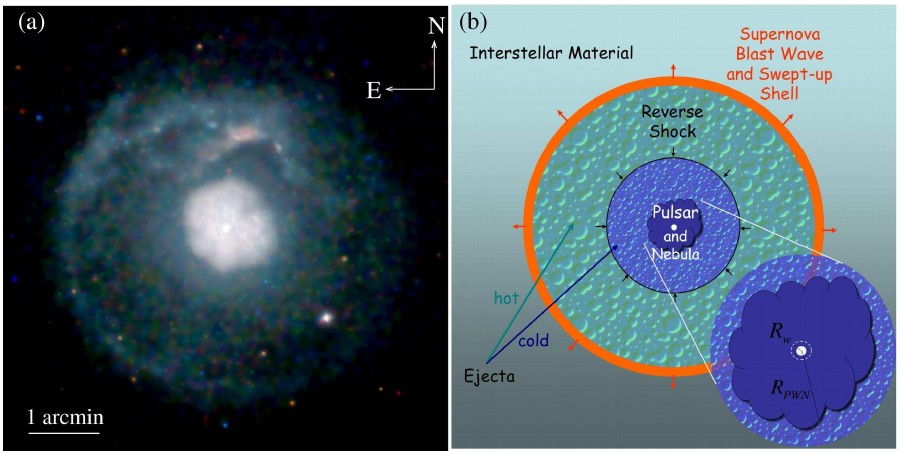
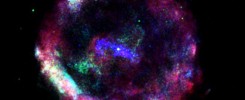
G21.5-0.9 is a particularly nice example of a composite supernova remnant, shown in the left panel in a Chandra X-ray image. The spherical supernova shell is faintly glowing in X-rays; the center of the remnant is filled by a pulsar wind nebula of highly relativistic electrons with strong X-ray emission. From Gaensler and Slane (2006).

The standard candle of VHE astronomy, the Crab Nebula, has served for decades as a yardstick in almost all wavelengths, and yet it is a very peculiar object, harboring the most energetic and one of the youngest pulsars of our Galaxy. In the VHE domain, H.E.S.S. has revealed more than a dozen pulsar wind nebulae (PWN), either firmly established as such or compelling candidates (e.g. SOM 2005/09, 2006/04, 2006/05, 2007/06), almost all of which are middle-aged (at least few kyrs up to 100 kyrs, except MSH 15-52) and which exhibit an extended VHE nebula with an offset between the pulsar position and the nebula center, quite different from the (for gamma-ray instruments) point-like Crab Nebula. The remnant G21.5-0.9 (Wilson and Weiler 1976) was previously classified as one of the about ten Crab-like SNR, and was already in 1995 predicted as a gamma-ray source with a flux of a few % of the Crab flux and hard spectrum (de Jager et al.). Chandra images (Safi-Harb et al, 2001; Bocchino et al., 2005) beautifully reveal the composite nature of the remnant, consisting of a spherical shell of 4′ diameter, tracing the supernova blast wave, and a pulsar wind nebula of about 1′ size, of high-energy electrons accelerated in a pulsar created in the explosion (Top figure and Fig. 1). Finally, in 2005, the 61.8 ms pulsar PSR J1833-1034, with a spin-down power of ˙E = 3.3 × 10^37erg/s and a characteristic age of 4.9 kyr was discovered through its faint radio pulsed emission (Gupta et al., 2005, Camilo et al., 2006). PSR J1833-1034 in G 21.5-0.9 is the second most energetic pulsar known in the Galaxy.
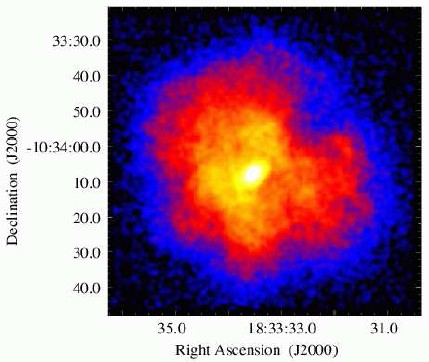
Fig. 1: Zoomed Chandra image of the somewhat irregular pulsar wind nebula in G21.5-0.9. From Camilo et al. (2006).

Data obtained in the H.E.S.S. Galactic Plane Survey (SOM 2007/12) finally seem to confirm the predictions of G21.5-0.9 as a VHE gamma-ray source and as a companion of the Crab Nebula. At the 2007 ICRC in Merida, evidence for the source HESS J1833-105 was presented (Djannati-Ataï et al., 2007), detected at a level of more than 6 standard deviations in about 20 h of observations (Fig. 2). The location of the source is determined with a precision of better than 1′ and coincides with the location of PSR J1833-1034 in G 21.5-0.9. On the scale of the H.E.S.S. angular resolution of 4′, the source appears point-like. The gamma ray flux, measured between 200 GeV and 5 TeV, corresponds to about 2% of that of the Crab Nebula, close to the predicted value. Why is G21.5-0.9, like the Crab Nebula, much more compact than most other PWN seen by HESS? One reason is obviously their relatively young age, giving the nebulae less time to expand. Most likely more important is the high luminosity of the pulsar, which generates relatively high magnetic fields in the nebula, resulting in strong synchrotron radiation losses and short lifetimes – and hence short range – of the accelerated electrons. G21.5-0.9 and the Crab Nebula are therefore rather inefficient gamma-ray sources, in the sense that synchrotron radiation losses dominate over Inverse-Compton production of high energy gamma rays: in the Crab nebula, the synchrotron luminosity is about 100 times higher than the gamma ray luminosity, in G21.5 it is by a factor of 30 higher.
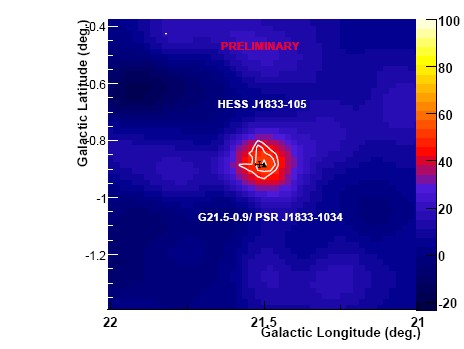
Fig. 2: Smoothed VHE gamma ray map of the region around G21.5-0.9. Contour lines show significance contours for 4,5,6 standard deviations. The location of the pulsar PSR J1833-1034 is indicated by the black triangle, the centroid of the VHE gamma ray source by the black error bars. Note difference in scale compared to the upper images; the source size is consistent with the angular resolution of the telescopes, of about 4′. Preliminary.

References:

“New Companions for the lonely Crab? VHE emission from young pulsar wind nebulae revealed by H.E.S.S.”
H.E.S.S. collaboration, A. Djannati-Atai et al. , Proc. 30th International Cosmic Ray Conference, Merida, 2007, arXiv:0710.2247
galactic source pulsar wind nebula Supernova remnant

Previous articleOops – HESS J1745–303Next article HESS J1809-193 - more than one PWN?

Source of the month

Each month a TeV gamma-ray source investigated with the H.E.S.S. telescopes is featured.

>> List of all sources

Latest sources

The flare that sweetened the lockdownOctober 1, 2026
A spectral steepening in the Galactic Centre ridge spectrumSeptember 1, 2026
Hunting dark matter in the Milky Way: constraints on spectral line features and the thermal HiggsinoAugust 1, 2026

Tags

Atmosphere (1) Axion-like particle (1) black holes (2) Blazar (10) Catalogue (1) Conference (1) Cosmic rays (1) Dark matter (3) Event (1) Extragalactic (13) Galactic Center (1) Galactic centre (1) galactic plane (9) galactic source (12) Gamma-ray binary (3) Gamma-ray burst (3) gamma-rays (4) IceCube (1) Meeting (2) microquasar (2) multi-messenger (1) neutrinos (4) nobelprize (1) Nova (1) publication (5) pulsar (1) pulsar wind nebula (6) Supernova remnant (4)

Contact

You can contact us for scientific queries and general information using:
contact.hess@hess-experiment.eu

Data Privacy Statement

https://www.mpi-hd.mpg.de/mpi/de/datenschutzhinweis
H.E.S.S. collaboration official website. Proudly Built By H.E.S.S. members.
(c) 2004-2026 by the H.E.S.S. collaboration.

Last sources of the month

The flare that sweetened the lockdownOctober 1, 2026
A spectral steepening in the Galactic Centre ridge spectrumSeptember 1, 2026
Hunting dark matter in the Milky Way: constraints on spectral line features and the thermal HiggsinoAugust 1, 2026

Internal

  • Log in
  • Entries feed
  • Comments feed
  • WordPress.org
H.E.S.S. Collaboration
Manage Consent
To provide the best experiences, we use technologies like cookies to store and/or access device information. Consenting to these technologies will allow us to process data such as browsing behavior or unique IDs on this site. Not consenting or withdrawing consent, may adversely affect certain features and functions.
Functional Always active
The technical storage or access is strictly necessary for the legitimate purpose of enabling the use of a specific service explicitly requested by the subscriber or user, or for the sole purpose of carrying out the transmission of a communication over an electronic communications network.
Preferences
The technical storage or access is necessary for the legitimate purpose of storing preferences that are not requested by the subscriber or user.
Statistics
The technical storage or access that is used exclusively for statistical purposes. The technical storage or access that is used exclusively for anonymous statistical purposes. Without a subpoena, voluntary compliance on the part of your Internet Service Provider, or additional records from a third party, information stored or retrieved for this purpose alone cannot usually be used to identify you.
Marketing
The technical storage or access is required to create user profiles to send advertising, or to track the user on a website or across several websites for similar marketing purposes.
  • Manage options
  • Manage services
  • Manage {vendor_count} vendors
  • Read more about these purposes
View preferences
  • {title}
  • {title}
  • {title}