

SGR J1935+2154: An active magnetar now linked to repeating fast radio bursts. A new opportunity for H.E.S.S.
June 2020 Magnetars are very highly magnetised neutron stars with a surface magnetic field reaching 1015 Gauss, about 1000x stronger than that derived for ‘normal’ neutron stars, and among the strongest magnetic fields found…

ATOM: A trailer, a trigger and a tug for H.E.S.S.
May 2020 The H.E.S.S. array is a very advanced and efficient observatory for ground-based gamma-ray astronomy, sensitive enough to trace rapid variations in flaring sources on time-scales of minutes. Nonetheless, most gamma-ray sources require…

Extended emission around the Geminga pulsar
April 2020 Geminga (Gemini gamma-ray source) was discovered in the early 1970s with the SAS-2 satellite and remained an unidentified gamma-ray source for a very long time. It is now known as a radio-quiet…
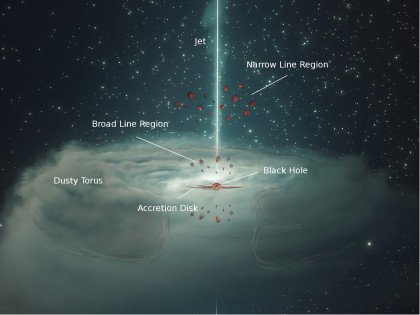
Gamma-ray quasars from the bright to the faint end: PKS 0736+017
March 2020 About two percent of the hundreds of billions of galaxies in the universe stand out as ‘active galaxies’. A very small nuclear region radiates enormous amounts of light, making Quasars (the most…
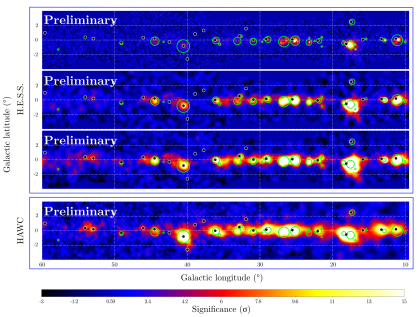
A fresh look at the Galactic Plane
February 2020 The H.E.S.S. Galactic Plane Survey (HGPS, SOM 2016-01) was a 10 year long observation program. For this survey the H.E.S.S. telescopes in Nambia systematically scanned the Milky Way for very high energetic…
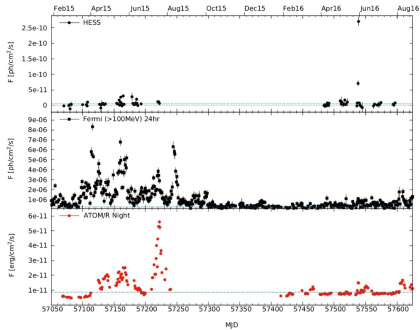
The many-faced quasar PKS 1510-089
January 2020 Among all classes of Active Galactic Nuclei (AGN), the so-called BL Lac objects had been prime candidates for Very High Energy (VHE) gamma-ray emission (Note 1) from the start, as they posses…
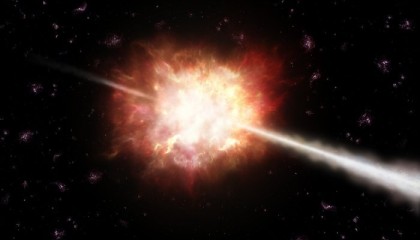
GRB 180720B The First Gamma-Ray Burst Detected in the Very-High-Energy Band
December 2019 After a decade-long search, the H.E.S.S. collaboration has succeeded to detected a gamma-ray burst in very-high-energy gamma light for the first time. This discovery was made in July 2018 using the huge…

A Gamma-ray view of Radio Galaxies
November 2019 The exploration of the universe at gamma-ray energies resulted in the discovery of ∼200 sources that emit photons of 1 Terra-Volt (1 000 000 000 000 eV) energy [1]. The largest group…
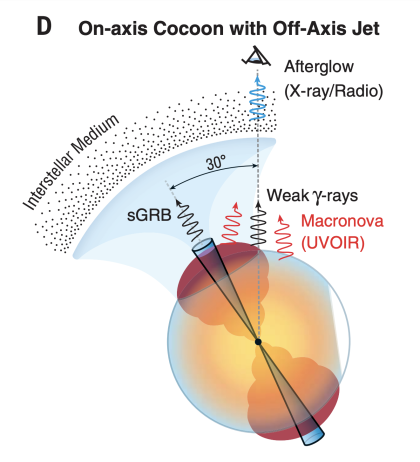
GW170817: Revisiting the site of a binary neutron star merger
October 2019 On August 17th 2017, the detection of the first electromagnetic counterpart to a gravitational-wave (GW) signal was achieved, originating from the binary neutron star (BNS) merger remnant. This result marked the start…
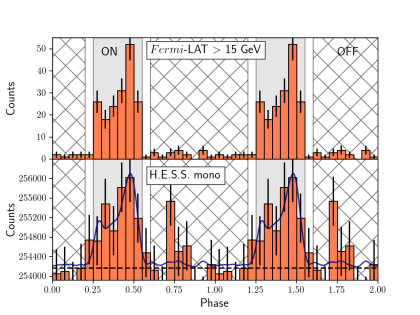
PSR B1706-44: The second pulsar detected by H.E.S.S. in the 10-100 GeV energy range
September 2019 Pulsars Over fifty years ago in 1967, a new type of signal was observed for the first time by radio astronomers [1]. The signal was periodic, remarkably regular, with a peak every…
