H.E.S.S. CollaborationH.E.S.S. Collaboration
  • Home
    • About H.E.S.S.
      • H.E.S.S. Science
      • H.E.S.S. Site
      • H.E.S.S. Telescopes
    • H.E.S.S. Collaboration
      • Organisation
    • H.E.S.S. Pictures
    • H.E.S.S. Prize
  • News
    • Announcements
    • Press releases
    • Blogs
  • Source of the Month
  • For scientists
    • Publications
      • Journals
      • Conferences
      • Astronomers Telegram
    • External Proposals
      • Visibility calculator
    • HESS GRB observations
      • Interactive Tool (Public)
      • Interactive Tool (Internal)
    • Public test data release
    • Telescope specifications
  • Contact
January 1, 2008 by H.E.S.S. Collaboration
Source of the Month

Oops – HESS J1745–303

Oops – HESS J1745–303
January 1, 2008 by H.E.S.S. Collaboration
Source of the Month

January 2008

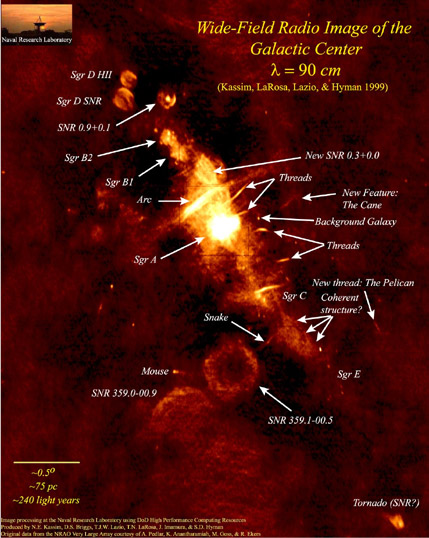
Wide-field VLA radio image of the Galactic Center region (Kassim et al. 1999). High-energy gamma ray point sources coincide with the Galactic Center Sgr A (HESS J1745-290) and with the supernova remnant SNR 0.9+0.1 (HESS J1747-281). In addition, extended diffuse emission is observed along the Galactic ridge, following the band of radio emission extending from Sgr B to Sgr C. This month, we discuss an unidentified extended source, HESS J1745-303, partly coincident with SNR 359.1-00.5.

HESS J1745-303 – a very faint source of very high energy gamma rays of about 0.2 x 0.1 degr. size, slightly south of the Galactic equator, was first mentioned in the 2nd paper on the HESS Galactic Plane Survey (Aharonian et al. 2006). Based on 35 hours of exposure, mostly directed at the Galactic Center, with HESS J1745-303 relatively far off-axis, a 6 standard deviation gamma-ray excess was detected. Roughly coincident with an EGRET source of high energy gamma rays, 3EG J1744-3011, the source had no obvious counterpart in radio or X-rays. With a spectral index of 1.82 +/- 0.29 +/- 0.2, the source was remarkable in that it exhibited the hardest spectrum among all sources in the survey.
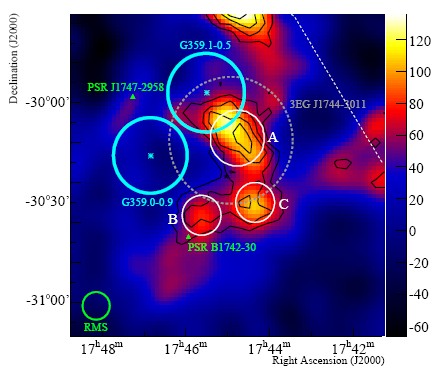
Fig. 1: Smoothed gamma-ray count map of HESS J1745-303, with 4,5,6,7 sigma contours (for a 0.12 degr. integration radius) shown in black. The dashed line indicates the Galactic plane; the gamma-ray source at the northern edge of the frame is the tail end of the galactic ridge diffuse emission. Shown as blue circles are the two supernova remnants visible in the radio image, and as green triangles two pulsars. (Preliminary)

With increased exposure, HESS J1745-303 is now detected at a significance level of 12 standard deviations (Fig. 1). The emission appears to have a complicated morphology, with multiple peaks in the image, labeled A, B and C. However, the dips between the peaks are not highly significant, hence it would be premature to claim multiple sources. Also, the energy spectra from the three regions are consistent in shape, within errors. Nevertheless, multiwavelength data of the region suggest a composite source (Fig. 2). In region A, the shock wave of the supernova remnant G359.1-0.5 seems to border dense clouds, visible in CO emission (Uchida et al. 1992). Given an estimated density of the clouds of several 1000 molecules per ccm, the clouds could provide a perfect target for shock-accelerated protons in the middle-aged (>10000 years) remnant. The southern region B, on the other hand, could represent a pulsar wind nebula powered by PSR B1742-30, slightly offset from this region. While the pulsar is not energetic enough to plausibly account for all of HESS J1745-303, the emission from region B corresponds to about 2% of its loss of rotational energy, not uncommon for pulsar-driven nebulae. There is no compelling explanation for the emission from region C.
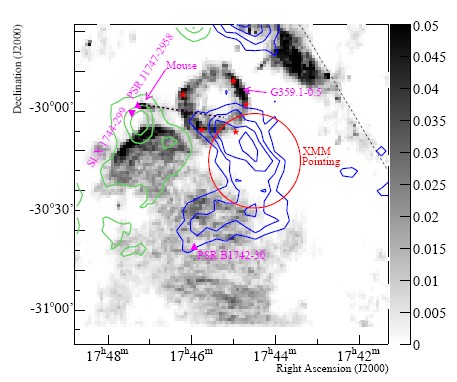
Fig. 2: VLA radio image of the region, with HESS significance contours superimposed. (Preliminary)

Why “oops”? While consistent in terms of morphology, the larger data set does,  however, show differences in the gamma-ray spectrum, with a new spectral index determined to 2.71 +/- 0.11(stat.) +/- 0.2(syst.), about 3 standard deviations from the initial determination and more in line with typical galactic sources. The data now cover a much larger energy range (Fig. 3), compared to the very restricted range in the initial analysis; the difference can be traced to the lowest-energy data points. A reanalysis of the old data set with current analysis tools gives an index consistent with the new result, and numerous checks led us to believe in an underestimated systematic error in the original determination, resulting from a combination of the very low surface density of the source, which made it particularly susceptible to details of the background determination, and imperfections of the analysis tools at the time, for sources near the edge of the useful field of view where the detection efficiencies and background rates vary rapidly. A reanalysis of all other survey sources – which do not suffer from these peculiar conditions – did not reveal significant differences to published results. Targeted sources observed in “wobble” mode with a small and alternating offset from the optical axis of the instrument (essentially all extragalactic sources and re-observations of Galactic targets) are intrinsically much more robust.
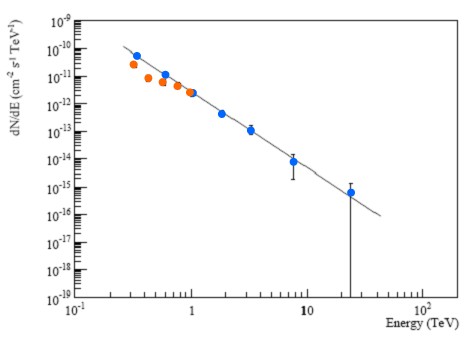
Fig. 3: Energy spectrum of gamma rays from HESS J1745-303. Orange: data from Aharonian et al. 2006; blue: new data set (Preliminary).

References

Aharonian et al., submitted.
galactic source

Previous articleThe Starry TeV SkyNext article A New Companion for the Lonely Crab? Gamma Rays from G21.5–0.9

Source of the month

Each month a TeV gamma-ray source investigated with the H.E.S.S. telescopes is featured.

>> List of all sources

Latest sources

The flare that sweetened the lockdownOctober 1, 2026
A spectral steepening in the Galactic Centre ridge spectrumSeptember 1, 2026
Hunting dark matter in the Milky Way: constraints on spectral line features and the thermal HiggsinoAugust 1, 2026

Tags

Atmosphere (1) Axion-like particle (1) black holes (2) Blazar (10) Catalogue (1) Conference (1) Cosmic rays (1) Dark matter (3) Event (1) Extragalactic (13) Galactic Center (1) Galactic centre (1) galactic plane (9) galactic source (12) Gamma-ray binary (3) Gamma-ray burst (3) gamma-rays (4) IceCube (1) Meeting (2) microquasar (2) multi-messenger (1) neutrinos (4) nobelprize (1) Nova (1) publication (5) pulsar (1) pulsar wind nebula (6) Supernova remnant (4)

Contact

You can contact us for scientific queries and general information using:
contact.hess@hess-experiment.eu

Data Privacy Statement

https://www.mpi-hd.mpg.de/mpi/de/datenschutzhinweis
H.E.S.S. collaboration official website. Proudly Built By H.E.S.S. members.
(c) 2004-2026 by the H.E.S.S. collaboration.

Last sources of the month

The flare that sweetened the lockdownOctober 1, 2026
A spectral steepening in the Galactic Centre ridge spectrumSeptember 1, 2026
Hunting dark matter in the Milky Way: constraints on spectral line features and the thermal HiggsinoAugust 1, 2026

Internal

  • Log in
  • Entries feed
  • Comments feed
  • WordPress.org
H.E.S.S. Collaboration
Manage Consent
To provide the best experiences, we use technologies like cookies to store and/or access device information. Consenting to these technologies will allow us to process data such as browsing behavior or unique IDs on this site. Not consenting or withdrawing consent, may adversely affect certain features and functions.
Functional Always active
The technical storage or access is strictly necessary for the legitimate purpose of enabling the use of a specific service explicitly requested by the subscriber or user, or for the sole purpose of carrying out the transmission of a communication over an electronic communications network.
Preferences
The technical storage or access is necessary for the legitimate purpose of storing preferences that are not requested by the subscriber or user.
Statistics
The technical storage or access that is used exclusively for statistical purposes. The technical storage or access that is used exclusively for anonymous statistical purposes. Without a subpoena, voluntary compliance on the part of your Internet Service Provider, or additional records from a third party, information stored or retrieved for this purpose alone cannot usually be used to identify you.
Marketing
The technical storage or access is required to create user profiles to send advertising, or to track the user on a website or across several websites for similar marketing purposes.
  • Manage options
  • Manage services
  • Manage {vendor_count} vendors
  • Read more about these purposes
View preferences
  • {title}
  • {title}
  • {title}