August 2026
Dark matter (DM) makes up about 85% of the Universe’s matter [1], yet its fundamental nature remains unknown. Among the most compelling candidates to explain dark matter are Weakly Interacting Massive Particles (WIMPs), which, if thermally produced in the early universe, could explain the DM abundance observed today [2].
While colliders like the Large Hadron Collider and direct detection experiments have ruled out many WIMP scenarios for masses up to the 100 GeV scale [3,4], TeV-scale candidates—such as the Wino, Higgsino, and Quintuplet—remain elusive [5]. These particles are predicted to annihilate into gamma rays, potentially producing spectral line features near their rest-mass energy [6], making them detectable by gamma-ray observatories.
The Galactic Centre (GC), with its high predicted DM density, is an ideal region to search for these signals. H.E.S.S., located in the Southern Hemisphere, is uniquely positioned to observe the GC at TeV energies with high sensitivity. Previous H.E.S.S. [7] and MAGIC [8] observations set strong limits on DM annihilation. A new study now pushes the sensitivity to DM signals further, using 546 hours of data from a survey of the inner few degrees of the Milky Way to search for spectral line features and constrain specific WIMP scenarios deep into the parameter space of TeV-scale DM [9].
Looking for a dark matter signal from the Milky Way
The results were obtained with 6 years of observations (2014–2020) from the five-telescope array, focusing on the inner few degrees of the Milky Way. This dataset, dubbed the Inner Galaxy Survey, was already employed to constrain the annihilation cross section of DM particles annihilating through the continuum channels [10]. However, the sensitivity of the analysis has now been improved by computing instrument response functions for the whole array via run-wise simulations [11]. The data were processed using likelihood-based statistical methods, accounting for both spectral and spatial features of potential DM signals. The search targeted gamma-ray spectral lines—a smoking gun for DM annihilation—across 61 energy bins (300 GeV to 64 TeV) and 25 spatial regions around the GC. For TeV electroweak DM candidates such as the Wino, Higgsino and Quintuplet, the total annihilation cross section is dominated by the line cross section. Constraints derived from the search of the line signal can therefore be compared to the predicted line cross section for the aforementioned DM candidates.
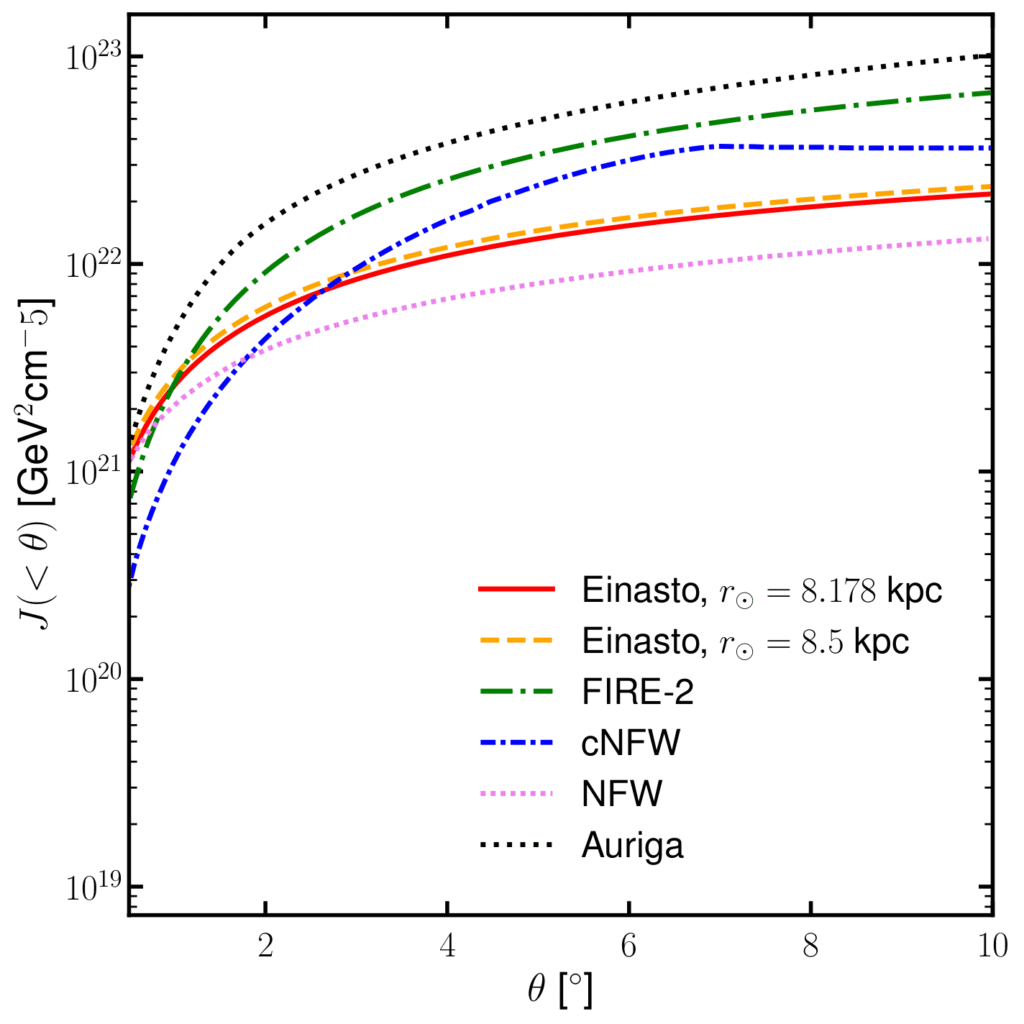
An open question is the real DM distribution in the Milky Way halo. To tackle this problem multiple Milky Way halo profiles were explored, including the Einasto (with two different distances from the Earth and the GC, = 8.178 kpc and = 8.5 kpc), NFW, cNFW, FIRE-2, and Auriga models, each with different assumptions about the density and structure of DM in the Galaxy. More details about the tested theoretical DM distribution profiles are provided in the paper [9]. The expected DM profile in the observed target is encapsulated by the J-factor, which is computed as a double integral of the squared DM density along the line of sight and the solid angle. The integrated J-factors as a function of the angular distance from the GC, for all the Milky Way halo profiles explored in our work, are shown in Fig. 1.
Constraining and thermal TeV dark matter models
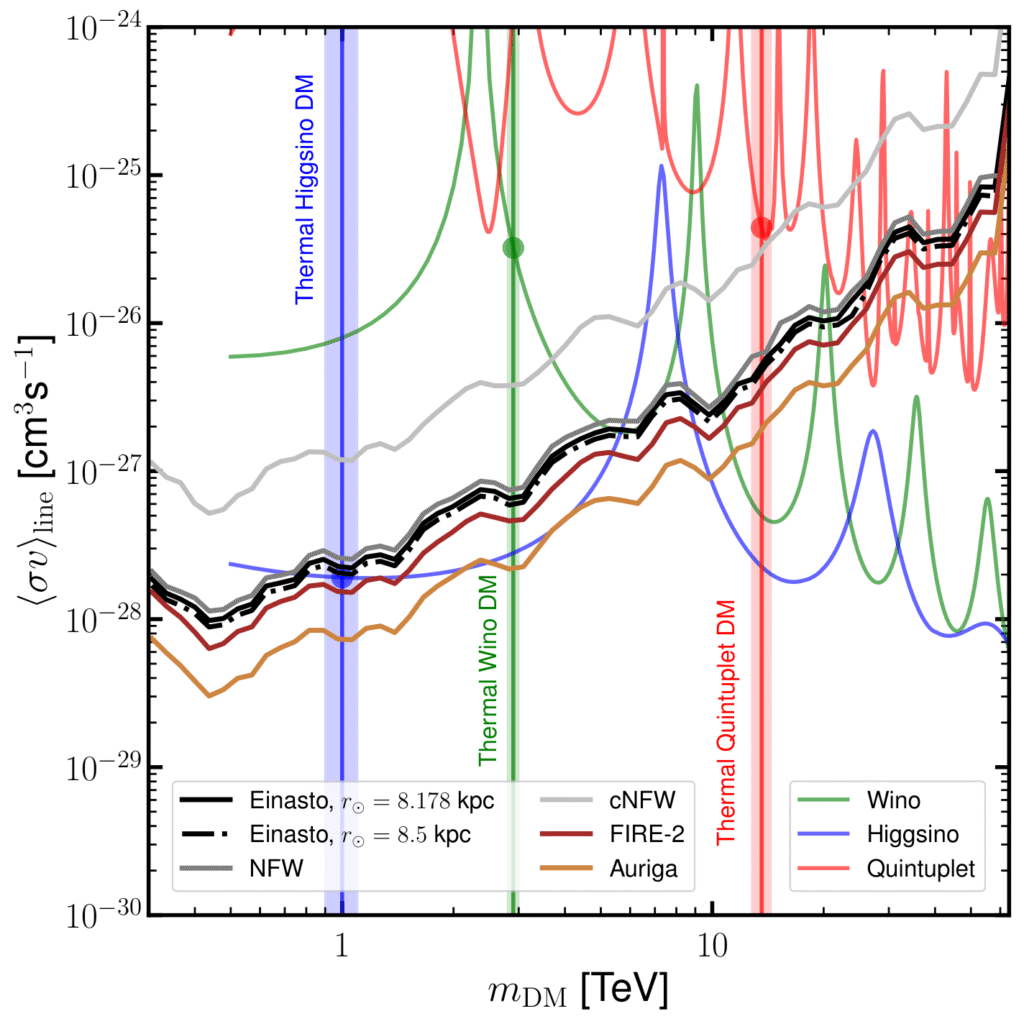
No significant gamma-ray line signal was detected in the data. This allowed us to derive the most stringent 95% confidence-level (C.L.) upper limits to date on the velocity-weighted annihilation cross section (⟨σv⟩line) for DM masses between 300 GeV and 70 TeV. In particular, unprecedented constraints of ⟨σv⟩line = 2.3×10⁻²⁸ cm3/s were obtained for a 1 TeV DM particle. The limits obtained with the Einasto DM distribution are the first to challenge the thermal Higgsino model; this long-sought DM candidate has evaded detection in collider and direct detection experiments so far. Moreover, the Higgsino model is tested up to ~10 TeV when adopting the Auriga profile to describe the DM distribution. Thermal Wino and Quintuplet models are instead now excluded for all considered Milky Way DM profiles. The upper limits on ⟨σv⟩line versus the DM mass mDM, for all adopted DM distribution profiles, can be compared to the theoretical line cross section for the Wino, Higgsino and Quintuplet canonical DM models in Fig. 2.
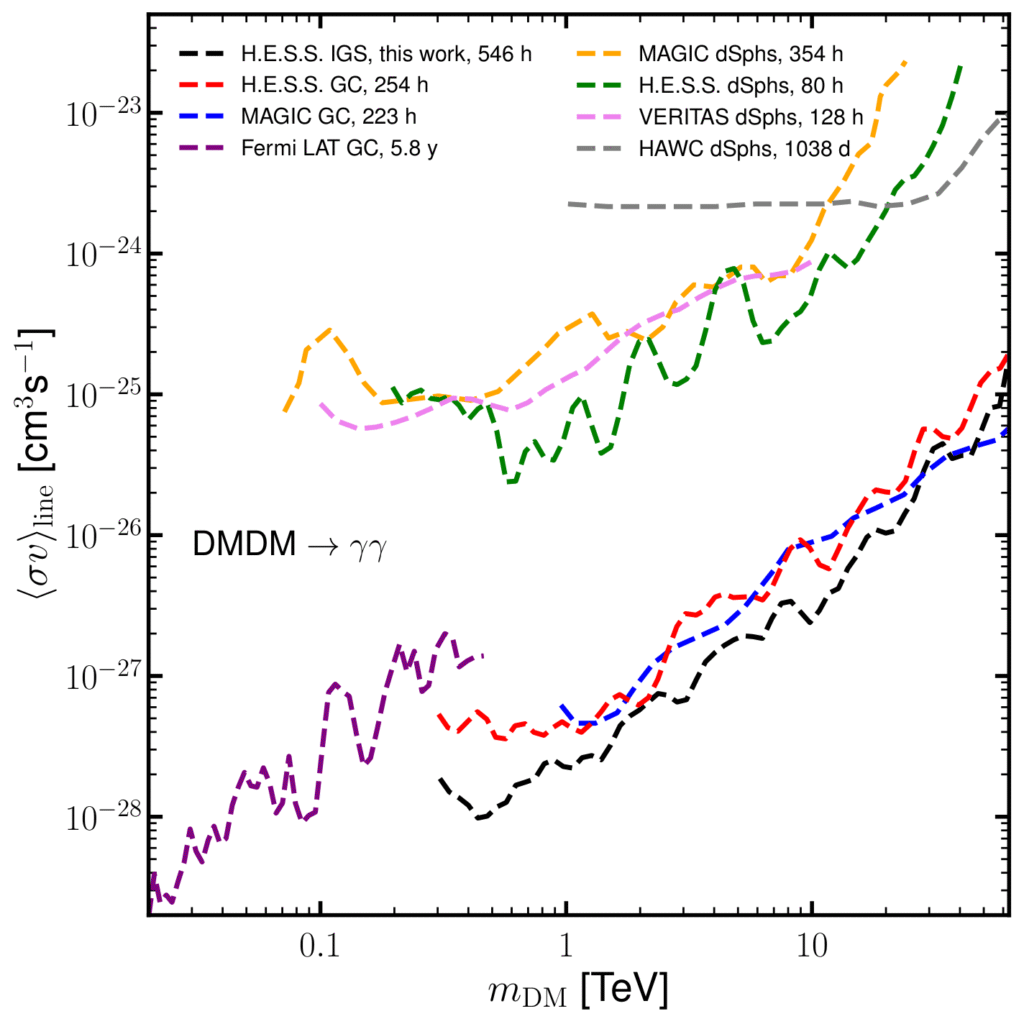
The new H.E.S.S. constraints improve upon previous H.E.S.S. limits by a factor of ~2 for a 1 TeV DM mass. Longer observation time (546 hours vs. 254 hours in the earlier H.E.S.S. analysis [7]), optimized pointing positions and instrument response modeling from run wise simulations improved the outcome. The results are compared with those from other observatories, including MAGIC [8], Fermi-LAT [12], HAWC [13], and VERITAS [16], confirming that H.E.S.S. currently sets the most stringent limits for multi-TeV DM annihilation into gamma-ray lines. From the comparison shown in Fig. 3, the H.E.S.S. results stand out as the most constraining ones on the annihilation cross section for TeV DM.
The results underscore the critical role of atmospheric Cherenkov telescopes like H.E.S.S. in exploring DM at TeV scales, where direct detection and collider experiments fall short. Future observations, particularly with the Cherenkov Telescope Array Observatory, will build on these findings, offering even greater sensitivity to unravel the mysteries of dark matter in the Universe.
References
[1] Planck Collaboration (2020), A&A, 641, A6, “Planck 2018 results. VI. Cosmological parameters”.
[2] L. Bergström (2000), Rept. Prog. Phys. 63, 793, “Nonbaryonic dark matter: Observational evidence and detection methods”.
[3] F. Kahlhoefer (2017), Int. J. Mod. Phys. A 32, 1730006, “Review of LHC Dark Matter Searches”.
[4] M. Schumann (2019), J. Phys. G 46, 103003,“Direct Detection of WIMP Dark Matter Concepts and Status”.
[5] S. Bottaro et al. (2022), “The last complex WIMPs standing” Eur. Phys. J. C 82, 992.
[6] M. Cirelli et al. (2011), “PPPC 4 DM ID: A Poor Particle Physicist Cookbook for Dark Matter Indirect Detection,” JCAP 1103, 051.
[7] H.E.S.S. Collaboration (2018) H. Abdallah et al., “Search for γ-Ray Line Signals from Dark Matter Annihilations in the Inner Galactic Halo from 10 Years of Observations with H.E.S.S.” Phys. Rev. Lett. 120, 201101.
[8] MAGIC Collaboration (2003) H. Abe et al., “Search for Gamma-Ray Spectral Lines from Dark Matter Annihilation up to 100 TeV toward the Galactic Center with MAGIC,” Phys. Rev. Lett. 130, 061002.
[9] H.E.S.S. Collaboration (2026) F. Aharonian et al.,, “Search for gamma-ray spectral lines from dark matter annihilation with the H.E.S.S. Inner Galaxy Survey,” accepted in Phys. Rev. Lett. arXiv:2608.07234
[10] H.E.S.S. Collaboration (2022) H. Abdalla et al. , “Search for Dark Matter Annihilation Signals in the H.E.S.S. Inner Galaxy Survey,” Phys. Rev. Lett. 129, 111101.
[11] M. Holler et al. (2020), “A Run-Wise Simulation and Analysis Framework for Imaging Atmospheric Cherenkov Telescope Arrays,” Astropart. Phys. 123, 102491.
[12] M. Ackermann et al. (Fermi-LAT, 2015), “Updated search for spectral lines from Galactic dark matter interactions with pass 8 data from the Fermi Large Area Telescope,” Phys. Rev. D 91, 122002.
[13] HAWC Collaboration (2020) A. Albert et al., “Search for gamma-ray spectral lines from dark matter annihilation in dwarf galaxies with the High-Altitude Water Cherenkov observatory,” Phys. Rev. D 101, 103001.
[14] H.E.S.S. Collaboration (2020) H. Abdallah et al. , “Search for dark matter signals towards a selection of recently detected DES dwarf galaxy satellites of the Milky Way with H.E.S.S.” Phys. Rev. D 102, 062001.
[15] V. A. Acciari et al. (MAGIC, 2022), “Combined searches for dark matter in dwarf spheroidal galaxies observed with the MAGIC telescopes, including new data from Coma Berenices and Draco,” Phys. Dark Univ. 35, 100912690.
[16] S. Archambault et al. (VERITAS, 2017), “Dark Matter Constraints from a Joint Analysis of Dwarf Spheroidal Galaxy Observations with VERITAS,” Phys. Rev. D 95, 082001.