
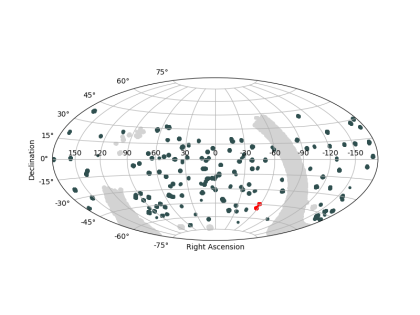
The H.E.S.S. I legacy extragalactic survey
March 2019 From the beginning of the H.E.S.S. I four telescope observations, until the upgrade with the addition of the 28m diameter telescope marking H.E.S.S. phase II (January 2013), H.E.S.S continuously observed both the…
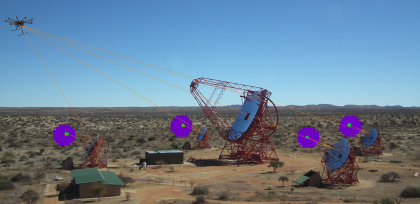
First observation of a UAV with IACTs
February 2019 In a never-ending quest to better understand the Universe around us, astronomers are constantly in pursuit of new technologies and techniques that make their observations more accurate and their telescopes more sensitive.…
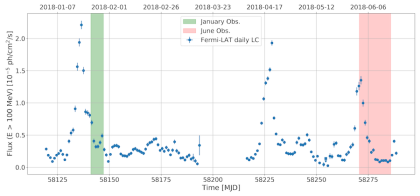
3C279 – the monster in Virgo is back!
January 2019 [1] The relativistic Doppler effect tells us that a receding object will appear redder, while an approaching one will appear bluer and the higher the relative velocity, the stronger the effect. Because…
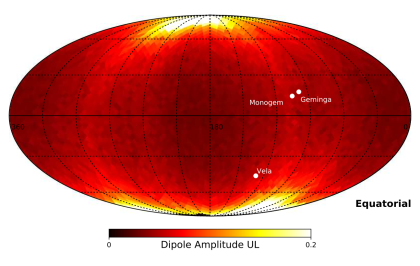
Searching for very-high-energy cosmic-ray electron sources
December 2018 Most TeV cosmic rays are believed to be produced in the Galaxy. In contrast to hadronic cosmic rays, cosmic ray electrons (CRE) propagating in the interstellar medium quickly lose their energy though…
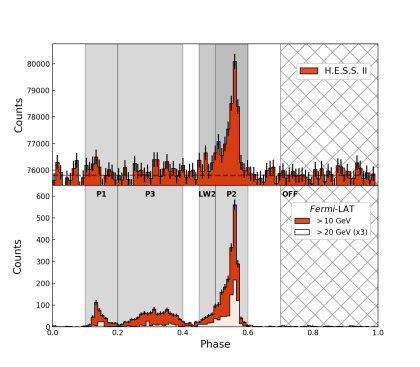
First ground-based measurement of sub-20 GeV to 100 GeV gamma-ray pulsations from the Vela pulsar
November 2018 Pulsars are fast rotating (up to ~1000 rotations per second) and strongly magnetised (magnetic field intensities are trillion times that of the Earth) neutron stars.These compact objects (~1.4 solar masses, but a…
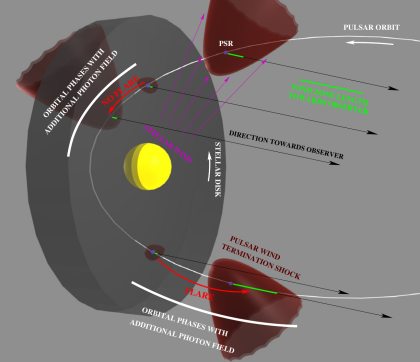
A Powerful Couple – Energetics of the old friend PSR B1259-63
October 2018 Whenever things collide, it gets interesting. Especially in space. A majority of the stars in our universe do not just live a happy life alone, but they are part of gravitationally bound…

Probing Lorentz symmetry at the Planck scale with Mrk 501
September 2018 Fig. 1: Artist’s view of how quantum spacetime may look like at Planck scale. The tiny fluctuations illustrated here may affect how photons propagate in vacuum. Image Credit: NASA/CXC/M.Weiss. Lorentz invariance is…
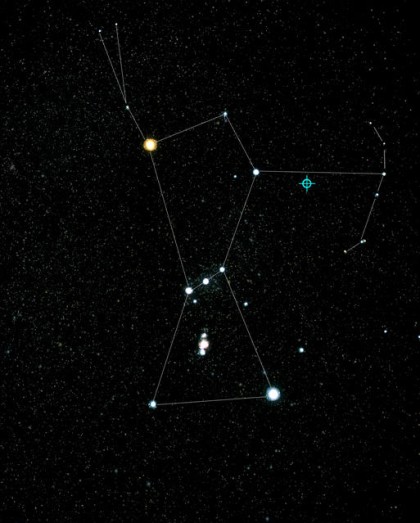
The first hint for a cosmic-ray accelerator?
August 2018 Fig. 1: Blazars are a type of active galaxy with one of its jets pointing toward us. In the left-panel, the position of the blazar TXS 0506+056 is indicated, sitting just below…
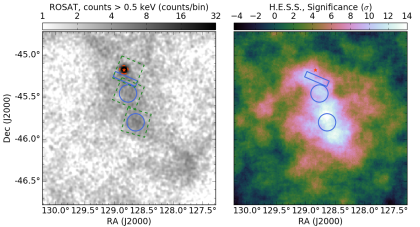
A joint X-ray and gamma-ray study of the Vela X pulsar wind nebula
July 2018 Pulsars are extreme stars left behind after the explosions of certain supernovae. They have masses slightly larger than the Sun, but concentrated in a very compact volume with a radius of approximately…
The tail of Centaurus A
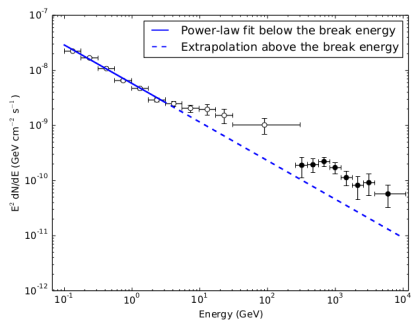
June 2018 Centaurus A is the brightest radio source in the southern constellation Centaurus and the nearest radiogalaxy to the Milky Way at a distance of 12 million of light years. Radio galaxies are…
