
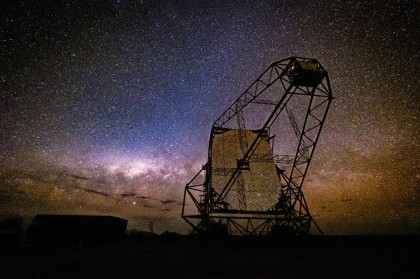
A new camera on the large telescope of H.E.S.S.
October 2020 Together with the continuation of H.E.S.S. operations into an extension phase starting October 2019, the H.E.S.S. collaboration has upgraded its 600 square metre Cherenkov telescope CT5 with a new high-performance camera with…
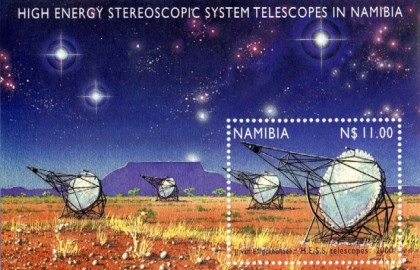
20th anniversary of H.E.S.S. groundbreaking
September 2020 The H.E.S.S. experiment is the biggest and longest-operating among all currently active facilities in ground-based gamma-ray astronomy, exploring the Very High Energy (VHE) radiation from the Universe. The collaboration that planned, built…
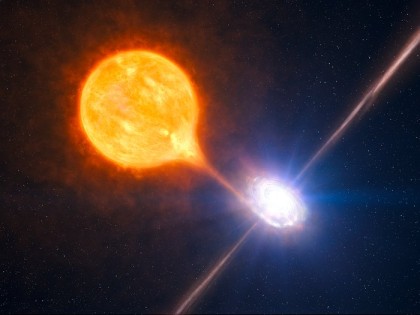
MAXI J1820+070: A powerful outburst launching superluminal jets in a Black Hole Binary
August 2020 MAXI J1820+070 is a Black Hole Binary (BHB) system consisting of a black hole with an estimated mass of 7-8 solar masses [1] and a companion star of less than one solar…
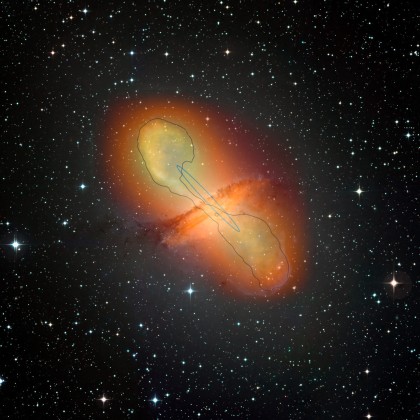
The kiloparsec-sized VHE gamma-ray emission of Centaurus A
July 2020 During the last decades the universe has been probed in the light of very high energy (VHE) gamma-rays, identifying many different kinds of Galactic sources, distant Quasars and other active galaxies. Curiously,…

SGR J1935+2154: An active magnetar now linked to repeating fast radio bursts. A new opportunity for H.E.S.S.
June 2020 Magnetars are very highly magnetised neutron stars with a surface magnetic field reaching 1015 Gauss, about 1000x stronger than that derived for ‘normal’ neutron stars, and among the strongest magnetic fields found…

ATOM: A trailer, a trigger and a tug for H.E.S.S.
May 2020 The H.E.S.S. array is a very advanced and efficient observatory for ground-based gamma-ray astronomy, sensitive enough to trace rapid variations in flaring sources on time-scales of minutes. Nonetheless, most gamma-ray sources require…

Extended emission around the Geminga pulsar
April 2020 Geminga (Gemini gamma-ray source) was discovered in the early 1970s with the SAS-2 satellite and remained an unidentified gamma-ray source for a very long time. It is now known as a radio-quiet…
Gamma-ray quasars from the bright to the faint end: PKS 0736+017
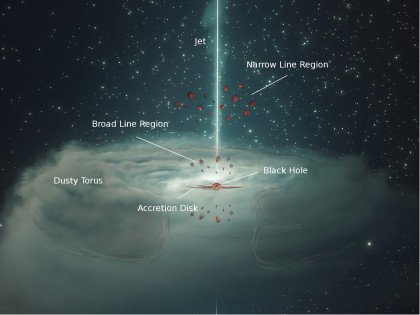
March 2020 About two percent of the hundreds of billions of galaxies in the universe stand out as ‘active galaxies’. A very small nuclear region radiates enormous amounts of light, making Quasars (the most…
A fresh look at the Galactic Plane
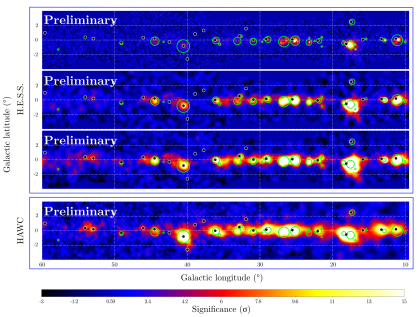
February 2020 The H.E.S.S. Galactic Plane Survey (HGPS, SOM 2016-01) was a 10 year long observation program. For this survey the H.E.S.S. telescopes in Nambia systematically scanned the Milky Way for very high energetic…
The many-faced quasar PKS 1510-089
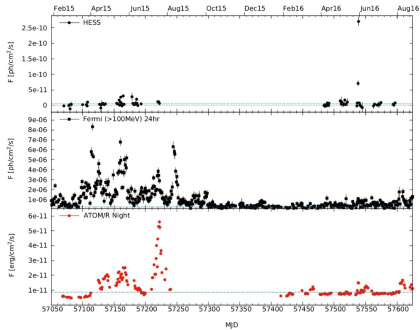
January 2020 Among all classes of Active Galactic Nuclei (AGN), the so-called BL Lac objects had been prime candidates for Very High Energy (VHE) gamma-ray emission (Note 1) from the start, as they posses…
