Usually our sources of the month deal with some of the extreme phenomena visible in very-high-energy (VHE) gamma rays: supernova remnants, black holes, microquasars, and blazars. For this month, we leave behind the realm of gamma rays, and focus on something else that is present in every single observation, but rarely the object of it: the optical night sky.
The main task of Imaging Atmospheric Cherenkov Telescopes (IACTs) such as H.E.S.S. is to reconstruct the direction and energy of incident gamma rays. The mechanism they use to accomplish this relies on visible light: when a VHE gamma ray enters the atmosphere, it interacts with an atomic nucleus and triggers a cascade of secondary particles. These particles travel superluminally through the atmosphere, creating blue light via the Cherenkov effect. The result is a flash of visible light lasting only nanoseconds, which the H.E.S.S. telescopes collect with their large mirrors and focus onto cameras made out of fast photomultiplier pixels, sensitive at optical wavelengths.
Hold on, did we just build an optical telescope by accident?
Since IACTs have to be sensitive to visible light, they also constantly capture everything else that shines in the night sky. Within the community, this light is referred to as the night sky background (NSB). For the purposes of gamma-ray reconstruction, this light is an unwanted background, but as we will see, it is far from useless.
The NSB is made up of several components. The most obvious is starlight, spanning from bright individual stars to the diffuse, unresolved background of the Milky Way. Then there is zodiacal light, which is sunlight scattered by interplanetary dust concentrated in the ecliptic, and airglow, the faint luminescence produced by chemical processes in the upper atmosphere. When observing while the Moon is up – H.E.S.S. does this under controlled conditions since 2020 [1,2] (see also SOM 2022/07) – scattered moonlight also contributes.
The balance between these components changes from night to night and across the sky: towards the Galactic plane, starlight dominates, while airglow varies with time of night, modulated by phenomena such as atmospheric gravity waves. Our cameras monitor this light continuously across their field of view. While the spatial resolution of our cameras is rough compared to the ~1 arcsecond resolution of dedicated optical telescopes – the CT1-4 cameras have 960 pixels at 0.16° resolution, the current camera on CT5 has 1761 pixels at 0.07° resolution – H.E.S.S. has nevertheless racked up a considerable amount of hours monitoring the night sky in the optical, enough to allow us to try our hand at optical astronomy.
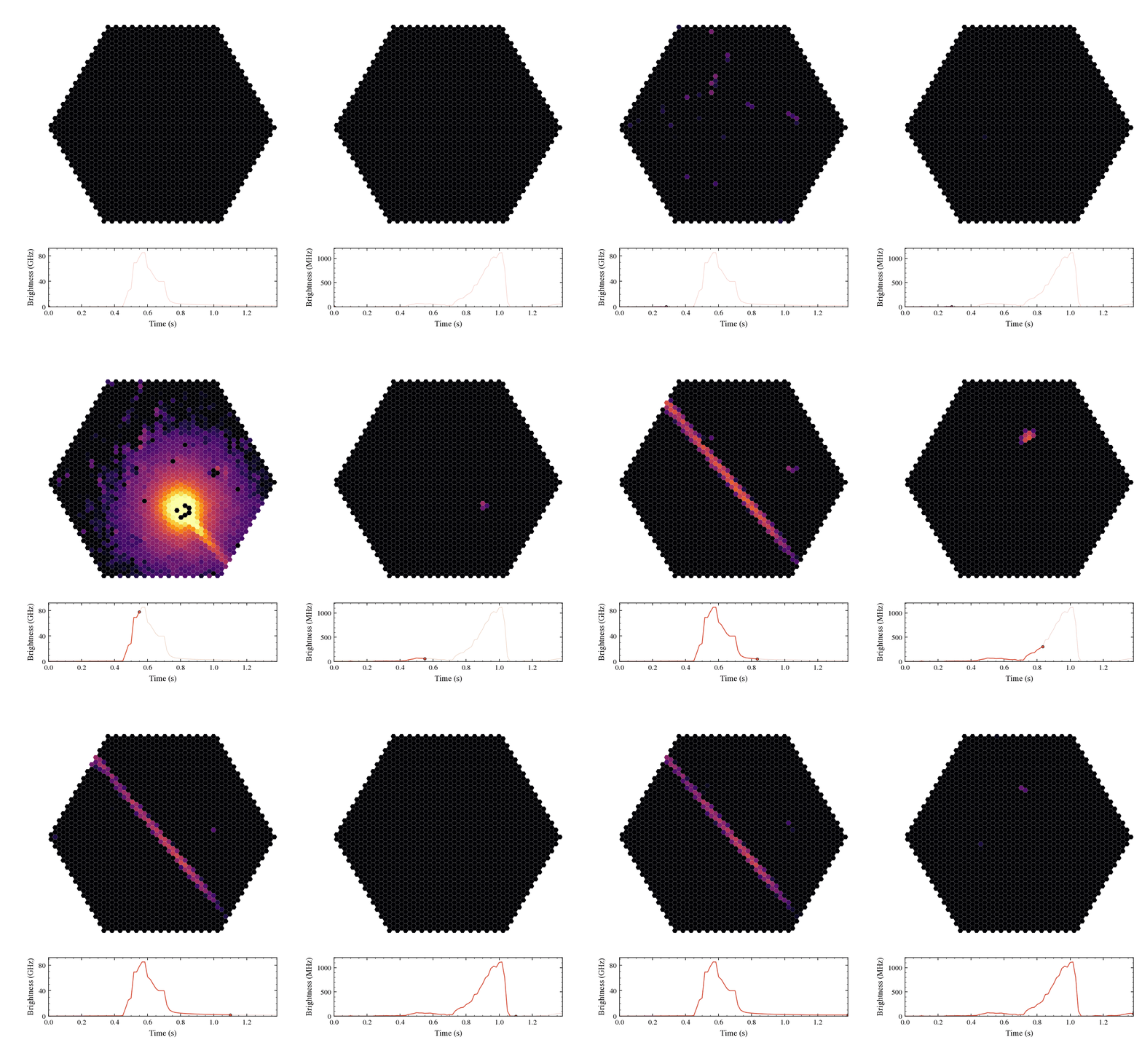
The number of optical phenomena we see is staggering, from birds flying in front of the camera [3], to satellites crossing the field of view [4], and even potential orbital debris [5]. A very common sight in our telescopes is meteors. We catch them ranging from extremely bright meteors (Figure 1, left), also visible to the naked eye, to faint meteors around visual magnitude 11 (Figure 1, right), far beyond the perception of the human eye. Thanks to this sensitivity and the wide field of view of the H.E.S.S. telescopes, we estimate that we detect at least 5000 meteors per year, or one every 16 minutes. (Which means, in principle, we could grant every collaboration member at least 23 wishes per year.)
This kind of optical astronomy via the NSB in IACTs is little more than a curiosity (there are other optical fields, such as stellar occultations [6] and intensity interferometry [7], where IACTs can contribute scientifically). But the NSB can prove useful for operating and calibrating the telescopes in other ways.
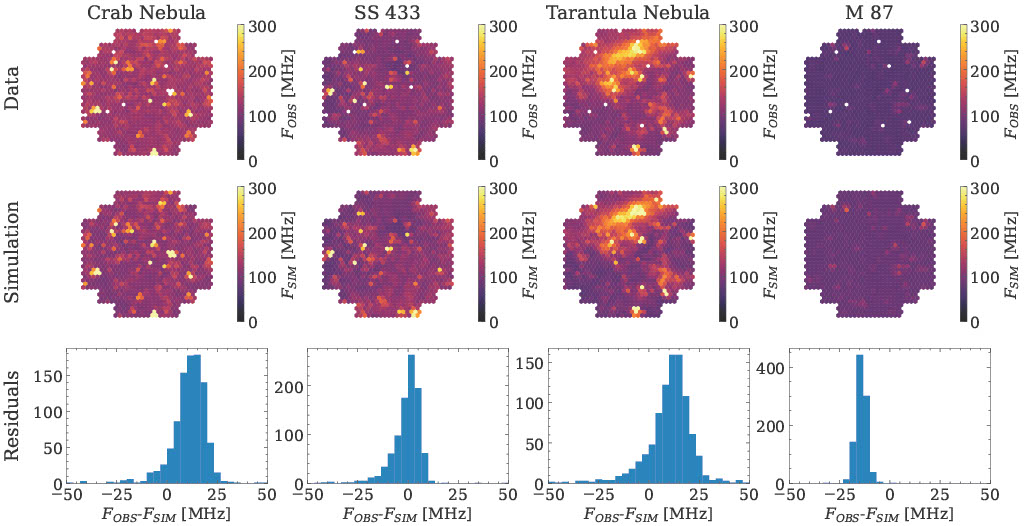
For the NSB to serve as a calibration reference, its properties have to be precisely known. Recent work done with data from the H.E.S.S. telescopes verified a new physics-driven approach to simulating the NSB in IACTs [8]. The model predicts the wavelength-dependent NSB for each individual photomultiplier pixel, including the contributions of the components described above, and accounting for atmospheric absorption and scattering as well as telescope-specific properties such as mirror reflectivity and pixel efficiency. The predictions match the measured NSB remarkably well (Figure 2), with the exception of bright nebulous regions such as the Carina Nebula. The software developed during this work has been released as the open-source tool nsb2, which has since been extended and applied to other IACTs, especially in the context of the upcoming Cherenkov Telescope Array Observatory (CTAO) [9].
This improved precision of the night sky model can be used to calibrate the telescopes. Comparing the expected light per pixel with actual measurements reveals information about pixel behaviour, pointing direction and atmospheric parameters. These techniques have been around since HEGRA [10], but with the improved NSB model they could potentially become competitive with existing dedicated calibration methods. The NSB, otherwise a nuisance, thus provides a way to monitor and calibrate IACTs without the need for dedicated calibration runs or hardware.
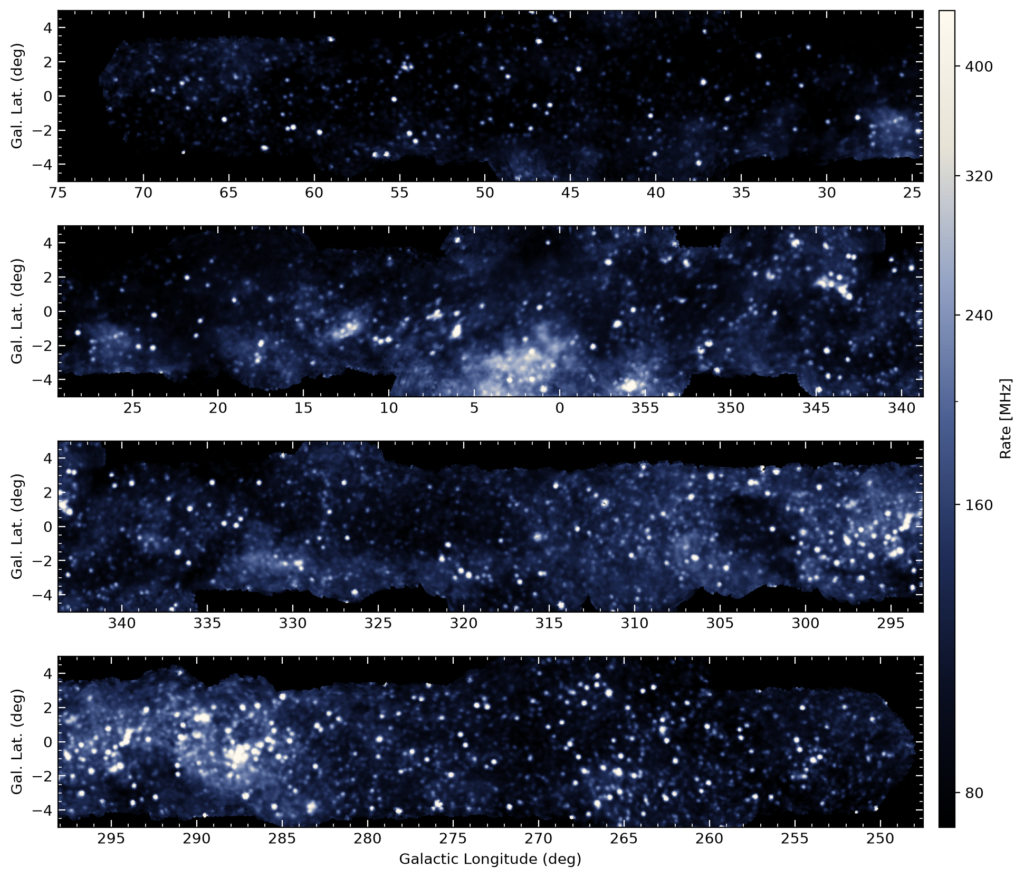
So, while the NSB channel is often underused and underappreciated, it carries a plethora of information useful for the operation of IACTs. And sometimes, it just secretly provides us with a unique view of the optical night sky:
References
[1] Tomankova, L. et al. (2022), Gain settings for the upgraded H.E.S.S. CT1-4 cameras under moonlight observations. Zenodo. Available at: https://doi.org/10.5281/zenodo.7400326.
[2] Ohm, S., Wagner, S., Current status and operation of the H.E.S.S. array of imaging atmospheric Cherenkov telescopes, NIMA 1055, 168442 (2023)
[3] https://www.instagram.com/tv/CcGCHy9A4pB/?stkn=MW92aDFpcXVkb2F6Yw%3D%3D
[4] Lang, T., Spencer, S. T., Mitchell, A. M. W., Impact of satellite trails on H.E.S.S. astronomical observations, A&A 677, A141 (2023)
[5] Deil, C. et al, Capability of Cherenkov telescopes to observe ultra-fast optical flares, Astroparticle Physics 31, 156-162 (2009)
[6] Benbow, W., et al. (The VERITAS Collaboration), Direct measurement of stellar angular diameters by the VERITAS Cherenkov Telescopes, Nature Astron. 3, 511–515 (2019)
[7] Zmija, A., et al., First intensity interferometry measurements with the HESS telescopes. MNRAS 527, 12243 (2024)
[8] Roellinghoff, G., Spencer, S.T., Funk, S., Advanced modelling of the night sky background light for IACTs, A&A 698, A212 (2025)
[9] nsb2, NSB simulation for IACTs, github.com/GerritRo/nsb2
[10] Daum, A. et al., First results on the performance of the HEGRA IACT array, Astroparticle Physics 8, 1-11 (1997)

