
H.E.S.S. CollaborationH.E.S.S. Collaboration
  • Home
    • About H.E.S.S.
      • H.E.S.S. Science
      • H.E.S.S. Site
      • H.E.S.S. Telescopes
    • H.E.S.S. Collaboration
      • Organisation
    • H.E.S.S. Pictures
    • H.E.S.S. Prize
  • News
    • Announcements
    • Press releases
    • Blogs
  • Source of the Month
  • For scientists
    • Publications
      • Journals
      • Conferences
      • Astronomers Telegram
    • External Proposals
      • Visibility calculator
    • HESS GRB observations
      • Interactive Tool (Public)
      • Interactive Tool (Internal)
    • Public test data release
    • Telescope specifications
  • Contact
June 1, 2007 by H.E.S.S. Collaboration
Source of the Month

PWN Abundance – HESS J1718–385

PWN Abundance – HESS J1718–385
June 1, 2007 by H.E.S.S. Collaboration
Source of the Month

June 2007

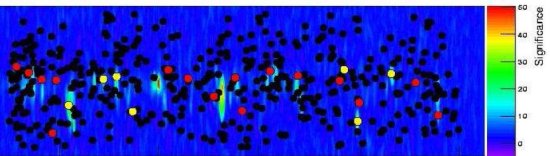
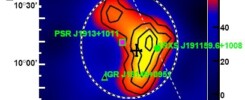
Sky map of the central region of the Milky Way, covering from about +30° to –60° Galactic longitude and from about +2° to –2° in latitude, used to investigate correlations between pulsars and very high energy gamma-ray emission measured by H.E.S.S. The color scale indicates gamma ray flux, the points show pulsar positions taken from the ATNF pulsar catalog. Black points show pulsars with a spin-down energy flux (dErot/dt)/D2 below 1034 ergs/s/kpc2, red points pulsars between 1034 and 1035, and yellow points above 1035. Of the high-luminosity pulsars, 5 of 7 appear to be associated with gamma-ray sources, with a probability for this representing a chance coincidence of 4×10⁻⁴ . The pulsar wind nebula reported here was identified in the context of this study.

Pulsar wind nebulae – PWNe – are amongst the most abundant sources of very high energy gamma rays in our Galaxy. Rotational energy of the neutron star is converted – by some not fully understood mechanism – into a relativistic stream of particles, presumably mostly electrons and positrons generated near the pulsar. This pulsar wind terminates in a shock when it encounters the ambient medium, which is often composed of ejecta from the supernova explosion which created the pulsar. From the termination shock, electrons emerge with the power-law energy distribution typical for shock-wave acceleration and stream or diffuse away from the shock. The electrons in the resulting pulsar wind nebula form an efficient source of high energy gamma rays, by upscattering of ambient photons, for example those of the microwave background. Compared to supernova remnants, where gamma rays are most likely produced by interactions of accelerated nuclei with ambient gas, the upscattering process is very efficient in generating gamma rays, which explains the abundance of pulsar wind nebulae detected in high energy gamma rays (e.g. SOM 2004/10, 2005/06, 2005/09, 2006/04, or 2007/05).
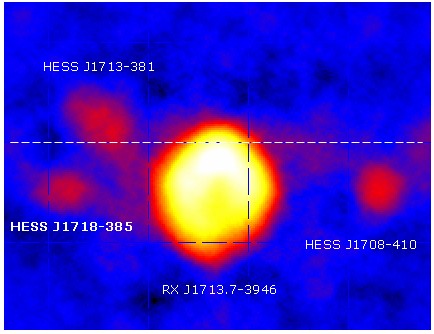
Fig. 1: VHE gamma ray sky in the range from about 345 degr. to 350 degr. longitude, showing the large supernova remnant RX J1713.7-3946, the known gamma ray sources HESS J1713-381 and HESS J1708-410 as well as the new source HESS J1718-385, which turned into a significant detection as more data on RX J1713.7-3946 were accumulated. The dashed lines show a 1 degr. Galactic coordinate grid; the white dashed line shows the Galactic plane.

The new gamma-ray source HESS J1718-385 was discovered in a systematic search for gamma-ray emission associated with known pulsars, see top figure. A gamma-ray excess of about 8 sigma significance is seen near the pulsar PSR J1718-3825 (Fig. 1, Fig. 2). The initial survey analysis (Aharonian et al. 2005, 2006) had less exposure in this region, and the structure corresponding to HESS J1718-385 was not significant.  The excess is slightly offset from the pulsar (Fig. 2). Similar offsets are observed for well-identified PWN such as Vela-X (SOM 2006/05) or HESS J1825-137 (SOM 2005/09); their origin is not yet understood in detail,  but may be attributed to inhomogeneities of the ambient medium.  Archival radio and X-ray data show no structures obviously associated with the pulsar or the gamma-ray source (Fig. 3). Firm identification of the gamma-ray source with the pulsar will require the search for a X-ray PWN in deeper X-ray exposures.
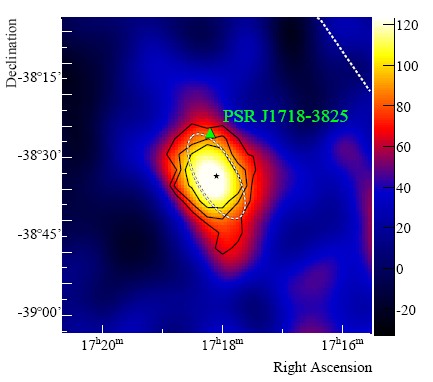
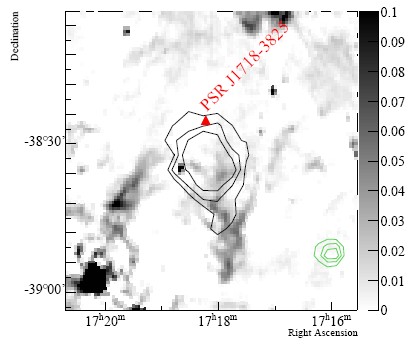
Fig. 2: Image of the VHE gamma-ray excess counts of HESS J1718−385, smoothed with a Gaussian of width 0.06 degr., in RA-Dec coordinates. The black contours are the 4, 5 and 6 significance contours. The position of the pulsar PSR J1718−3825 is marked with a green triangle and the Galactic plane is shown as a white dotted line. The best-fit position for the gamma-ray source is marked with a black star and the fit ellipse approximating the intrinsic extension of the source with a dashed line.
Fig. 3: Radio image from the Molonglo Galactic Plane Survey at 843MHz (in Jy/beam) (Green et al. 1999). The H.E.S.S. significance contours are overlaid in black and the pulsar position is marked with a red triangle. Adaptively smoothed ROSAT hard-band X-ray contours are shown in green (Voges et al. 2001).

References:

Discovery of two candidate pulsar wind nebulae in very-high-energy gamma rays, H.E.S.S. collaboration, F. Aharonian et al., in preparation, arXiv:0705.1605
galactic plane pulsar wind nebula

Previous articleHESS J1912+101 – Yet Another Pulsar Wind Nebula?Next article The Supernova Remnant RCW 86

Source of the month

Each month a TeV gamma-ray source investigated with the H.E.S.S. telescopes is featured.

>> List of all sources

Latest sources

The flare that sweetened the lockdownOctober 1, 2026
A spectral steepening in the Galactic Centre ridge spectrumSeptember 1, 2026
Hunting dark matter in the Milky Way: constraints on spectral line features and the thermal HiggsinoAugust 1, 2026

Tags

Atmosphere (1) Axion-like particle (1) black holes (2) Blazar (7) Catalogue (1) Conference (1) Cosmic rays (1) Dark matter (3) Event (1) Extragalactic (10) Galactic Center (1) Galactic centre (1) galactic plane (8) galactic source (10) Gamma-ray binary (3) Gamma-ray burst (3) gamma-rays (4) IceCube (1) Meeting (2) microquasar (2) multi-messenger (1) neutrinos (4) nobelprize (1) Nova (1) publication (5) pulsar (1) pulsar wind nebula (5) Supernova remnant (3)

Contact

You can contact us for scientific queries and general information using:
contact.hess@hess-experiment.eu

Data Privacy Statement

https://www.mpi-hd.mpg.de/mpi/de/datenschutzhinweis
H.E.S.S. collaboration official website. Proudly Built By H.E.S.S. members.
(c) 2004-2026 by the H.E.S.S. collaboration.

Last sources of the month

The flare that sweetened the lockdownOctober 1, 2026
A spectral steepening in the Galactic Centre ridge spectrumSeptember 1, 2026
Hunting dark matter in the Milky Way: constraints on spectral line features and the thermal HiggsinoAugust 1, 2026

Internal

  • Log in
  • Entries feed
  • Comments feed
  • WordPress.org
H.E.S.S. Collaboration
Manage Consent
To provide the best experiences, we use technologies like cookies to store and/or access device information. Consenting to these technologies will allow us to process data such as browsing behavior or unique IDs on this site. Not consenting or withdrawing consent, may adversely affect certain features and functions.
Functional Always active
The technical storage or access is strictly necessary for the legitimate purpose of enabling the use of a specific service explicitly requested by the subscriber or user, or for the sole purpose of carrying out the transmission of a communication over an electronic communications network.
Preferences
The technical storage or access is necessary for the legitimate purpose of storing preferences that are not requested by the subscriber or user.
Statistics
The technical storage or access that is used exclusively for statistical purposes. The technical storage or access that is used exclusively for anonymous statistical purposes. Without a subpoena, voluntary compliance on the part of your Internet Service Provider, or additional records from a third party, information stored or retrieved for this purpose alone cannot usually be used to identify you.
Marketing
The technical storage or access is required to create user profiles to send advertising, or to track the user on a website or across several websites for similar marketing purposes.
  • Manage options
  • Manage services
  • Manage {vendor_count} vendors
  • Read more about these purposes
View preferences
  • {title}
  • {title}
  • {title}