
H.E.S.S. CollaborationH.E.S.S. Collaboration
  • Home
    • About H.E.S.S.
      • H.E.S.S. Science
      • H.E.S.S. Site
      • H.E.S.S. Telescopes
    • H.E.S.S. Collaboration
      • Organisation
    • H.E.S.S. Pictures
    • H.E.S.S. Prize
  • News
    • Announcements
    • Press releases
    • Blogs
  • Source of the Month
  • For scientists
    • Publications
      • Journals
      • Conferences
      • Astronomers Telegram
    • External Proposals
      • Visibility calculator
    • HESS GRB observations
      • Interactive Tool (Public)
      • Interactive Tool (Internal)
    • Public test data release
    • Telescope specifications
  • Contact
January 1, 2007 by H.E.S.S. Collaboration
Source of the Month

HESS J1616-508 – Evidence for a Dark Particle Accelerator

HESS J1616-508 – Evidence for a Dark Particle Accelerator
January 1, 2007 by H.E.S.S. Collaboration
Source of the Month

January 2007

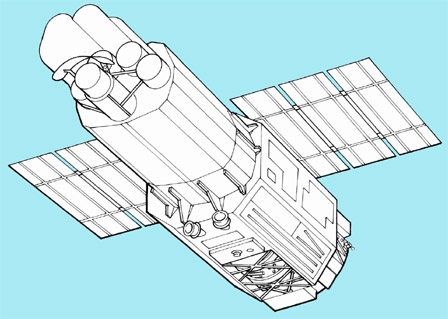
The Suzaku X-ray satellite. The Suzaku X-ray detectors have very low background, which makes them ideal for the search for faint and extended X-ray counterparts of the Galactic H.E.S.S. gamma-ray sources.

HESS J1616–508 (Fig. 1) is one of the objects discovered in the H.E.S.S. survey of the Galactic Plane; it is an extended source with a size of about 8 arc min., a flux of about 20% of the Crab Nebula, and a gamma-ray spectral index of 2.35. While bracketed by two supernova remnants, G332.4+0.1 (also known as MSH 16-51, Kes 32; MOST radio image) and G332.4-0.4 (RCW 103, see also here; MOST radio image), neither of those provides a likely counterpart. More interesting is the young pulsar PSR J1617–5055 (Torii et al. 1998) which was proposed as a gamma-ray source (Hirotani 2001) and which provides sufficient energy; about 1% of the spin-down power of the pulsar would be needed to feed the high-energy gamma rays. However, the pulsar is offset by almost 0.3 degr. from the H.E.S.S. source. At the time of the discovery of the gamma ray source, such large offsets were considered implausible. In the meantime, several examples of TeV sources were discovered by H.E.S.S. where the gamma-ray emission region is located asymmetrically with respect to the pulsar; the two most clear-cut cases are Vela-X and HESS J1825-137 (see also Aharonian et al., 2006). Hence, such a scenario appears more plausible. Among the alternative explanations proposed for such “Dark Accelerators”, i.e. sources without X-ray or radio counterpart, are old supernova remnants where electron acceleration cannot compete with radiation cooling and where gamma rays are produced in proton interactions (Yamazaki et al. 2006), or gamma-ray burst remnants, where again high magnetic fields in the early phases of the expansion kill all high-energy electrons due to radiative losses (Atoyan et al. 2006).
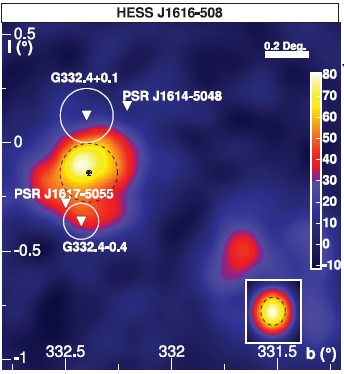
Fig. 1: Gamma-ray sky around HESS J1616-508. The gamma-ray source is bracketed by the two supernova remnants G332.4+0.1 (MSH 16-51, Kes 32) and G332.4-0.4 (RCW 103), but neither represents a plausible counterpart. The pulsar PSR J1617-5055 could provide enough spin-down power to generate the observed gamma-ray flux, but is offset from the peak of the TeV emission.

Sensitive X-ray observations are therefore crucial to determine the nature of TeV sources such as HESS J1616-508, and in a sense the Suzaku satellite is ideal to hunt for counterparts of the extended H.E.S.S. sources: Suzaku’s instruments provide a – by X-ray standards – modest angular resolution but have very low instrumental backgrounds, allowing for the sensitive detection even of faint extended sources. Suzaku observations of HESS J1616–508 were reported by Matsumoto et al. (2006). In an exposure centered on the H.E.S.S. source and covering a large fraction of it, no significant X-ray emission was detected (Fig. 2), and upper limits are given (Fig. 3). For many typical gamma-ray sources, the ratio of gamma-ray energy flux (in the 1-10 TeV range) to X-ray energy flux (2-10 keV) is of order unity; for HESS J1616–508, the upper limit on the X-ray flux implies that at least 55 times more energy goes into gamma rays (Matsumoto et al., 2006). For an electron accelerator and typical Galactic magnetic fields of about 5 microGauss, one would expect a ratio around unity, so an electronic origin of the gamma-rays seems ruled out. A few caveats, however, should be mentioned: for microGauss fields, X-rays at energies of some keV originate from ~100 TeV electrons whereas the H.E.S.S. gamma-rays are produced by lower-energy electrons in the 10 TeV range. This is also evident from Fig. 3, where the X-ray flux predicted under the assumption of an electronic origin is shown: at least for small B fields, the H.E.S.S. gamma rays correspond to sub-keV X-rays. If the electron energy spectrum has a sharp cutoff between 10 and 100 TeV, the two data sets could therefore be reconciled. Also, gamma ray production could be boosted relative to X-rays by providing intense target photon fields for Inverse-Compton scattering of electrons, see e.g. Hinton and Aharonian (2006); however, unlike near the Galactic center there is no obvious reason for such an enhancement in HESS J1616-508.
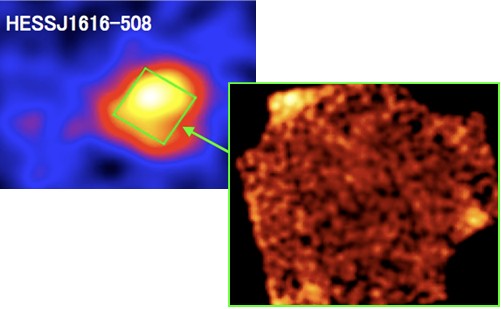
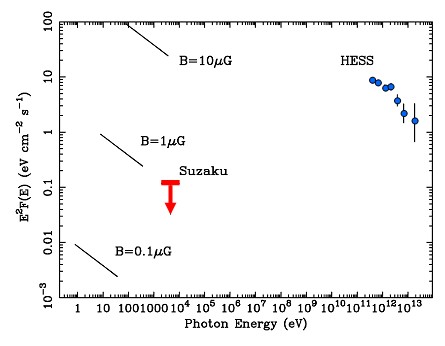
Fig. 2: Coverage of the central region of HESS J1616-506 by Suzaku observations and resulting Suzaku XIS image (T. Uchiyama, Texas Symposium 2006; Matsumoto et al., 2006). Note that PSR J1617-5055 is just outside the XIS field of view; it is clearly visible as an X-ray source in XMM-Newton data covering the region (Matsumoto et al., 2006).
Fig. 3: Wide-band spectral energy distribution (SED) of HESS J1616-508 (Matsumoto et al. 2006). The SED is related to the power emitted each decade of the electromagnetic spectrum. The upper limit on the X-ray flux from the Suzaku XIS instrument is well below the gamma-ray flux measured by H.E.S.S. Using XMM-Newton X-ray data, Matsumoto et al. derive a limit three times worse than with XIS. Assuming that a population of high-energy electrons is responsible for the gamma-ray emission, the expected X-ray level due to synchrotron radiation depends on the magnetic field in the source, as indicated by the lines. Typical interstellar fields are around 5 microGauss, a value for which X-ray energy flux and gamma-ray energy flux should comparable.

References

The H.E.S.S. survey of the Inner Galaxy in very high-energy gamma-rays, H.E.S.S. collaboration, F. Aharonian et al., Astrophysical Journal 636 (2006) 777-797
(note that the paper contains a typing mistake concerning the size of the source which is quoted as 16′ in the text; the value of 0.136 degr. given in Table 3 is correct)
galactic plane

Previous articleA novel type of source? Gamma rays from the vicinity of the Wolf-Rayet binary WR 20aNext article A Point-Like Gamma-Ray Source in Monoceros

Source of the month

Each month a TeV gamma-ray source investigated with the H.E.S.S. telescopes is featured.

>> List of all sources

Latest sources

The flare that sweetened the lockdownOctober 1, 2026
A spectral steepening in the Galactic Centre ridge spectrumSeptember 1, 2026
Hunting dark matter in the Milky Way: constraints on spectral line features and the thermal HiggsinoAugust 1, 2026

Tags

Atmosphere (1) Axion-like particle (1) black holes (2) Blazar (7) Catalogue (1) Conference (1) Cosmic rays (1) Dark matter (3) Event (1) Extragalactic (10) Galactic Center (1) Galactic centre (1) galactic plane (8) galactic source (10) Gamma-ray binary (3) Gamma-ray burst (3) gamma-rays (4) IceCube (1) Meeting (2) microquasar (2) multi-messenger (1) neutrinos (4) nobelprize (1) Nova (1) publication (5) pulsar (1) pulsar wind nebula (5) Supernova remnant (3)

Contact

You can contact us for scientific queries and general information using:
contact.hess@hess-experiment.eu

Data Privacy Statement

https://www.mpi-hd.mpg.de/mpi/de/datenschutzhinweis
H.E.S.S. collaboration official website. Proudly Built By H.E.S.S. members.
(c) 2004-2026 by the H.E.S.S. collaboration.

Last sources of the month

The flare that sweetened the lockdownOctober 1, 2026
A spectral steepening in the Galactic Centre ridge spectrumSeptember 1, 2026
Hunting dark matter in the Milky Way: constraints on spectral line features and the thermal HiggsinoAugust 1, 2026

Internal

  • Log in
  • Entries feed
  • Comments feed
  • WordPress.org
H.E.S.S. Collaboration
Manage Consent
To provide the best experiences, we use technologies like cookies to store and/or access device information. Consenting to these technologies will allow us to process data such as browsing behavior or unique IDs on this site. Not consenting or withdrawing consent, may adversely affect certain features and functions.
Functional Always active
The technical storage or access is strictly necessary for the legitimate purpose of enabling the use of a specific service explicitly requested by the subscriber or user, or for the sole purpose of carrying out the transmission of a communication over an electronic communications network.
Preferences
The technical storage or access is necessary for the legitimate purpose of storing preferences that are not requested by the subscriber or user.
Statistics
The technical storage or access that is used exclusively for statistical purposes. The technical storage or access that is used exclusively for anonymous statistical purposes. Without a subpoena, voluntary compliance on the part of your Internet Service Provider, or additional records from a third party, information stored or retrieved for this purpose alone cannot usually be used to identify you.
Marketing
The technical storage or access is required to create user profiles to send advertising, or to track the user on a website or across several websites for similar marketing purposes.
  • Manage options
  • Manage services
  • Manage {vendor_count} vendors
  • Read more about these purposes
View preferences
  • {title}
  • {title}
  • {title}