October 2026
Everyone remembers what they did in April 2020. With the Covid-19 pandemic hitting hard, practically the entire planet was sitting at home, hoping for the best. Thanks to its remote location, H.E.S.S. was one of the very few ground-based astronomical observatories that could continue operations uninterrupted. And this really helped easing the burden of the lockdowns for some of us. Namely in March 2020, a so-far rather unremarkable gamma-ray blazar decided to make itself known.
Blazars are a type of active galaxies. A galaxy is considered active if the supermassive black hole at its centre is fed by an accretion disk, in which hot gas is funneled towards the black hole. It is these hot accretion disks that produce the extreme brightness of these galactic cores. A by-product of the accretion process – even though the exact circumstances are a topic of active research – can be a relativistic jet, which is launched from the black-hole-accretion-disk system and moves outward reaching scales potentially longer than the size of the host galaxy. Matter within these jets moves close to the speed of light, which allows for all sorts of fascinating relativistic effects. One of them is that a jet emits most of the light produced within it into the forward direction. In other words, if a jet points towards the Earth, it appears tremendously bright to us, even outshining the entire host galaxy. In this case, the object is called a blazar. It emits light across the entire electromagnetic spectrum, from the lowest radio frequencies to the highest gamma-ray energies. And most interestingly, blazars are extremely variable. They can change their observed fluxes by orders of magnitude within days, hours, or – sometimes – even minutes (SOM 2007/09). These outbursts imply incredibly fast changes within the jet, which can be used to study particle acceleration and energy loss processes.
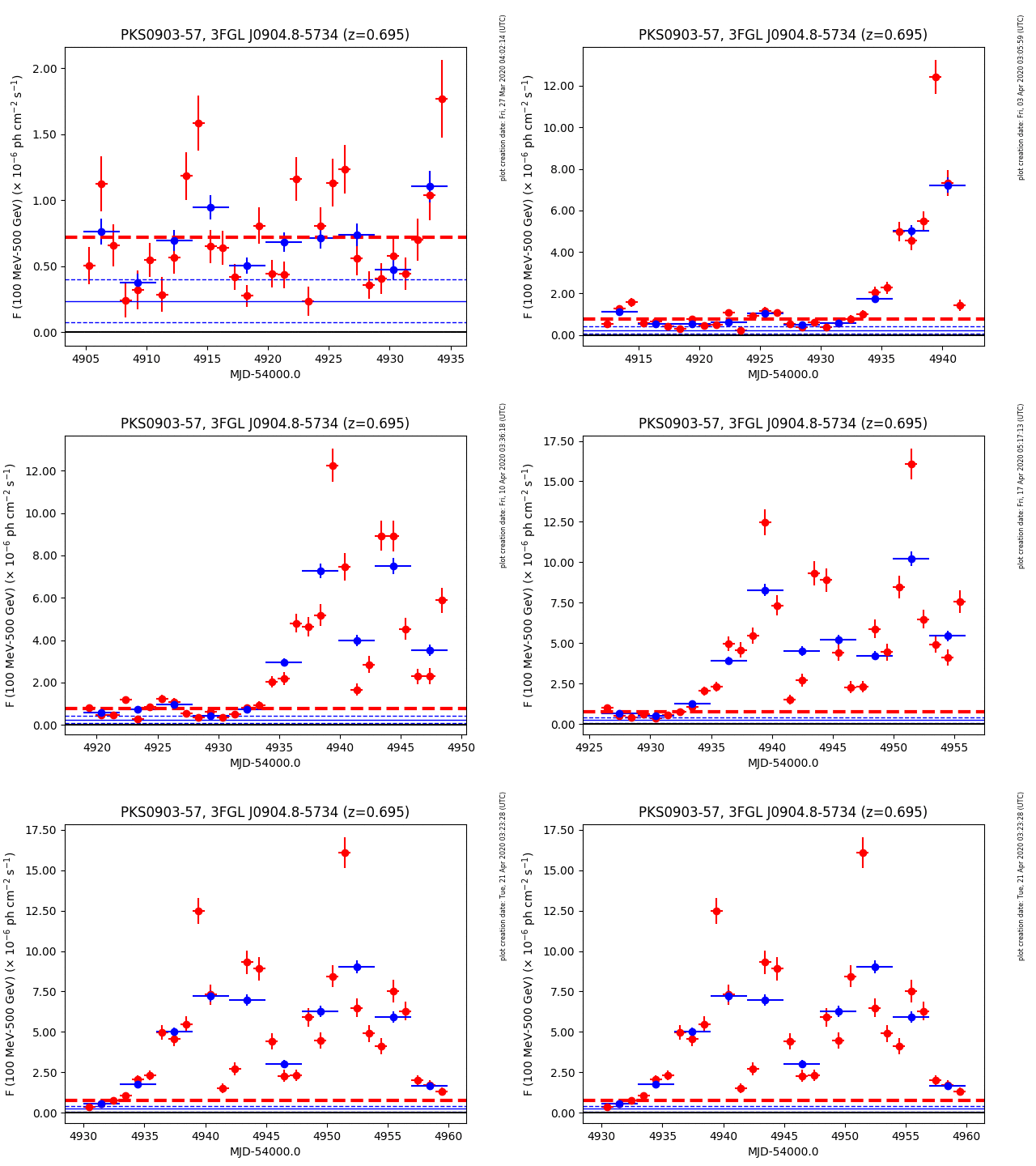
The name of the blazar-of-honour in this story is PKS 0903–57. In 2020, it was believed to be located at a rather large distance to Earth, with a cosmological redshift of 0.695 – this corresponds to a light travel time of around 6.5 billion years! In March 2020, PKS 0903–57 began a month-long, very powerful outburst phase in the high-energy (HE, E > 100 MeV) gamma-ray domain as observed with Fermi-LAT. We were alerted to this outburst by the FLaapLUC monitoring tool [1]. The evolution of the flux is shown in Fig. 1:
Initially, weather and the full moon prevented any observations with H.E.S.S. Luckily, the source remained active for a few weeks, and we were finally able to observe with H.E.S.S. starting right after the third peak (marked as flare “C” in Fig. 2) in the Fermi-LAT light curve. And – oh my! – it was worth the wait! The very-high-energy (VHE, E > 100 GeV) gamma-ray flux turned out to be tremendously bright, nearly reaching half the flux of the Crab Nebula (SOM 2004/10) in the first night. Observations continued for a total of six nights with the flux being strongly variable, although mostly decreasing. The full multiwavelength light curve (VHE, HE, X-ray, optical) is shown in Fig. 2. The VHE light curve presents results obtained with our largest telescope, CT5, and was the first major event recorded with the “FlashCam” camera installed just a few months prior (SOM 2020/10).
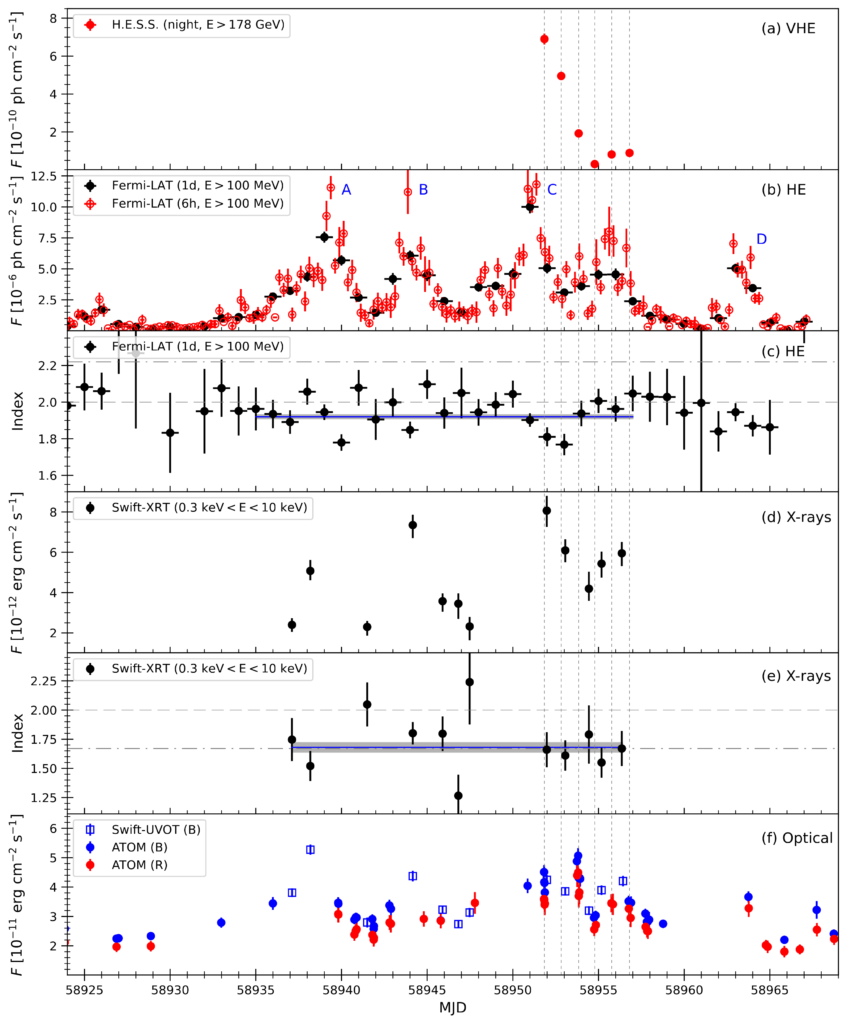
As is obvious from the light curves in Fig. 2, every energy band is very variable. Interestingly, the behaviour between the bands differs. For instance, peak fluxes are not reached simultaneously, nor is the absolute peak reached in each band at the same time (e.g., HE during flare C, but the optical maximum seemingly during flare A). Similarly, while the HE spectral index (panel c) is variable, the X-ray spectral index (panel e) is not. These observations point to complicated interplays (e.g., particle acceleration and energy loss) within the source during the outburst phase.
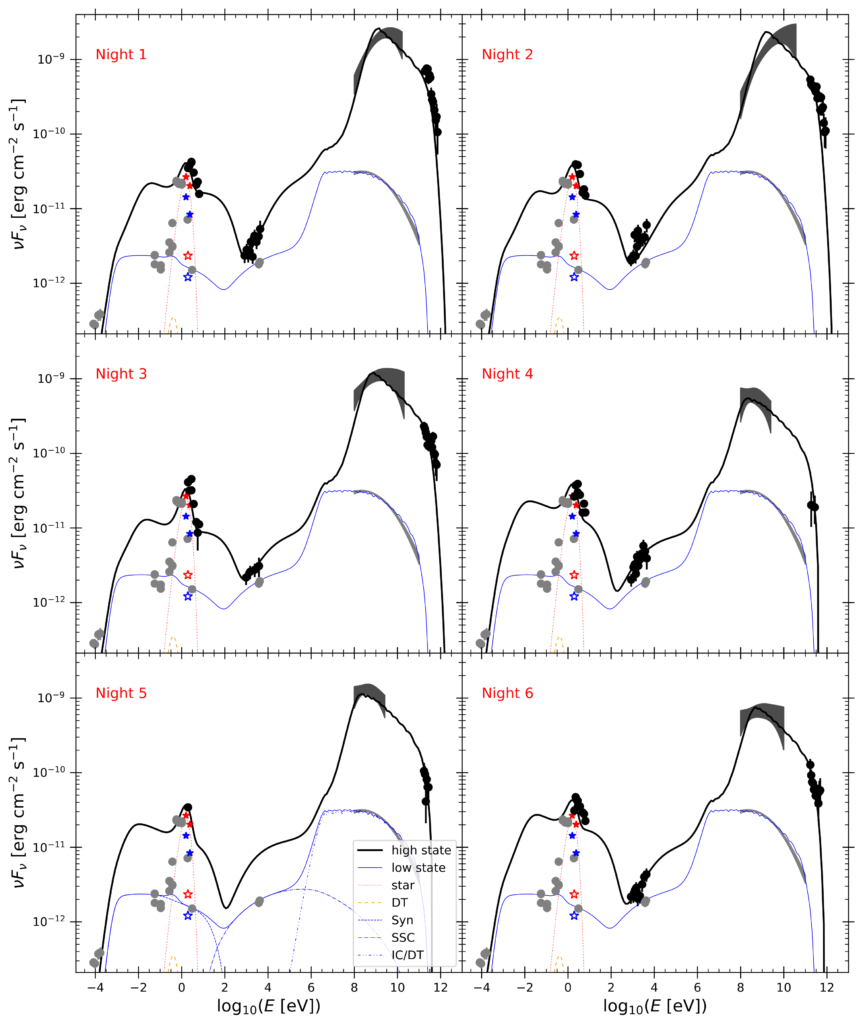
The broadband spectral energy distributions (SEDs) corresponding to the 6 H.E.S.S. observation nights are shown in Fig. 3. The narrow peak in the optical domain (around log10(E/eV)=0) reveals one of the major complication of this source. Namely, there is a foreground star located so close to the blazar’s position that most optical instruments cannot separate them. Hence, the optical spectrum is a mix of the blazar and the star. The Gaia satellite was capable of separating the two sources (shown by colored stars in Fig. 3) providing broadband fluxes.
However, obtaining a highly detailed optical spectrum would be crucial to further understand this source. The H.E.S.S. detection with its spectrum reaching beyond 1 TeV put strong doubts on the claimed cosmological redshift of 0.695. A multi-year effort was launched in order to obtain the real redshift, which was finally established at 0.262 [2]. This means that the photons were still travelling for around 3 billion years, but is much more in-line with the H.E.S.S. observations, as TeV photons do not reach Earth if they are emitted at too far cosmological distances (see e.g. SOM 2026/02).
The modelling, which is also shown in Fig. 3, supports this assessment from the light curves. The reproduction of the SEDs requires intricate changes in the source parameters. It also turns out that the usual one-zone model, in which one homogenous zone describes all the data, is insufficient in this case. Instead, a second, low-flux zone (blue line) is needed to fully explain the observations. This is similar to results obtained for another source, PKS 1510–089 (SOM 2023/08). The present results highlight once more that highly detailed data sets strongly challenge conventional models, and are thus crucial to advance the field.
All details regarding this extraordinary flare that so sweetened the first Covid-19 lockdown, are published in [3].
References
[1] Lenain, J.-P., 2018, A&C, 22, 9
[2] Goldoni, P., et al., 2024, A&A, 691, L5
[3] Acharyya, A., et al. (H.E.S.S. Collaboration), 2026, JHEAp, 53, 100599