September 2007
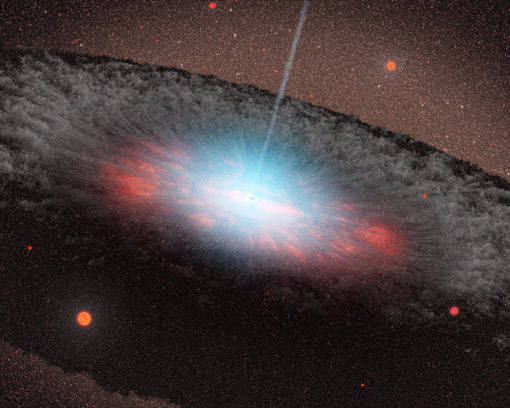
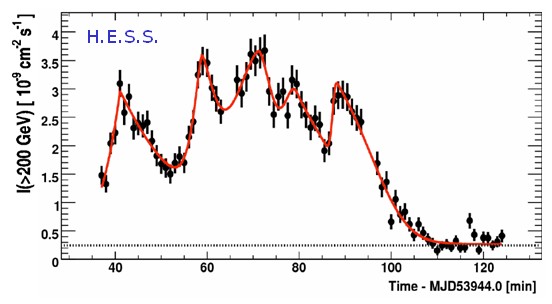
“Photons from a hotter hell” is the title of T. Weekes recent commentary in Nature, concerning the recent detection of giant outbursts of active galaxies observed in high-energy gamma rays. At the core of an active galaxy, a supermassive black hole is accreting matter, frequently launching a jet of high energy particles (top figure), which are the source of the observed gamma rays. The detailed mechanisms which generate the jet and also the nature of the particles which make up the jet are not fully understood. Fluctuations in the lauching of the jet, or within the jet cause sources to flare. A most impressive outburst of the Southern active galaxy PKS 2155-304 was recently reported by H.E.S.S. (Aharonian et al., 2007). PKS 2155-304 was one of the first objects covered in SOM 2004/11, but these recent data merit a second report. Within about 90 minutes of observations, close to 12,000 gamma rays were detected, corresponding to a rate of more than 2 Hz. The measured light curve is shown in Fig. 1 in one-minute bins; it displays at least five distinct sub-flares. The peak flux reaches up to 15 times the flux of the Crab Nebula, and is almost a factor 100 higher than the minimal (“quiescent”) flux from PKS 2155-304. Given that this active galaxy is more than 200,000 times more distant than the Crab Nebula – about 450 Mpc compared to 2 kpc – this implies an energy output in high-energy gamma rays which is about 12 orders of magnitude higher than for the Crab Nebula, whereas the emission region, governed by the scale of the black hole, is several orders of magnitude smaller than the size of the Crab Nebula. The fast rise times of the flares, in the range of 100 s, are among the fastest ever observed from such objects. This is puzzling since it is only about 1% of light-crossing time of the black hole, usually assumed to be the shortest time scale on which the jet can flare. Relativistic boosting can shorten time variation as viewed by an observer at rest, but to achieve a speed-up of a factor 100, the jet would have to move with an unprecedented Doppler factor around 100, or 99.995% of the speed of light.
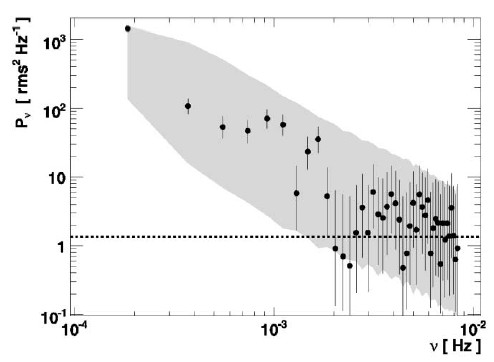
A frequency decomposition of the light curve was made to find out which frequency components are most strongly represented in the flux variation (Fig. 2), with the surprising result that the signal somewhat resembles “red noise”: all frequencies are present, with increasing intensity towards lower frequency. This result questions the assumption that the rise times of the individual sub-flares represent a single characteristic time scale which can a associated with a corresponding length scale of the emission region. Possibly, the emission region has a fractal nature where emission from features of many different scales is superimposed, with decreasing intensity from smaller-scale features, which cause the higher-frequency components.
References
An Exceptional Very High Energy Gamma-Ray Flare of PKS 2155-304, Aharonian et al., Astrophys. Journal, 664 (2007) L71