September 2026
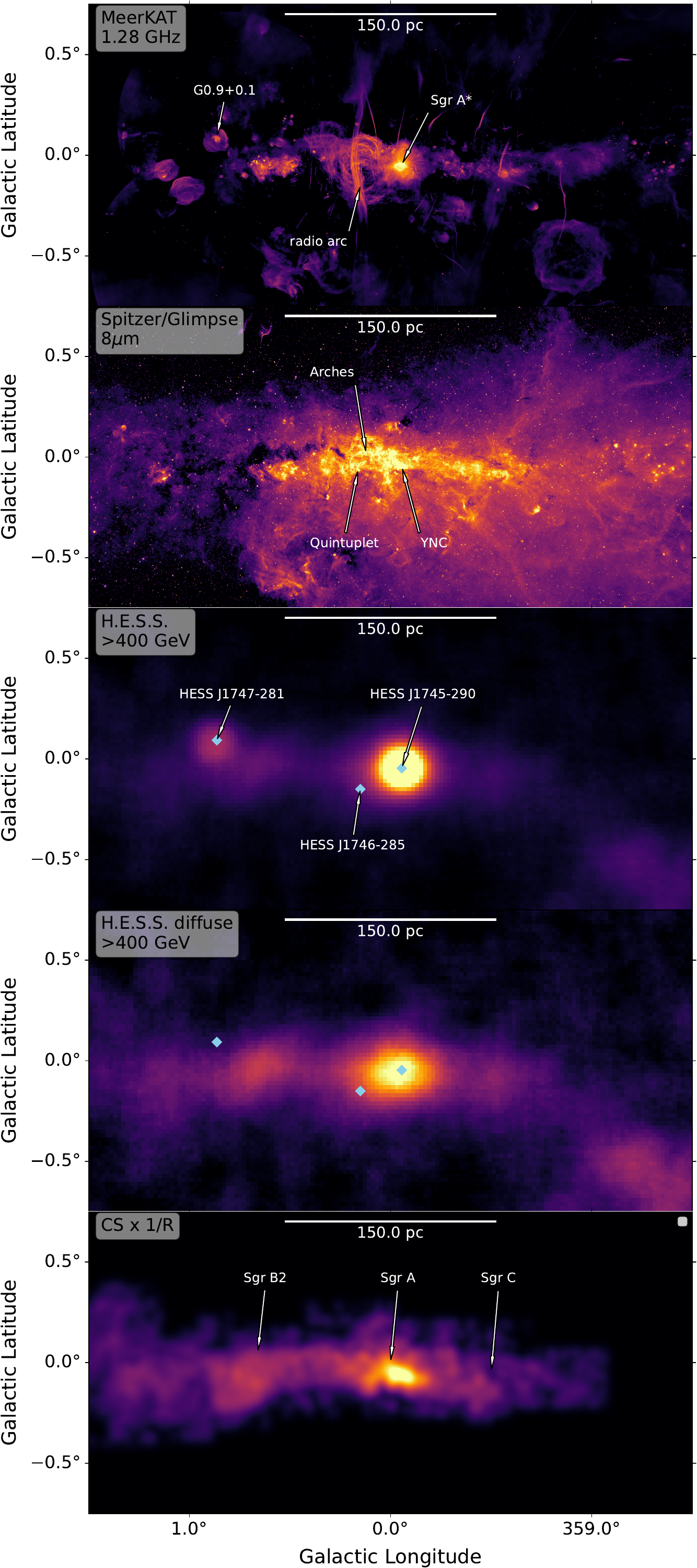
The Galactic Centre is one of the richest regions in the Milky Way, harboring a large variety of potential particle accelerators such as supernova remnants, pulsar wind nebulae and young massive stellar clusters (the Arches, the Quintuplet and the Young Nuclear Central clusters). The supermassive black hole Sgr A*, lying at the Galactic Centre, is surrounded by dense molecular complexes that shape the so-called Central Molecular Zone (CMZ). Very-high-energy (VHE) gamma-ray emission is seen by H.E.S.S. towards this region [1, 2, 3] that correlates with the gas content modulated by a non-uniform cosmic-ray distribution (called the Galactic Centre ridge, see Fig. 1). Previous studies confirmed an excess of cosmic rays towards the Galactic Centre and revealed a cosmic-ray density profile indicative of a continuous injection and homogeneous diffusion through the CMZ [2]. At that time, no evidence for a spectral curvature was reported and it was thought that the Galactic centre region could possibly harbor a source able to explain the Galactic cosmic-ray spectrum up to PeV energies, i.e. with a gamma-ray spectrum extending to ~100 TeV [2, 3].
Since then, indications of a possible spectral transition have emerged from MAGIC observations, although the evidence for a spectral cutoff remains statistically limited [7]. HAWC has also reported a detection of VHE emission from a source positionally consistent with part of the Galactic Centre ridge, extending to PeV energies, but characterized by a softer spectrum, indicating a change in the spectral behavior of the underlying particle population [8].
In this new analysis, we aim to obtain a clearer picture of the particle population in the CMZ, by combining a larger amount of data with advanced analysis techniques. The extraction of the Galactic Centre ridge spectrum is a difficult task because of the overlapping components in the region, such as the large-scale gamma-ray emission from the Galactic disk and the residual hadronic background that can affect significantly our measurement. With a new analysis method that simultaneously models (morphologically and spectrally) and therefore separates the different sources of gamma-ray emission [9], we revisited the gamma-ray emission from the Galactic Centre ridge in more details. Constraining the three-dimensional cosmic-ray distribution in the CMZ using gamma-ray data requires an accurate description of the underlying matter distribution. We therefore built a three-dimensional model of the CMZ gas distribution combining CS and CO observations [6, 10].
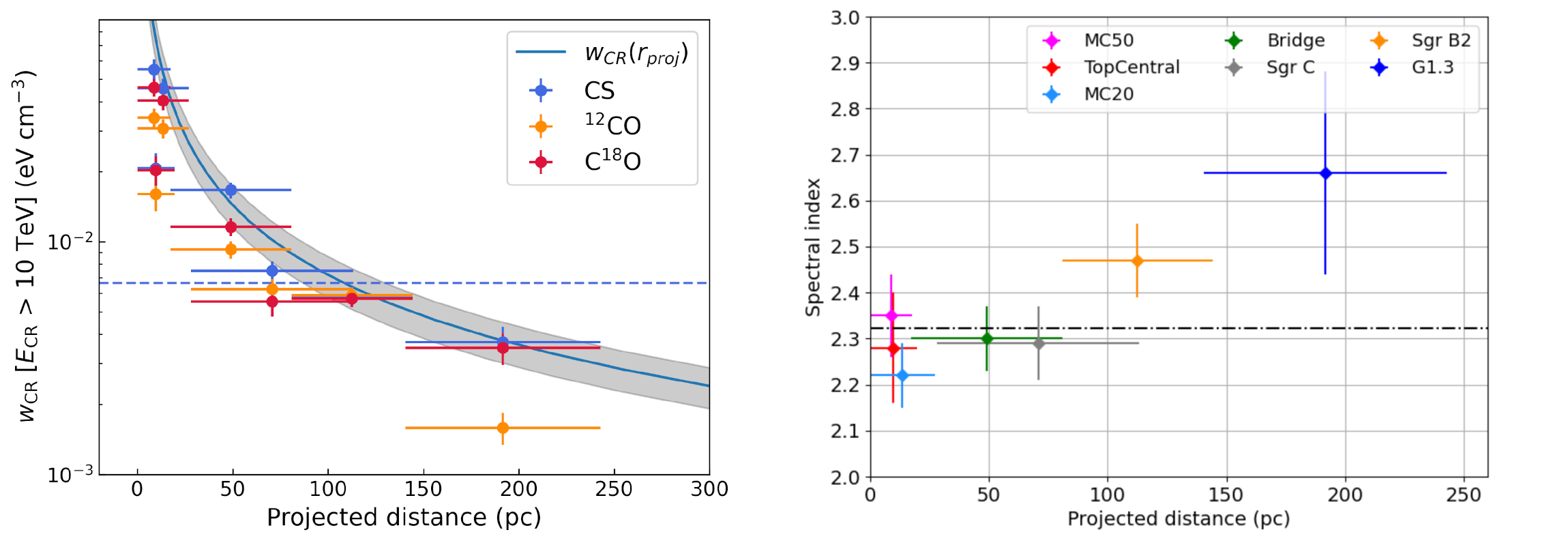
Our analysis confirms a continuous injection of particles near the Galactic Centre, with a cosmic-ray density profile decreasing as ∝ 1/ r with distance. No evidence for spectral variations across the CMZ is observed (see Fig 2).
This continuous injection scenario brings forward a fundamental question: what is the source powering this cosmic-ray population in the CMZ? It could arise from the accretion outflow in the vicinity of the supermassive black hole Sgr A* or from the massive stellar clusters where evidence for continuous particle injection has been found in some cases, such as in Westerlund 1 or in the Cygnus Cocoon [11]. Alternatively, a series of supernova events could also mimic a continuous injection [12]. Interestingly the spatial distribution of the emission provides important constraints on the origin of the particle injection.
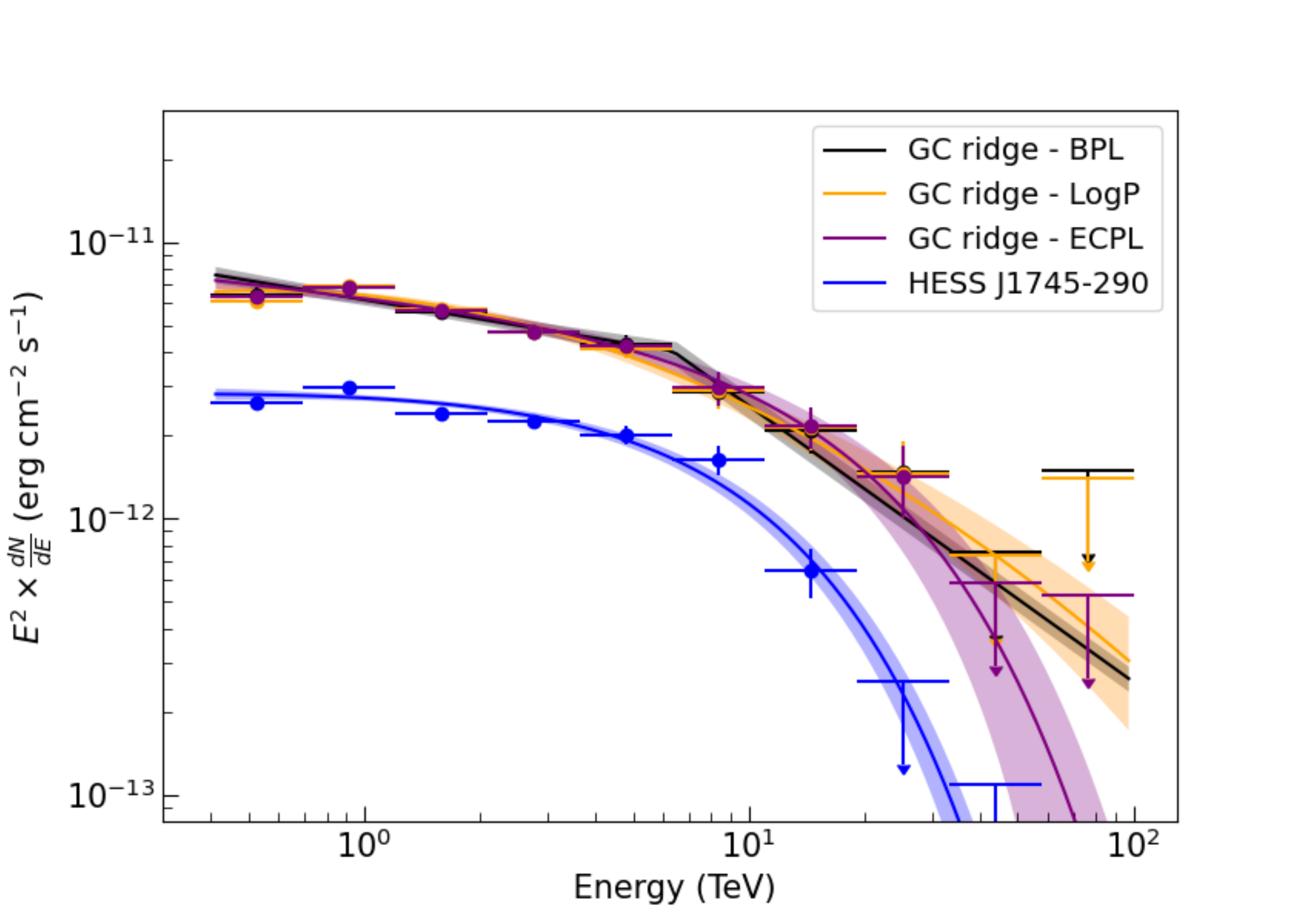
Our analysis allowed us, for the first time, to constrain the origin of the emission to be located close to the Galactic Centre, ruling out a significant contribution of the Arches and Quintuplet clusters, leaving the Young Nuclear Central cluster as the only remaining massive stellar cluster candidate for the origin of the emission. Additionally we found evidence for a spectral curvature (> 3σ) in the Galactic Centre ridge spectrum (Fig 3), which indicates that the maximal energy reached by the bulk of protons is limited to hundreds of TeV and do not reach PeV energies. Although quite unlikely, it is still possible that the detected curvature arises from propagation effects and more data and improved modeling will give better insight onto the acceleration process and its origin in the most complex region of the Galaxy.
References
[1] H.E.S.S. Collaboration, Aharonian et al. (2006), Nature 439, 695-698, “Discovery of very-high-energy γ-rays from the Galactic Centre ridge”.
[2] H.E.S.S. Collaboration, Abramowski et al. (2016), Nature 531, 476-479, “Acceleration of petaelectronvolt protons in the Galactic Centre”.
[3] H.E.S.S. Collaboration, Abdalla et al. (2018), A&A 612, A9, “Characterising the VHE diffuse emission in the central 200 parsecs of our Galaxy with H.E.S.S.”
[4] Heywood at al. (2022), The Astrophysical Journal 925, 2, “The 1.28 GHz MeerKAT Galactic Center Mosaic”.
[5] Churchwell et al. (2009), Publications of the Astronomical Society of the Pacific, Volume 121, Issue 877, pp. 213, “The Spitzer/GLIMPSE Surveys: A New View of the Milky Way”.
[6] Tsuboi, M., Handa, T., & Ukita, N. (1999), ApJS, 120, 1, “Dense Molecular Clouds in the Galactic Center Region. I. Observations and Data”.
[7] MAGIC Collaboration, Acciari et al. (2020), A&A, 642, A190, “MAGIC observations of the diffuse γ-ray emission in the vicinity of the Galactic center”.
[8] HAWC Collaboration, Albert et al. (2024), The Astrophysical Journal Letters 973, 1, “Observation of the Galactic Center PeVatron Beyond 100 TeV with HAWC”.
[9] A. Donath et al. (2023), A&A 678, A157, “Gammapy: A Python package for gamma-ray astronomy”.
[10] Sawada et al. (2004), MNRAS, 349, 1167, “A molecular face-on view of the Galactic Centre region”.
[11] Aharonian, F., Yang, R., & de Oña Wilhelmi, E. (2019), Nature Astronomy, 3, 561, “Massive stars as major factories of Galactic cosmic rays”.
[12] Jouvin, L., Lemière, A., & Terrier, R. (2020), A&A, 644, A113, “Time-dependent escape of cosmic rays from supernova remnants potentially at the origin of the very-high-energy cosmic-ray gradient of the Galactic center”.