March 2026
A pulsar is a highly magnetised, rapidly-rotating neutron star resulting from the collapse of the progenitor star’s compact core during a supernova explosion. This strong magnetic field then induces an electric field strong enough to strip particles from the stellar surface and accelerate them along the magnetic field lines. This in turn forms a high-energy relativistic electron-positron wind. When this energetic wind interacts with the surrounding medium, it creates an extended gamma-ray emitting region known as pulsar wind nebula (PWN), a dominant source of TeV gamma-rays [1].
The Vela Junior supernova remnant (SNR) was first discovered in X-rays [2] and subsequently detected at TeV energies by H.E.S.S. [3]. Since then, numerous studies have been dedicated to understanding this SNR at TeV energies ([4],[5], SoM 06/2017). Vela Junior is one of only a few SNRs whose shell morphology has been resolved in gamma rays. All of these studies focus on the Vela Junior SNR, however, there is an energetic pulsar at the edge of Vela Junior denoted PSR J0855-4644. The pulsar is unlikely to be physically connected to Vela Junior and therefore not thought to have originated in the same supernova event [6]. Pulsars are among the most efficient particle accelerators in our Galaxy, making the study of this region of interest. PSR J0855-4644 has remarkable X-ray and radio features, revealing a PWN structure along with a bow shock nebula. It lies in a complex environment spatially coincident with the SNR shock, offering a unique opportunity to study the evolution of the PWN and particle acceleration physics.
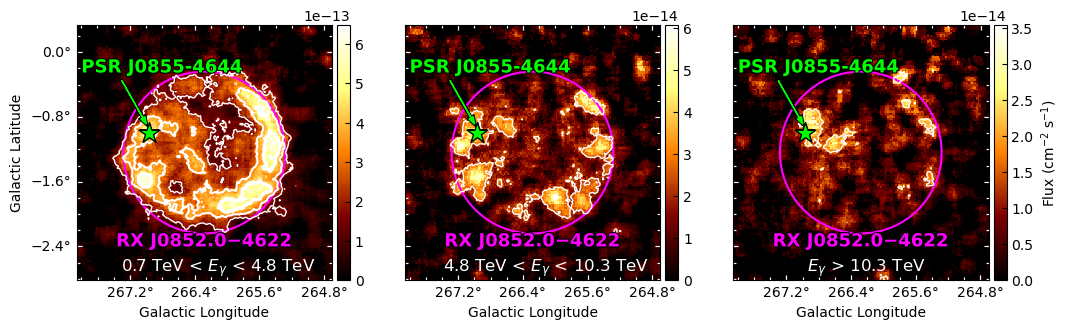
During a search for ∼50 TeV hotspots aimed at identifying candidate PeVatron accelerators, we detected a prominent excess within the Vela Junior SNR. This high-energy emission hints at a hidden particle accelerator embedded in the SNR. A closer look at the H.E.S.S. data reveals that this emission is not uniform across energies, but instead shows clear signs of energy-dependent morphology (Fig. 1). The northwest rim of the Vela Junior shell is a very bright feature at lower energies (Egamma<5TeV). Above 10 TeV, the significant emission becomes more compact and shifts towards the position of PSR J0855−4644. This behaviour is evidence for particle propagation within the nebula and supports its identification as the nebula’s progenitor, motivating a deeper investigation of the region using new analysis techniques.
The close spatial overlap with the SNR shell and a potential PWN made it difficult to disentangle their respective contributions using traditional analysis methods. However, recent advances in the analysis techniques have fundamentally changed this picture, enabled by the use of 3D analysis techniques with the open-source analysis tool Gammapy [7, 8].
By studying this region at gamma-ray energies with the H.E.S.S. telescopes and utilising a 3D analysis of the data, we discovered a TeV gamma-ray counterpart of the PWN of PSR J0855-4644. This important result has been made possible thanks to the deep observations (~130 hours) combined with advanced 3D analysis and modelling technique, allowing the emission in the Vela Junior region to be resolved into distinct components. We find 6 individual components within the field of view labeled alphabetically from “A” to “F”, shown in Fig. 2. Using a detailed frequentist statistical analysis, we test whether the spectral properties of these components are consistent with a common origin.
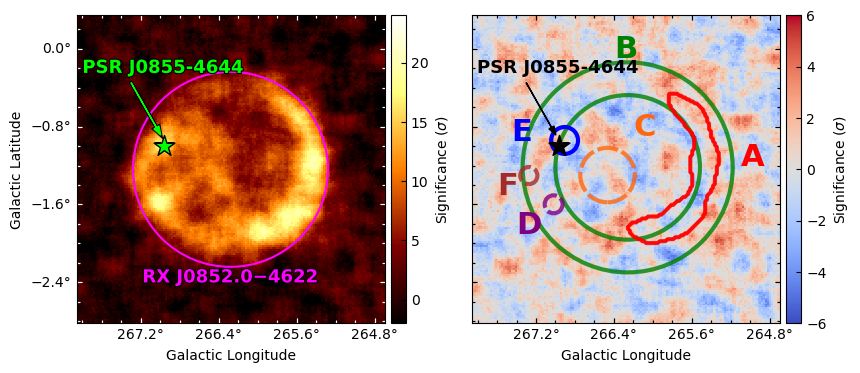
The results show that the emission from components A, B, C, D, and F is well described by a shared spectral model associated with the SNR shell. Component E, on the other hand, is significantly different from the others (6σ). We also tested for a cut-off in component E , but found no significant evidence for one (<1σ). This extended emission of component E (σE = 0.14° ± 0.02°stat) is detected at a significance of 12.2σ. The PWN of PSR J0855-4644 can be clearly separated from the shell of Vela Junior at TeV energies, and is preferred as a pure power law spectral model with ГE=1.78 ± 0.08 (Fig. 3).
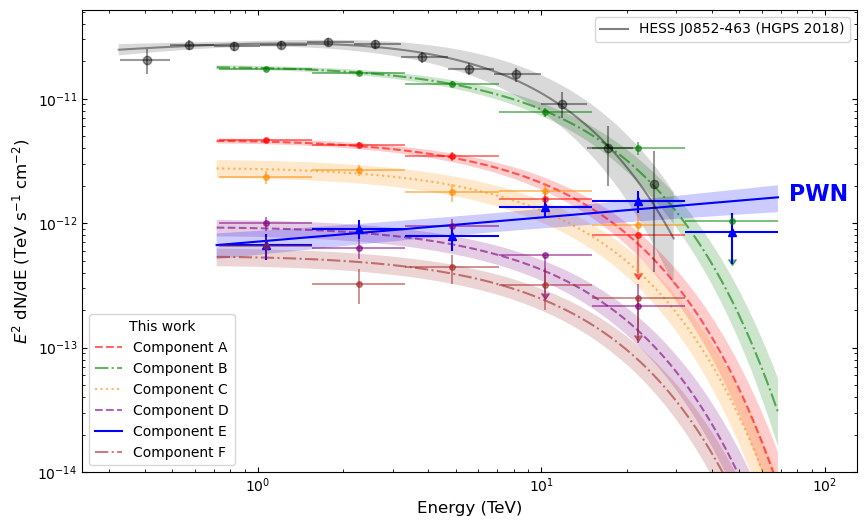
Component E spatially overlaps with PSR J0855−4644 (see Fig.2), suggesting a potential physical association. This interpretation is supported by the detection of a PWN at X-ray wavelengths with XMM-Newton [6] and a radio nebula [9], both at the same location as component E. The spectral index of component E is hard (ΓE ∼ 1.8), which is consistent with expectations from the inverse-Compton (IC) emission from an energetic PWN. A joint multi-wavelength fit is performed across both the X-ray and gamma-ray wavelengths utilising Naima and XSPEC in the Gammapy framework. This is a full forward modelling technique (not flux point fitting). This one leptonic joint fit leads to a lower limit on the magnetic field of 1.6µG and a spectral index of α = 1.88 ± 0.01 (Fig 4). This is in line with expectations of PWN, as they are expected to exhibit a hard spectral index (i.e. see [10, 11]).
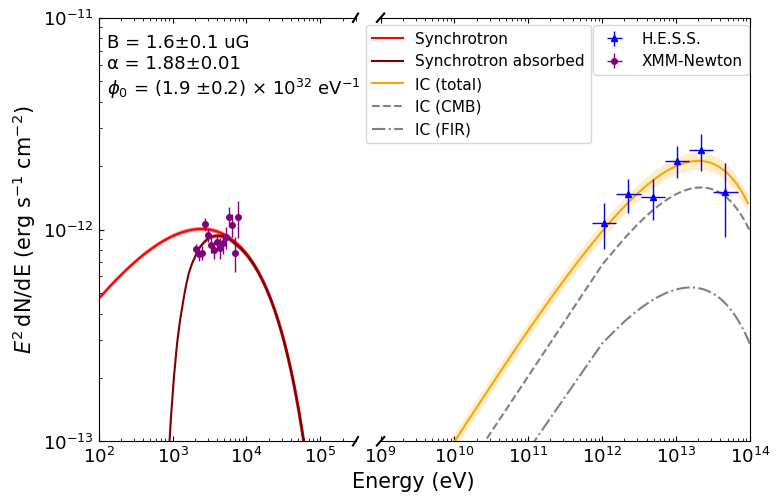
For the first time, we are able to disentangle the emission from the PWN from the supernova remnant emission due, in part, to its significantly different gamma-ray spectrum. Given the observed characteristics, spectral properties, and the spatial alignment with the X-ray PWN, the most plausible interpretation is that this component is a PWN. Comparing the spin-down power (Ė = 1.1 × 1036 erg s−1) to the luminosity of component E (L1-10 TeV = 3.9 × 1032 (d/kpc)2 erg s−1) at the distance to the pulsar (900 pc), we find a TeV conversion efficiency of the PWN of 0.03%. This supports this scenario from an energetics point of view. Given the gamma-ray characteristics and the properties of the PSR powering this PWN, this object is in line with our current understanding of the VHE PWN, as exemplified in [12].
The results of our new study will be published shortly in the journal Astronomy & Astrophysics [13].
References
[1] H.E.S.S. Collaboration, H. Abdalla et al. (2018), A&A, 612, A1
[2] B. Aschenbach (1998), Nature 396, 141, “Discovery of a young nearby supernova remnant”
[3] H.E.S.S. Collaboration, F. Aharonian et al. (2005), A&A 437, L7–L10, “Detection of TeV γ-ray emission from the shell-type supernova remnant RX J0852.0-4622 with HESS”
[4] H.E.S.S. Collaboration, F. Aharonian et al. (2007), The Astrophysical Journal 661, 236, “H.E.S.S. Observations of the Supernova Remnant RX J0852.0-4622: Shell-Type Morphology and Spectrum of a Widely Extended Very High Energy Gamma-Ray Source”
[5] H.E.S.S. Collaboration, H. Abdalla et al., (2018), A&A, 612, A7, “Deeper H.E.S.S. Observations of Vela Junior (RX J0852.0-4622): Morphology Studies and Resolved Spectroscopy”
[6] F. Acero et al. (2013), A&A, 551, A7, “A new nearby pulsar wind nebula overlapping the RX J0852.0-4622 supernova remnant”
[7] A. Donath et al. (2023),A&A 678, A157, “Gammapy: A Python package for gamma-ray astronomy”
[8] F. Acero et al. (2025), gammapy v1.3 Zenodo
[9] C. Maitra et al. (2018), MNRAS, 477, L66, “Discovery of a radio nebula around PSR J0855−4644”
[10] de Jager et al. (2008), ApJ, 689, L125, “Probing the Radio to X-Ray Connection of the Vela X Pulsar Wind Nebula with Fermi LAT and H.E.S.S.”
[11] Olmi et al. (2023), PASA, 40, e007, “The Dawes Review 11: From young to old: The evolutionary path of Pulsar Wind Nebulae”
[12] H.E.S.S. Collaboration, H. Abdalla et al., (2018), A&A, 612, A2, “The population of TeV pulsar wind nebulae in the H.E.S.S. Galactic Plane Survey”
[13] H.E.S.S. Collaboration, F. Aharonian et al., (2026), A&A accepted, “H.E.S.S. detection of the PSR J0855−4644 nebula”