Gamma-ray bursts (GRBs) are the most powerful explosions in the universe, releasing more energy in seconds than our Sun will in its entire lifetime. Since their discovery, understanding the processes that drive these immense events has been a core pursuit of astrophysics. The H.E.S.S. collaboration has just published a comprehensive catalogue of observations of GRBs and their implications to previous scientific contributions to the field of GRBs [1]. This paper, which is the topic of this edition of the Source of the Month, synthesises over a decade of GRB observations with H.E.S.S., providing a definitive statement on the capabilities, discoveries, and future potential of very-high-energy (VHE; >100 GeV) gamma-ray observations of these immense cosmic explosions.
Introduction: The Gamma-Ray Burst Puzzle
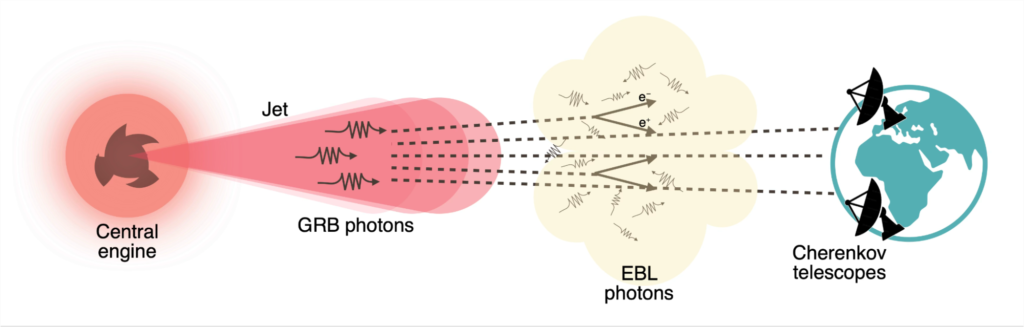
GRBs are thought to originate from the collapse of massive stars or the merger of neutron stars. They consist of a brief prompt emission phase, followed by a longer “afterglow” phase with emission across the entire electromagnetic spectrum [2]. Understanding the underlying physical mechanisms has been a primary goal of astrophysics, and observations in the VHE band have always been considered a crucial, yet challenging, piece of the puzzle. Ground-based Cherenkov telescope arrays, like H.E.S.S., need to respond to an initial satellite trigger within seconds. Furthermore, they are affected by factors such as the fast decay of the gamma-ray flux and the typically large distance (redshift) of the GRB, which leads to absorption of the emitted photos by the extragalactic background light (EBL) (see Figure 1).
Overcoming the Odds: The Long Road to Detection
In the new H.E.S.S. publication, we detail the persistent effort to detect GRBs at very-high energies and place these observations within a broader population and modelling context. The observations presented were carried out from the beginning of H.E.S.S. operations and span a 15-year period. Over this interval, H.E.S.S. conducted follow-up observations on 107 GRBs, representing the largest and most comprehensive VHE dataset of these events ever released. While these specific observations did not yield new detections, the upper limits derived from the dataset are instrumental in constructing a coherent framework for interpreting VHE GRB emission.
Before, during, and after the efforts of this H.E.S.S. GRB publication, a series of breakthroughs occurred with the detection of GRB 180720B and, later, the remarkable GRB 190829A. In those years, these detections, alongside results from MAGIC, provided the first direct insight into the VHE spectrum of GRBs [3]. Combined with lower-energy data, these observations have allowed astrophysicists to constrain emission models and provide strong evidence for mechanisms such as synchrotron self-Compton (SSC) scattering operating in the GRB’s jets. In this mechanism, gamma rays are produced through up-scattering of low-energy photons by high-energy electrons, where the low-energy photons are synchrotron radiation emitted by the electrons themselves in the ambient magnetic field.
A Population-Level View
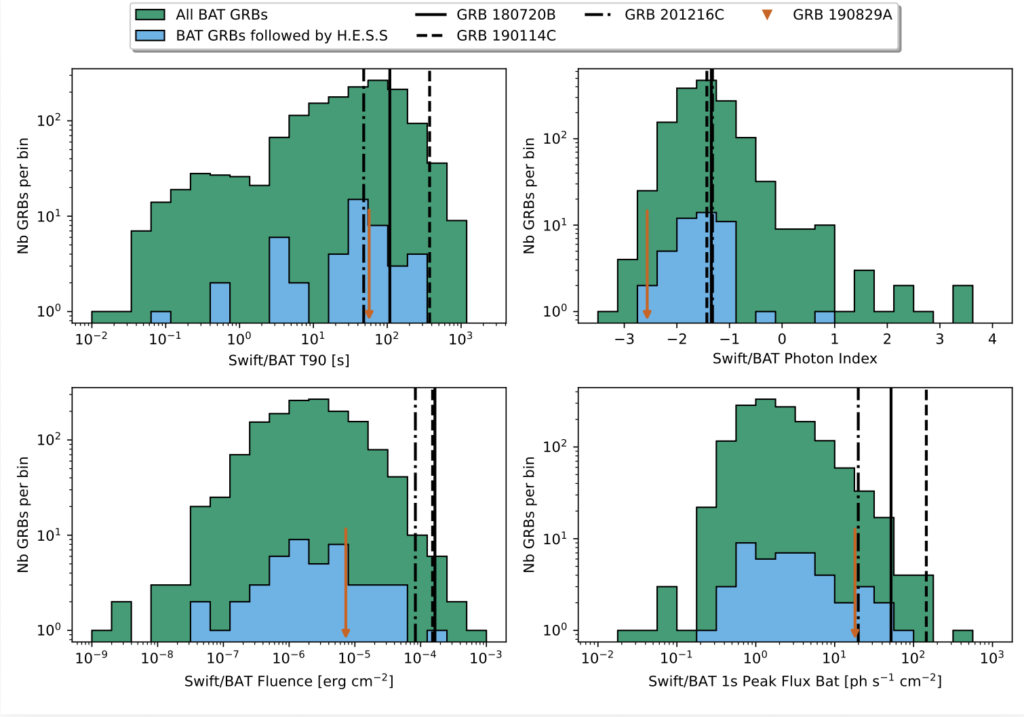
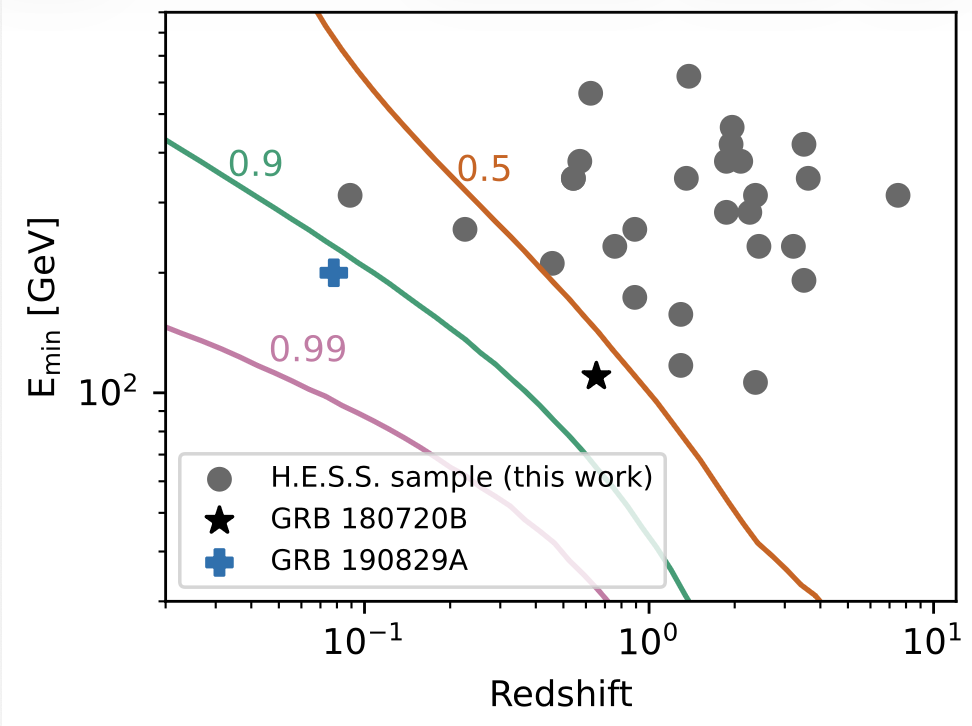
A cornerstone of this publication is its population-level analysis, which goes beyond individual detections to understand VHE-detected and non-detected GRBs as a class. H.E.S.S. observations were systematically compared to the broader population of GRBs, using data from the Fermi and Swift satellites. Figure 2 illustrates some of these GRB populations, compared statistically, in terms of parameters like X-ray flux, burst duration and spectral features. We have solidly concluded that VHE-detected GRBs do not constitute a distinct class of GRBs compared to the non-detected GRBs observed by H.E.S.S. or the bulk of GRBs detected in X-rays. This offers a new perspective on why some GRBs are detectable and what limitations are in place. This extensive survey confirms that detecting these elusive flashes requires a burst of immense brightness, proximity to Earth, and/or a rapid response with a sensitive telescope. Figure 3, also part of this publication, illustrates the concept of “cosmic horizon”. It maps the energy threshold of the H.E.S.S. sample against redshift, demonstrating the physical boundary where the Extragalactic Background Light (EBL) absorbs the majority of VHE photons from distant sources.
A Theoretical-Level view
From the extensive H.E.S.S. dataset, a subset of three specific events, GRB 100621A, GRB 131030A, and GRB 161001A, was selected for detailed physical modelling. These bursts were identified as the most promising candidates for very-high-energy (VHE) detection due to their exceptionally high X-ray flux, relatively low redshift, and favourable observing conditions, such as short follow-up delays and low zenith angles. For instance, GRB 100621A featured the brightest X-ray afterglow ever detected by the Swift/XRT at the time of its discovery. We applied a single-zone SSC model to these bursts [4], testing both constant-density and wind-like environments, to determine if the VHE non-detections could constrain the underlying physics (see Figure 4). The modelling demonstrated that the H.E.S.S. upper limits remain entirely consistent with the predicted SSC flux, showing no tension with standard relativistic forward-shock scenarios.
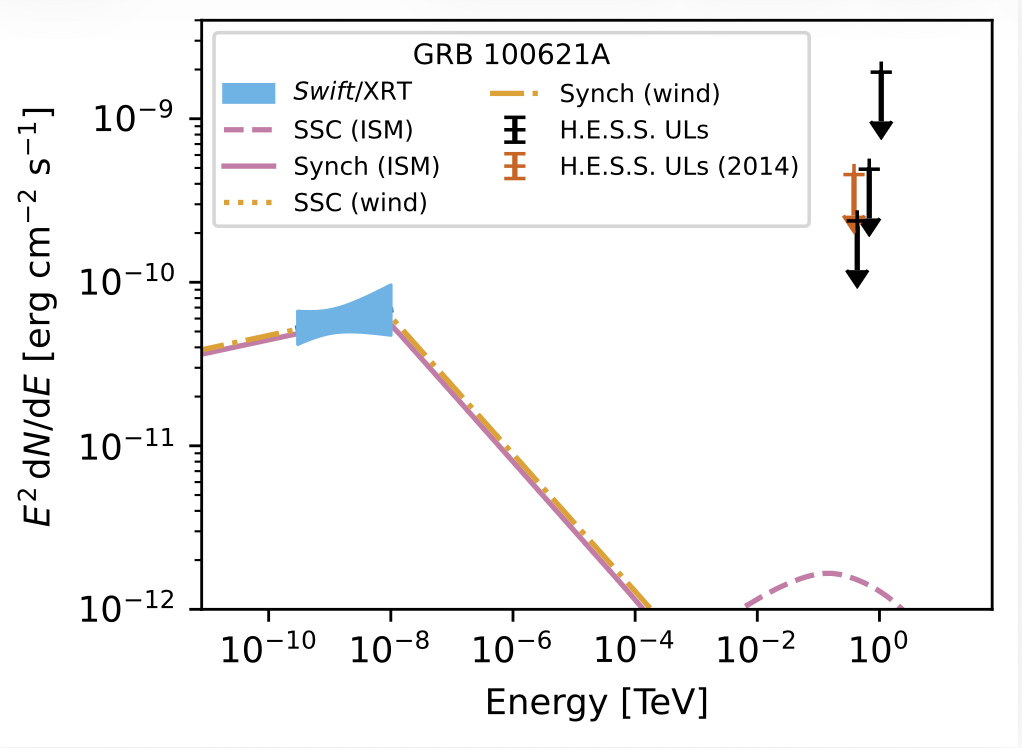
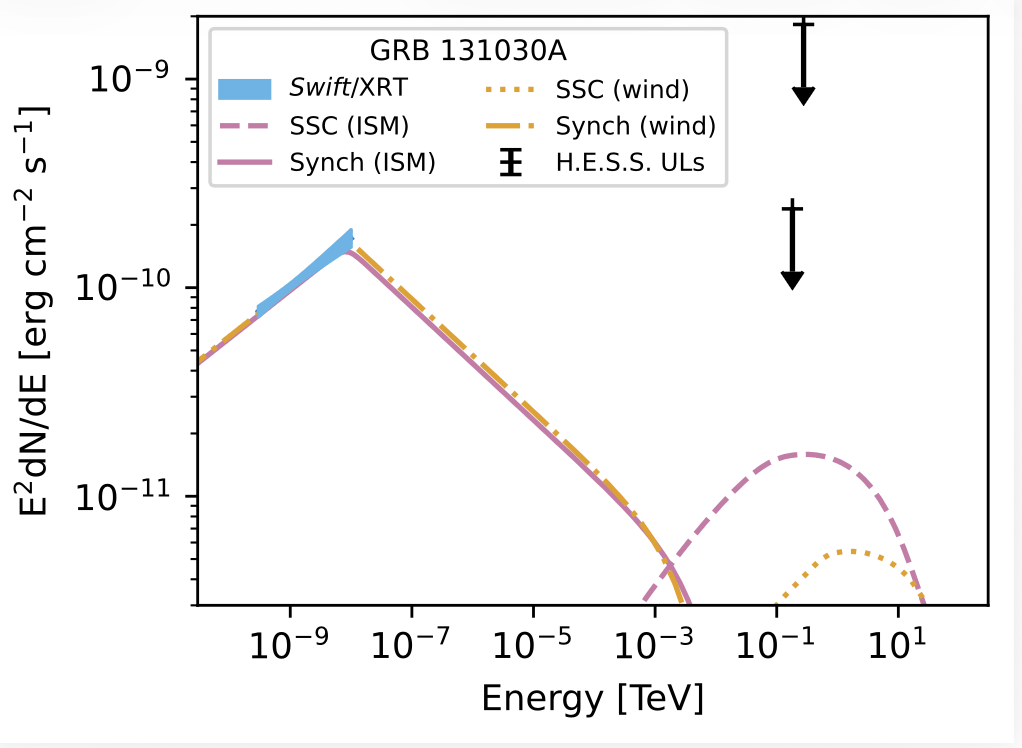
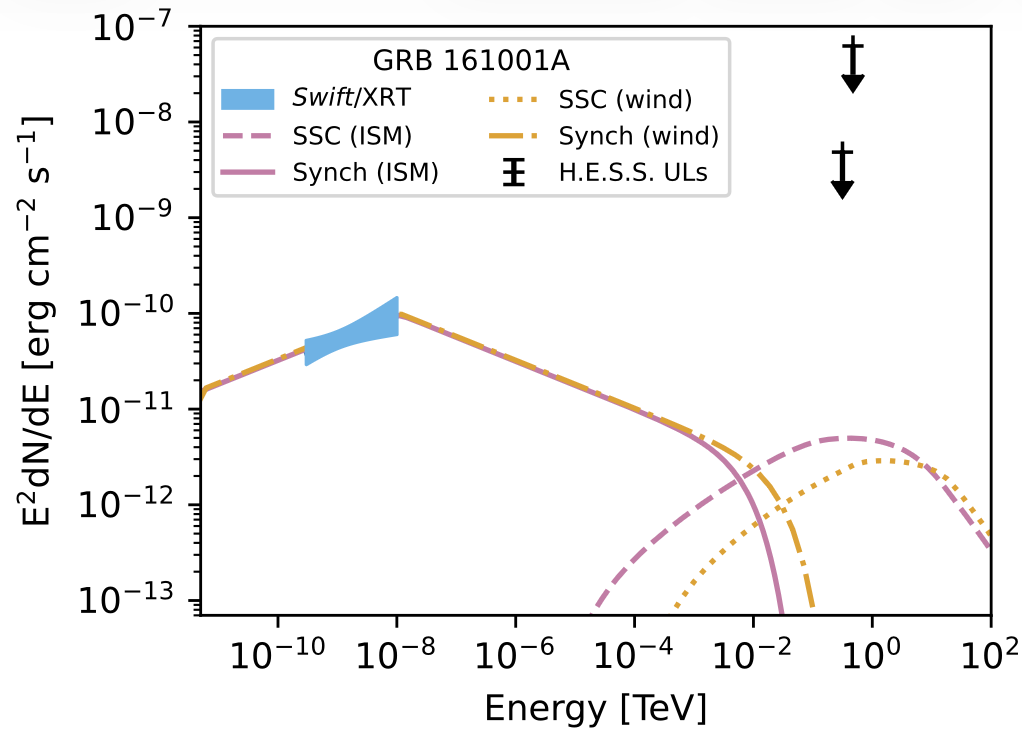
Fig. 4: The broadband spectral energy distributions (SEDs) for three of the most promising GRBs in the H.E.S.S. sample: GRB 100621A (left), GRB 131030A (centre), and GRB 161001A (right). Each panel shows the X-ray afterglow detected by Swift/XRT (blue butterflies) with the VHE upper limits established by H.E.S.S. (black data points). The overlaid curves represent theoretical models for two distinct environments: a constant-density interstellar medium (pink) and a stellar wind profile (yellow). By comparing the predicted “Synchrotron Self-Compton” component (dashed lines) against our observational limits, these plots demonstrate that while these bursts were exceptionally powerful, their highest-energy radiation remained just beyond the reach of current telescope sensitivity.
Scientific Impact and Legacy
Detections have confirmed that particle acceleration to extreme energies is possible in these events, and that the resulting VHE radiation can last for hours or days. The upper limits, now contextualised on a population scale and modelling of three specific events, are showing that VHE emission can be a common feature, only obscured by limitations: detecting these elusive flashes requires a burst of immense brightness, proximity to Earth, and/or a rapid response with sensitive telescopes. The paper concludes by looking towards the future. The lessons learned and techniques developed with H.E.S.S. will be vital for the Cherenkov Telescope Array Observatory (CTAO) [5], which is expected to detect GRBs with greater frequency and sensitivity, probing them to even higher energies and greater distances.
References
[1] A. Acharyya et al. (H.E.S.S. Collaboration), 2026, “The second H.E.S.S. gamma-ray burst catalogue: 15 years of observations with the H.E.S.S. telescopes”, Astronomy & Astrophysics 707, A382.
[2] P. Mészáros, 2006, “Gamma-ray bursts”, Reports on Progress in Physics, 69, 2259
[3] VHE-Detected GRBs (Consolidated References)
- H.E.S.S. (GRB 180720B): Abdalla, H., et al. 2019, “A very-high-energy component deep in the γ-ray burst afterglow”, Nature, 575, 464.
- H.E.S.S. (GRB 190829A): Abdalla, H., et al. 2021, “Revealing x-ray and gamma ray temporal and spectral similarities in the GRB 190829A afterglow”, Science, 372, 1081.
- MAGIC (GRB 190114C): Acciari, V. A., et al. 2019, “Teraelectronvolt emission from the gamma-ray burst GRB 190114C”, Nature, 575, 455.
- MAGIC (GRB 201216C): Acciari, V. A., et al. 2021, “MAGIC detection of GRB 201216C at z=1.1”, GCN Circular, 29075.
- LHAASO (GRB 221009A): Cao, Z., et al. 2023, “A tera–electron volt afterglow from a narrow jet in an extremely bright gamma-ray burst”, Science, 380, 1390.
[4] Huang, Z., et al. 2022, “The Implications of TeV-detected GRB Afterglows for Acceleration at Relativistic Shocks”, Astrophysical Journal, 925, 182.
[5] Cherenkov Telescope Array Observatory (CTAO), 2026, “Explore the Science”, https://www.ctao.org/science/.