December 2025
For decades, we have sought to understand the origin of the most energetic particles in the Universe: cosmic rays. The energy range of cosmic rays arriving to Earth span more than ten orders of magnitude, reaching energies far beyond what human-made accelerators can achieve. At the most extreme energies (>one million TeV), the energy of the particles is such that they cannot be contained within the size of the Galaxy. Thus, when we detect them at Earth, we can be confident that they do not originate within the Milky Way, but rather other, distant galaxies.
However, below those highest energies, the bulk of cosmic rays that we detect at Earth must be produced somewhere inside our Galaxy. For decades it was thought that supernova remnants (SNRs) could explain the whole range of Galactic cosmic rays. However gamma-ray observations of SNRs already in the early days of H.E.S.S. (SOM 2005/01 and 2005/02) revealed that their gamma-ray spectra stops at energies too low to explain the entire range of Galactic cosmic rays. The search for a new type of sources which could fill the gap left open by SNRs is now ongoing. In order to explain the most energetic Galactic cosmic rays (>1000 TeV), one needs to identify sources which not only do not taper off before reaching gamma-ray energies of 100 TeV, but reach much further beyond.
A possible candidate are powerful stellar clusters (see e.g. SOM 2022/08, [1]). Another one are so-called microquasars: compact objects which orbit a companion star and take matter from it. As a result of this transfer of matter, very fast outflows (jets) are frequently launched. These jets have long been proposed to be able to accelerate particles to very high energies.
Enter V4641 Sagittarii (or V4641 Sgr for short). It is a microquasar located in the Sagittarius constellation which, until recently appeared to be fairly unremarkable. It was discovered in 1999 when it underwent a bright outburst (as microquasars often do), but had been relatively quiet since. It hosts a black hole seven times heavier than our Sun, which is orbiting a star of around half that mass. Very high resolution radio observations of the system during the 1999 outburst revealed a compact radio source, which was interpreted as a jet which is almost pointed directly towards us.
Despite its unremarkable nature at other wavelengths, V4641 Sgr appears extraordinarily strange in the gamma-ray band. The HAWC collaboration reported the detection of extended and elongated emission around V4641 Sgr, which contradicts what one would expect from a jet so closely aligned with our line of sight. The LHAASO collaboration was able to detect photons from it which extended to energies of 800 TeV, which requires particle energies of >1000 TeV: could it be that it is the missing puzzle piece to explain Galactic cosmic rays?
The H.E.S.S. telescopes observed the V4641 Sgr region for around 100 hours as part of three successive campaigns in 2022, 2023 and 2024. The results of the analysis of this data were recently published in the journal Astronomy & Astrophysics [2]. The H.E.S.S. observations reveal a large, elongated structure around the microquasar position, confirming the picture from previous observations. Figure 1 shows the H.E.S.S. significance map of the region.
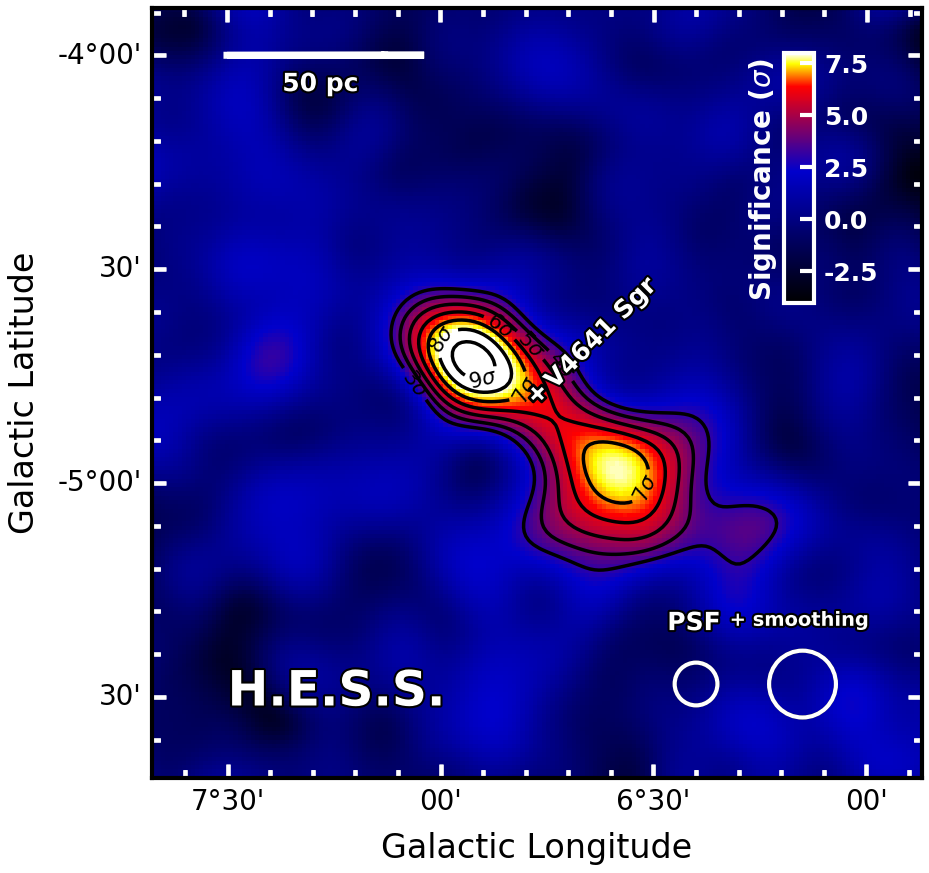
Detailed spectro-morphological modelling reveals that the emission is spatially extended in both the narrow and wide directions. A model with two spatial components is slightly (3σ) preferred by the data, but cannot be firmly established as preferred, since the emission is also consistent with a single, more elongated region. Regardless of the model used to describe the shape of the emission, the spectral properties of it are always consistent and do not depend on the spatial properties. In particular, H.E.S.S. measured a photon spectral index of 1.8 across the entire emission region, which deviates from the average for Galactic sources (2.0-2.2) and indicates that V4641 Sgr produces more very-high-energy particles than the average source.
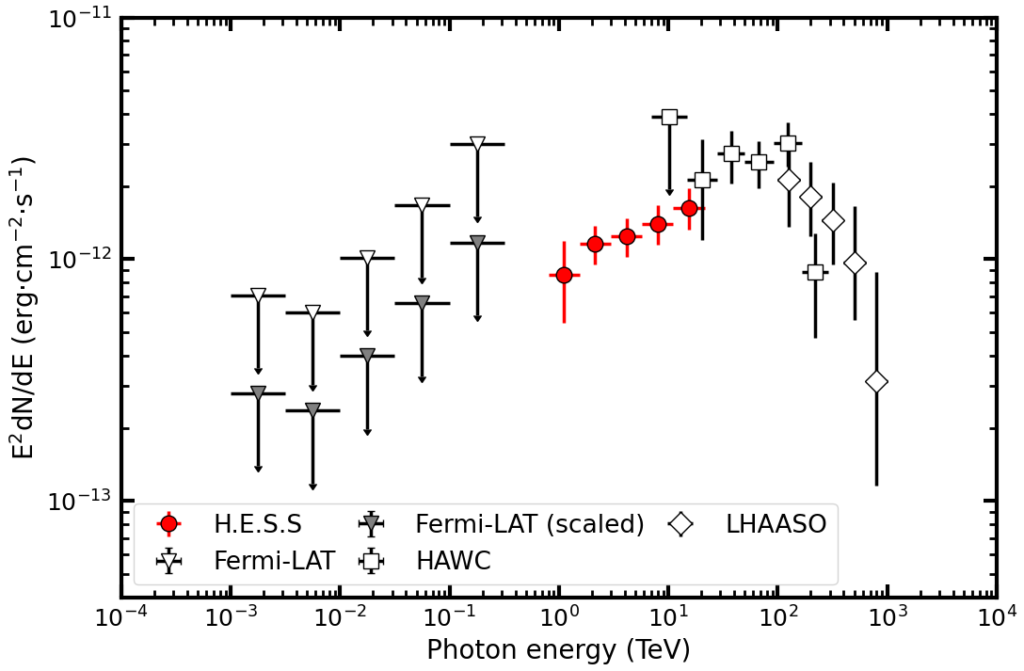
When putting together this measurement with those in other ranges of the gamma-ray band, something remarkable is revealed. As can be seen in the broad-band spectrum shown in Figure 2, the H.E.S.S., HAWC and LHAASO data reveal, for the first time, a source spectrum which peaks at ~100 TeV. The output of the source not only reaches extreme energies, but is actually concentrated on them. This makes V4641 Sgr a truly special gamma-ray source, despite not looking the part in other wavelengths.
To explain the strange morphology of the emission, we considered two opposite scenarios: one where the jet is indeed almost pointed towards us, and the morphology is unrelated to the jets, and one where there is actually a previously unknown outflow with the same orientation as the gamma-ray emission (close to perpendicular to our line of sight). Using arguments about the required energy and the properties of the environment, we conclude that the scenario with an unknown outflow is actually the most likely – although new radio and x-ray observations are required to settle the question firmly.
Taken together, these and other gamma-ray observations indicate that systems like V4641 Sgr are capable of accelerating particles to energies high enough to “close the gap” in our understanding of the origin of Galactic cosmic rays. Of course, a single source would not be powerful enough on its own but, if such an “unremarkable” source turned out to be so special, what else could be hiding out there?
References
[1] H.E.S.S. Collaboration A&A 666, A124 (2022) “A deep spectromorphological study of the γ-ray emission surrounding the young massive stellar cluster Westerlund 1”
[2] H.E.S.S. Collaboration, A&A forthcoming, DOI 10.1051/0004-6361/202557532 “Constraining the nature of the most extreme Galactic particle accelerator. H.E.S.S. observations of the microquasar V4641 Sgr”
[3] HAWC Collaboration Nature 634 (2024) 557-560 “Ultra-High-Energy Gamma-Ray Bubble around Microquasar V4641 Sgr”
[4] LHAASO Collaboration National Science Review, nwaf496 “Ultrahigh-Energy Gamma-ray Emission Associated with Black Hole-Jet Systems”
[5] Zhao, Z. et al, ApJ, 984, 3 (2025) “Upper Limits on the Gamma-Ray Emission from the Microquasar V4641 Sgr”