
H.E.S.S. CollaborationH.E.S.S. Collaboration
  • Home
    • About H.E.S.S.
      • H.E.S.S. Science
      • H.E.S.S. Site
      • H.E.S.S. Telescopes
    • H.E.S.S. Collaboration
      • Organisation
    • H.E.S.S. Pictures
    • H.E.S.S. Prize
  • News
    • Announcements
    • Press releases
    • Blogs
  • Source of the Month
  • For scientists
    • Publications
      • Journals
      • Conferences
      • Astronomers Telegram
    • External Proposals
      • Visibility calculator
    • HESS GRB observations
      • Interactive Tool (Public)
      • Interactive Tool (Internal)
    • Public test data release
    • Telescope specifications
  • Contact
September 1, 2007 by H.E.S.S. Collaboration
Source of the Month

PKS 2155–304 – Photons from a Hotter Hell

PKS 2155–304 – Photons from a Hotter Hell
September 1, 2007 by H.E.S.S. Collaboration
Source of the Month

September 2007

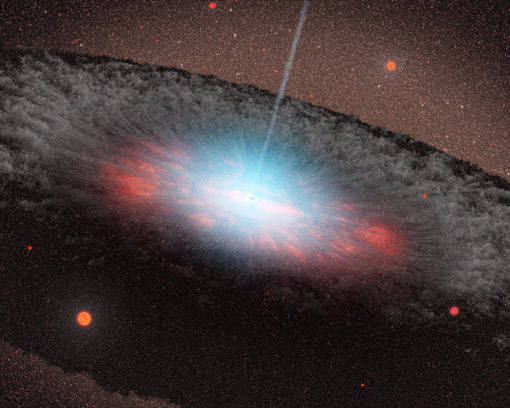
This artist’s concept depicts a supermassive black hole at the center of a galaxy. The active galaxy PKS 2155-304 hosts such a black hole of about 109 solar masses. The blue color represents radiation pouring out from material very close to the black hole. The grayish structure surrounding the black hole, called a torus, is made up of gas and dust. Beyond the torus, only the old red-colored stars that make up the galaxy can be seen. A jet of energetic particles is launched in the vicinity of the black hole. For blazars such as PKS 2155-304, the jet is pointed towards our Galaxy and is the source of the high-energy gamma rays. Based on NASA/JPL-Caltech.

“Photons from a hotter hell” is the title of T. Weekes recent commentary in Nature, concerning the recent detection of giant outbursts of active galaxies observed in high-energy gamma rays. At the core of an active galaxy, a supermassive black hole is accreting matter, frequently launching a jet of high energy particles (top figure), which are the source of the observed gamma rays. The detailed mechanisms which generate the jet and also the nature of the particles which make up the jet are not fully understood. Fluctuations in the lauching of the jet, or within the jet cause sources to flare. A most impressive outburst of the Southern active galaxy PKS 2155-304 was recently reported by H.E.S.S. (Aharonian et al., 2007). PKS 2155-304 was one of the first objects covered in SOM 2004/11, but these recent data merit a second report. Within about 90 minutes of observations, close to 12,000 gamma rays were detected, corresponding to a rate of more than 2 Hz. The measured light curve is shown in Fig. 1 in one-minute bins; it displays at least five distinct sub-flares. The peak flux reaches up to 15 times the flux of the Crab Nebula, and is almost a factor 100 higher than the minimal (“quiescent”)  flux from PKS 2155-304. Given that this active galaxy is more than 200,000 times more distant than the Crab Nebula – about 450 Mpc compared to 2 kpc – this implies an energy output in high-energy gamma rays which is about 12 orders of magnitude higher than for the Crab Nebula, whereas the emission region, governed by the scale of the black hole, is several orders of magnitude smaller than the size of the Crab Nebula. The fast rise times of the flares, in the range of 100 s, are among the fastest ever observed from such objects. This is puzzling since it is only about 1% of light-crossing time of the black hole, usually assumed to be the shortest time scale on which the jet can flare. Relativistic boosting can shorten time variation as viewed by an observer at rest, but to achieve a speed-up of a factor 100, the jet would have to move with an unprecedented Doppler factor around 100, or 99.995% of the speed of light.
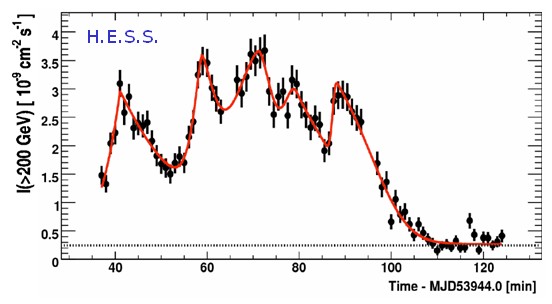
Fig. 1: Integral flux above 200 GeV observed from PKS 2155-304 on July 28, 2006. The data are binned in 1 minute intervals. The horizontal dotted line represents the flux from the Crab Nebula.

A frequency decomposition of the light curve was made to find out which frequency components are most strongly represented in the flux variation (Fig. 2), with the surprising result that the signal somewhat resembles “red noise”: all frequencies are present, with increasing intensity towards lower frequency. This result questions the assumption that the rise times of the individual sub-flares represent a single characteristic time scale which can a associated with a corresponding length scale of the emission region. Possibly, the emission region has a fractal nature where emission from features of many different scales is superimposed, with decreasing intensity from smaller-scale features, which cause the higher-frequency components.
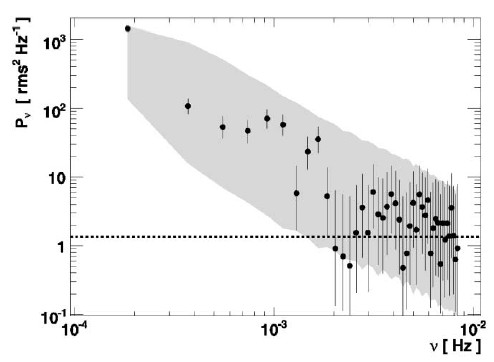
Fig. 2: Fourier power spectrum of the light curve, indicating at which frequencies the emission is varying. The gray-shaded area corresponds to the estimated 90% confidence interval. The horizontal line indicates the average noise level.

References

An Exceptional Very High Energy Gamma-Ray Flare of PKS 2155-304, Aharonian et al., Astrophys. Journal, 664 (2007) L71

Blazar Extragalactic

Previous articleConfirming MGRO 1908+06Next article Gamma Rays from the Distant BL Lac 1ES 0347-121

Source of the month

Each month a TeV gamma-ray source investigated with the H.E.S.S. telescopes is featured.

>> List of all sources

Latest sources

The flare that sweetened the lockdownOctober 1, 2026
A spectral steepening in the Galactic Centre ridge spectrumSeptember 1, 2026
Hunting dark matter in the Milky Way: constraints on spectral line features and the thermal HiggsinoAugust 1, 2026

Tags

Atmosphere (1) Axion-like particle (1) black holes (2) Blazar (7) Catalogue (1) Conference (1) Cosmic rays (1) Dark matter (3) Event (1) Extragalactic (10) Galactic Center (1) Galactic centre (1) galactic plane (8) galactic source (10) Gamma-ray binary (3) Gamma-ray burst (3) gamma-rays (4) IceCube (1) Meeting (2) microquasar (2) multi-messenger (1) neutrinos (4) nobelprize (1) Nova (1) publication (5) pulsar (1) pulsar wind nebula (5) Supernova remnant (3)

Contact

You can contact us for scientific queries and general information using:
contact.hess@hess-experiment.eu

Data Privacy Statement

https://www.mpi-hd.mpg.de/mpi/de/datenschutzhinweis
H.E.S.S. collaboration official website. Proudly Built By H.E.S.S. members.
(c) 2004-2026 by the H.E.S.S. collaboration.

Last sources of the month

The flare that sweetened the lockdownOctober 1, 2026
A spectral steepening in the Galactic Centre ridge spectrumSeptember 1, 2026
Hunting dark matter in the Milky Way: constraints on spectral line features and the thermal HiggsinoAugust 1, 2026

Internal

  • Log in
  • Entries feed
  • Comments feed
  • WordPress.org
H.E.S.S. Collaboration
Manage Consent
To provide the best experiences, we use technologies like cookies to store and/or access device information. Consenting to these technologies will allow us to process data such as browsing behavior or unique IDs on this site. Not consenting or withdrawing consent, may adversely affect certain features and functions.
Functional Always active
The technical storage or access is strictly necessary for the legitimate purpose of enabling the use of a specific service explicitly requested by the subscriber or user, or for the sole purpose of carrying out the transmission of a communication over an electronic communications network.
Preferences
The technical storage or access is necessary for the legitimate purpose of storing preferences that are not requested by the subscriber or user.
Statistics
The technical storage or access that is used exclusively for statistical purposes. The technical storage or access that is used exclusively for anonymous statistical purposes. Without a subpoena, voluntary compliance on the part of your Internet Service Provider, or additional records from a third party, information stored or retrieved for this purpose alone cannot usually be used to identify you.
Marketing
The technical storage or access is required to create user profiles to send advertising, or to track the user on a website or across several websites for similar marketing purposes.
  • Manage options
  • Manage services
  • Manage {vendor_count} vendors
  • Read more about these purposes
View preferences
  • {title}
  • {title}
  • {title}