H.E.S.S. CollaborationH.E.S.S. Collaboration
  • Home
    • About H.E.S.S.
      • H.E.S.S. Science
      • H.E.S.S. Site
      • H.E.S.S. Telescopes
    • H.E.S.S. Collaboration
      • Organisation
    • H.E.S.S. Pictures
    • H.E.S.S. Prize
  • News
    • Announcements
    • Press releases
    • Blogs
  • Source of the Month
  • For scientists
    • Publications
      • Journals
      • Conferences
      • Astronomers Telegram
    • External Proposals
      • Visibility calculator
    • HESS GRB observations
      • Interactive Tool (Public)
      • Interactive Tool (Internal)
    • Public test data release
    • Telescope specifications
  • Contact
July 1, 2007 by H.E.S.S. Collaboration
Source of the Month

The Supernova Remnant RCW 86

The Supernova Remnant RCW 86
July 1, 2007 by H.E.S.S. Collaboration
Source of the Month

July 2007

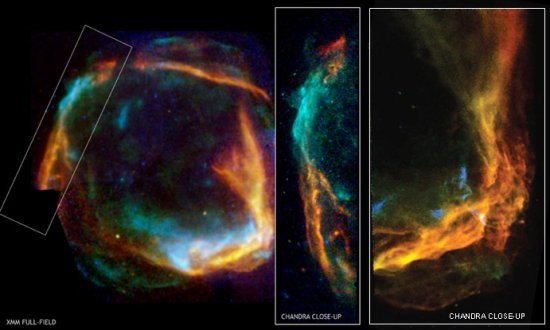
X-ray images of the supernova remnant RCW 86. The left frame shows an XMM image of the entire remnant, the middle frame a Chandra close-up of the north-east corner of the remnant (both from Vink et al., 2007), and the right frame a close-up of the south-west corner (Rho et al, 2002). Colors correspond to X-ray energies; red/yellow indicates low-energy thermal emission whereas blue/green shows higher-energy X-rays, most likely representing emission by high-energy particles.

RCW 86 is a supernova remnant with a barrel-shaped shell, nicely visible in X-rays (top image), in the optical and in radio waves (Fig. 1). Concerning its age, two options are discussed in the literature. Given the modest speeds of the supernova blast wave – 400-900 km/s – determined in some regions of the remnant, the large size of the remnant implies an age of order 10000 years, combined with a distance of about 3 kpc (Rho et al, 2002 and refs. given there). On the other hand, Vink et al. (2007) argue that the spectrum and structures visible in the synchrotron radiation in particular in the high-resolution Chandra images of the north-east corner (middle frame, top figure) require much higher speeds of the blast  wave, around 2700 km/s. Acceleration efficiency of synchrotron-emitting electrons in blast waves is closely related to the speed of the blast wave. For modest speeds, the energy losses due to radiation would outweigh the energy gains, preventing electrons from reaching high energies. Vink et al. speculate that the supernova explosion might have taken place in a bubble in the interstellar medium, allowing high blast wave speeds, and that now certain parts of the remnant have reached dense material at the edge of the bubble, slowing down the expansion, whereas other sections still expand at high speed (see also Chandra press release, APOD). In this case, the remnant would be much younger and RCW 86 could be the result of a stellar explosion recorded in 185 A.D. by Chinese astronomers (e.g. Green and Stephenson, 2003)
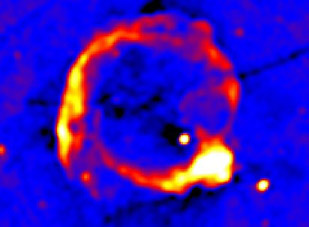
Fig. 1: MOST radio image of RCW 86, at 843 MHz, with the clearly visible shell.

The relatively large size of the remnant – about 40′ in diameter – and the observation of non-thermal X-rays make it a promising target for gamma-ray observations, aiming at increasing the currently modest number of remnants where the shells are resolved in very high energy gamma rays. Hints for gamma-ray emission from RCW 86 were seen with the CANGAROO-II instrument (S. Watanabe, Proc. 28th ICRC), but no firm detection was claimed. RCW 86 was observed for about 30 h with the H.E.S.S. instrument, and a clear gamma-ray signal with more than 9 standard deviations is detected, using an a priori defined integration region which encompasses the entire remnant (Fig. 2). The exact morphology of the gamma-ray emission is still under study: whereas one type of data analysis shows hints of a 3/4 shell lining up with the X-ray emission (Fig. 2 top, Fig. 3), this morphology is not quite as evident with other analysis techniques (Fig. 2 bottom), and more data may be required to fully settle this issue. The flux from the remnant is 5-10% of the flux from the Crab nebula, with a similar spectral index of 2.5, but the spectrum is also well described by a power law with index 1.5-2 and a cutoff around 5 TeV. The observation of TeV gamma-rays from the remnant favors somewhat the scenario of a young remnant with high expansion speed, easing the acceleration of high-energy particles.
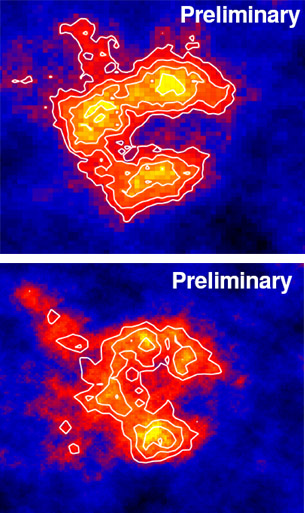
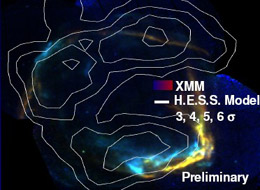
Fig. 2: Very high energy gamma ray emission from RCW 86, as seen with H.E.S.S. The top image shows the result of a ‘model data analysis’ where shower images are matched against image templates, whereas the bottom image results from the classical, slightly less sensitive Hillas analysis technique. White contours correspond to 3,4,5,6 sigma significance, obtained by counting gamma rays within 0.11 degr. from a given location. Summing over the entire remnant, one finds over 9 sigma significance.
Fig. 3: Contours of gamma-ray emission (from the model analysis) superimposed onto the XMM X-ray image of the remnant.

galactic source Supernova remnant

Previous articlePWN Abundance – HESS J1718–385Next article Confirming MGRO 1908+06

Source of the month

Each month a TeV gamma-ray source investigated with the H.E.S.S. telescopes is featured.

>> List of all sources

Latest sources

The flare that sweetened the lockdownOctober 1, 2026
A spectral steepening in the Galactic Centre ridge spectrumSeptember 1, 2026
Hunting dark matter in the Milky Way: constraints on spectral line features and the thermal HiggsinoAugust 1, 2026

Tags

Atmosphere (1) Axion-like particle (1) black holes (2) Blazar (7) Catalogue (1) Conference (1) Cosmic rays (1) Dark matter (3) Event (1) Extragalactic (10) Galactic Center (1) Galactic centre (1) galactic plane (8) galactic source (10) Gamma-ray binary (3) Gamma-ray burst (3) gamma-rays (4) IceCube (1) Meeting (2) microquasar (2) multi-messenger (1) neutrinos (4) nobelprize (1) Nova (1) publication (5) pulsar (1) pulsar wind nebula (5) Supernova remnant (3)

Contact

You can contact us for scientific queries and general information using:
contact.hess@hess-experiment.eu

Data Privacy Statement

https://www.mpi-hd.mpg.de/mpi/de/datenschutzhinweis
H.E.S.S. collaboration official website. Proudly Built By H.E.S.S. members.
(c) 2004-2026 by the H.E.S.S. collaboration.

Last sources of the month

The flare that sweetened the lockdownOctober 1, 2026
A spectral steepening in the Galactic Centre ridge spectrumSeptember 1, 2026
Hunting dark matter in the Milky Way: constraints on spectral line features and the thermal HiggsinoAugust 1, 2026

Internal

  • Log in
  • Entries feed
  • Comments feed
  • WordPress.org
H.E.S.S. Collaboration
Manage Consent
To provide the best experiences, we use technologies like cookies to store and/or access device information. Consenting to these technologies will allow us to process data such as browsing behavior or unique IDs on this site. Not consenting or withdrawing consent, may adversely affect certain features and functions.
Functional Always active
The technical storage or access is strictly necessary for the legitimate purpose of enabling the use of a specific service explicitly requested by the subscriber or user, or for the sole purpose of carrying out the transmission of a communication over an electronic communications network.
Preferences
The technical storage or access is necessary for the legitimate purpose of storing preferences that are not requested by the subscriber or user.
Statistics
The technical storage or access that is used exclusively for statistical purposes. The technical storage or access that is used exclusively for anonymous statistical purposes. Without a subpoena, voluntary compliance on the part of your Internet Service Provider, or additional records from a third party, information stored or retrieved for this purpose alone cannot usually be used to identify you.
Marketing
The technical storage or access is required to create user profiles to send advertising, or to track the user on a website or across several websites for similar marketing purposes.
  • Manage options
  • Manage services
  • Manage {vendor_count} vendors
  • Read more about these purposes
View preferences
  • {title}
  • {title}
  • {title}