July 2006

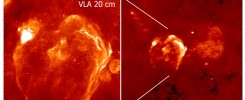
The H.E.S.S. survey of the Galactic plane (Aharonian et al. 2006) revealed a significant number of gamma ray sources, some of which are clearly related to particle acceleration in supernova remnants, some more or less line up with known pulsars, but for a handful of sources no counterpart in other wavelength regions is known. The “dark” sources – with HESS J1702-420 (Fig. 1) among them – seem to contain none or few high-energy electrons, which would create prominent X-ray or radio signals. For example, in the ROSAT X-ray data, the only significant X-ray flux detected in the region of HESS J1702-420 (Fig. 2) is most likely related to the well-contained supernova remnant G344.7-0.1, which is also clearly visible at radio wavelengths (Fig. 3), but is fairly compact and can hardly be responsible for the extended gamma-ray emission characterizing HESS J1702-420.
The nature of “dark” sources has been subject of much speculation; for example, some of them could represent gamma-ray burst remnants (Atoyan et al. 2005) or clumps of annihilating dark matter, although neither of these scenarios fully accounts for their observed characteristics. Recent studies of pulsar wind nebulae – an electron “wind” emerging from a pulsar, see e.g. SOM 2005/06 – have opened a possible new interpretation for objects like HESS J1702-420. Quite often, the pulsar wind nebulae are found displaced from the pulsar by fractions of a degree, corresponding to 10 or more parsec. Examples of displaced pulsar wind nebulae include Vela X, the two nebulae in the Kookaburra region, or HESS J1825-137 (see top figure). Properties of the ambient medium might be responsible for the displacement (see e.g. SOM 2005/09), or proper motion of the pulsar, which leaves parts of the nebula behind. Large displacement of gamma-ray pulsar wind nebulae seems to be the rule, rather than the exception. Displacement are also observed for some X-ray nebula (e.g. Gaensler et al. 2003), but are more prominent for gamma-rays, since the gamma-ray emitting electrons usually have a longer lifetime and can travel further. Given these observations in other nebulae, one might now be prepared to accept displacements as large as 1/2 degree, which corresponds to the angular distance from the pulsar PSR J1702-4128 to the center of the HESS source J1702-420. In earlier discussions, an association was considered unlikely because of the large distance. Indeed, this pulsar (see ATNF pulsar catalog) is quite energetic and a few percent of its spin-down energy loss would be sufficient to power the gamma-ray source; comparable or larger efficiency for conversion from spin-down power to gamma-ray luminosity is seen in other pulsars. In this interpretation, it remains open, however, why the gamma-ray emission peaks so far from the pulsar, as opposed to peaking near the pulsar with a long trail away from the pulsar. One might speculate that the pulsar, with a distance of 5 kpc and an age of 50000 years, was much more active in the past and that the gamma-ray profile traces the time evolution of pulsar luminosity. A way to verify any such interpretation of the gamma-ray source as a pulsar wind nebula will be more sensitive X-ray measurements, where ultimately a nebula of nonthermal synchrotron X-rays will have to show up.
References:
The H.E.S.S. survey of the Inner Galaxy in very high-energy gamma-rays, H.E.S.S. collaboration, F. Aharonian et al.,Astrophysical Journal 636 (2006) 777-797