Gamma-ray bursts (GRBs), which are bright flashes of gamma rays from extragalactic sources followed by fading afterglow emission, are associated with stellar core collapse events. We report the detection of very-high-energy (VHE) gamma rays from the afterglow of GRB 190829A, between 4 and 56 hours after the trigger, using the High Energy Stereoscopic System (H.E.S.S.). The low luminosity and redshift of GRB 190829A reduce both internal and external absorption, allowing determination of its intrinsic energy spectrum. Between energies of 0.18 and 3.3 tera–electron volts, this spectrum is described by a power law with photon index of 2.07 ± 0.09, similar to the x-ray spectrum. The x-ray and VHE gamma-ray light curves also show similar decay profiles. These similar characteristics in the x-ray and gamma-ray bands challenge GRB afterglow emission scenarios.

Main paper
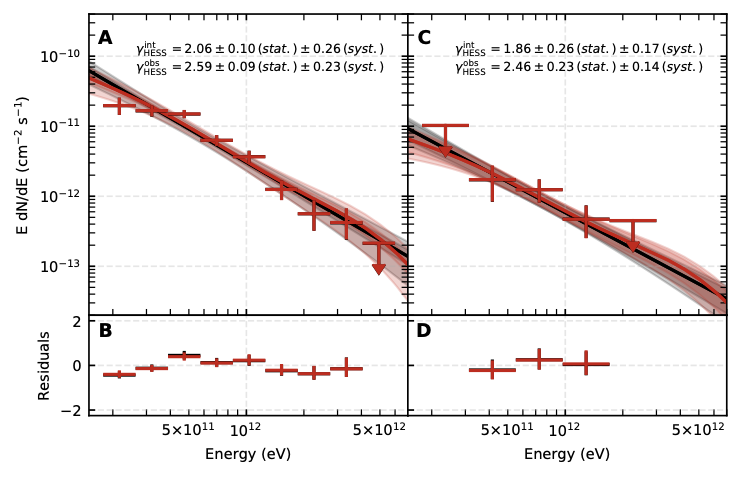
| E [TeV] | dNdE [1/(cm^2 s TeV)] | dNdE_err_pos [1/(cm^2 s TeV)] | dNdE_err_neg [1/(cm^2 s TeV)] | residuals | res_err_pos | res_err_neg |
|---|---|---|---|---|---|---|
| 0.216 | 9.074e-11 | 2.731e-11 | 2.389e-11 | -0.435 | 0.149 | 0.170 |
| 0.320 | 5.165e-11 | 9.990e-12 | 8.954e-12 | -0.126 | 0.152 | 0.169 |
| 0.473 | 3.151e-11 | 4.371e-12 | 4.016e-12 | 0.450 | 0.185 | 0.201 |
| 0.699 | 8.998e-12 | 1.690e-12 | 1.500e-12 | 0.126 | 0.188 | 0.211 |
| 1.033 | 3.563e-12 | 7.707e-13 | 6.801e-13 | 0.212 | 0.231 | 0.262 |
| 1.528 | 8.216e-13 | 2.938e-13 | 2.430e-13 | -0.241 | 0.225 | 0.272 |
| 2.258 | 2.485e-13 | 1.385e-13 | 1.065e-13 | -0.375 | 0.268 | 0.348 |
| 3.338 | 1.248e-13 | 7.421e-14 | 5.324e-14 | -0.148 | 0.364 | 0.507 |
| 4.935 | 4.298e-14 (U.L.) | – | – | – | – | – |
| E [TeV] | dNdE [1/(cm^2 s TeV)] | dNdE_err_pos [1/(cm^2 s TeV)] | dNdE_err_neg [1/(cm^2 s TeV)] | residuals | res_err_pos | res_err_neg |
|---|---|---|---|---|---|---|
| 0.236 | 1.692e-11 (U.L.) | – | – | – | – | – |
| 0.415 | 4.122e-12 | 2.422e-12 | 2.122e-12 | -0.202 | 0.411 | 0.469 |
| 0.731 | 1.697e-12 | 6.879e-13 | 5.904e-13 | 0.255 | 0.437 | 0.509 |
| 1.286 | 3.675e-13 | 2.101e-13 | 1.706e-13 | 0.038 | 0.482 | 0.594 |
| 2.262 | 1.979e-13 (U.L.) | – | – | – | – | – |
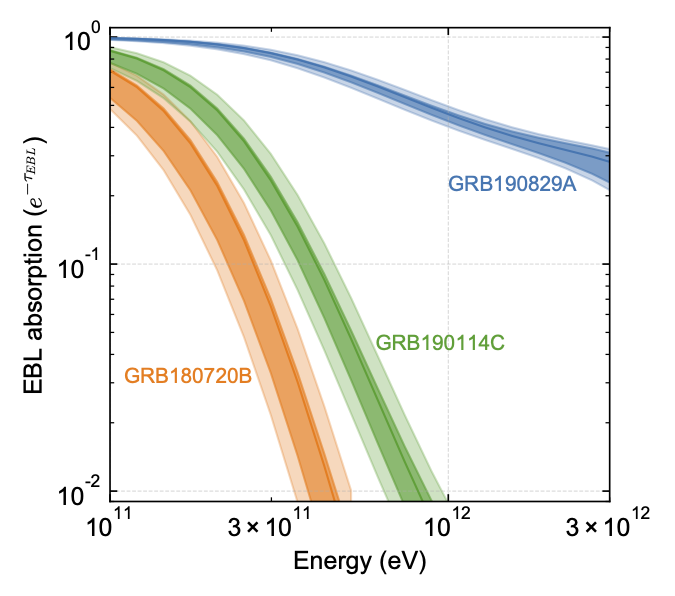
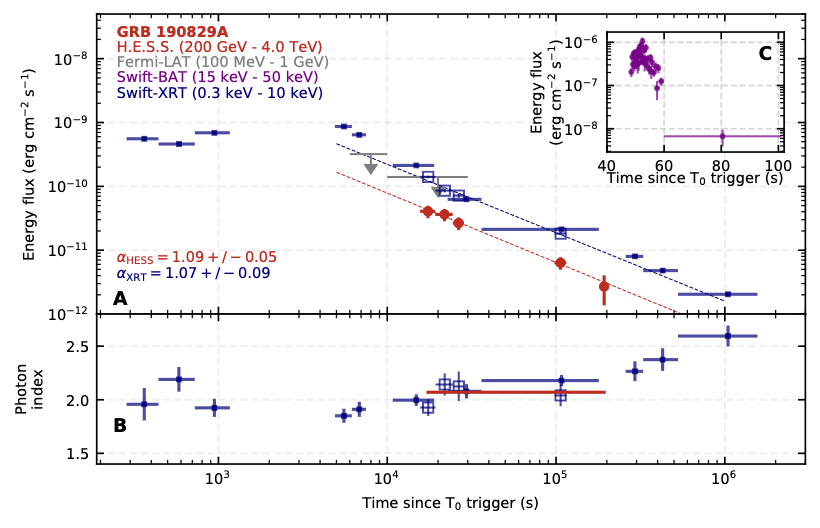
| Interval | Time after T0 [s] | Energy flux [10^-11 erg / (cm s)] | stat. uncert. [10^-11 erg / (cm s)] | sys. uncert. [10^-11 erg / (cm s)] |
|---|---|---|---|---|
| Night 1, cluster 1 | 1.56e4 – 1.92e4 | 4.06 | 0.65 | 0.90 |
| Night 1, cluster 2 | 1.92e4 – 2.44e4 | 3.57 | 0.42 | 0.77 |
| Night 1, cluster 3 | 2.44e4 – 2.85e4 | 2.66 | 0.39 | 0.60 |
| Night 2 | 9.79e4 – 1.15e5 | 0.64 | 0.14 | 0.14 |
| Night 3 | 1.84e5 – 2.01e5 | 0.27 | 0.13 | 0.07 |
For a detailed description, usage instructions, etc. we point towards the README.md file contained in the package. It also contains all necessary experimental data (including the butterflies in Figure 4) and a Juyter notebook reproducing the figures of the paper. The output of the MCMC chains used for the figures in the paper can be found here.
The MCMC code is also available from Github.
Supplementary Material
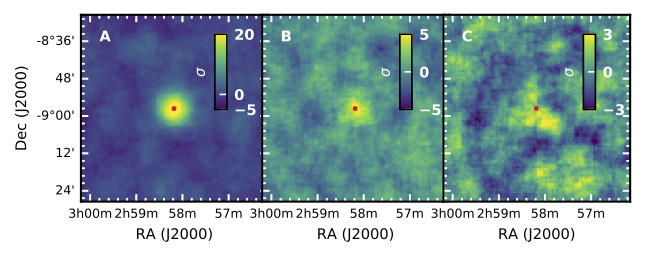
Swift-XRT results
This archive, XRT_data_files.tar.gz, contains the files to recreate the time-sliced XRT analyses in this paper. The results are provided in Tables S3 and S4, and plotted in Figs. 3, 4, S4, and S5. The files “timeslices_tableS3.txt” and “timeslices_tableS4.txt” correspond to the time intervals described in Tables S3 and S4, respectively, and were uploaded to https://www.swift.ac.uk/xrt_spectra/addspec.php?targ=00922968 to build the time-sliced spectra. Note that the BAT trigger time (which is what the XRT uses) is 51.5 seconds after the GBM one, and the times listed in Tables S3 and S4 are calculated from the GBM trigger time (T0 in the paper).
Collaboration Acknowledgement
