Welcome to the new H.E.S.S. blog. Here we publish insights into H.E.S.S., especially interviews with scientists from the H.E.S.S. collaboration, who explain how one of the world’s leading gamma-ray observatories works behind the scenes. Our first interview is with Dr. Sylvia J. Zhu (DESY Zeuthen) who talks about data acquisition (DAQ) at H.E.S.S.
Most of the light we see with our eyes comes from stars and galaxies, but the Universe also shines in forms of light we cannot see directly. One of these is gamma rays; the highest-energy form of light. They are made in extreme places, such as supernova remnants, powerful cosmic explosions. H.E.S.S. uses its large telescopes to detect flashes of light in the atmosphere created when a gamma ray enters from space. By combining signals from several telescopes, scientists can work out where the gamma ray came from and how energetic it was. For analysing the data, everything first needs to be recorded during the night. That job is done by the data acquisition system. It saves the camera images and makes observations happen as planned.
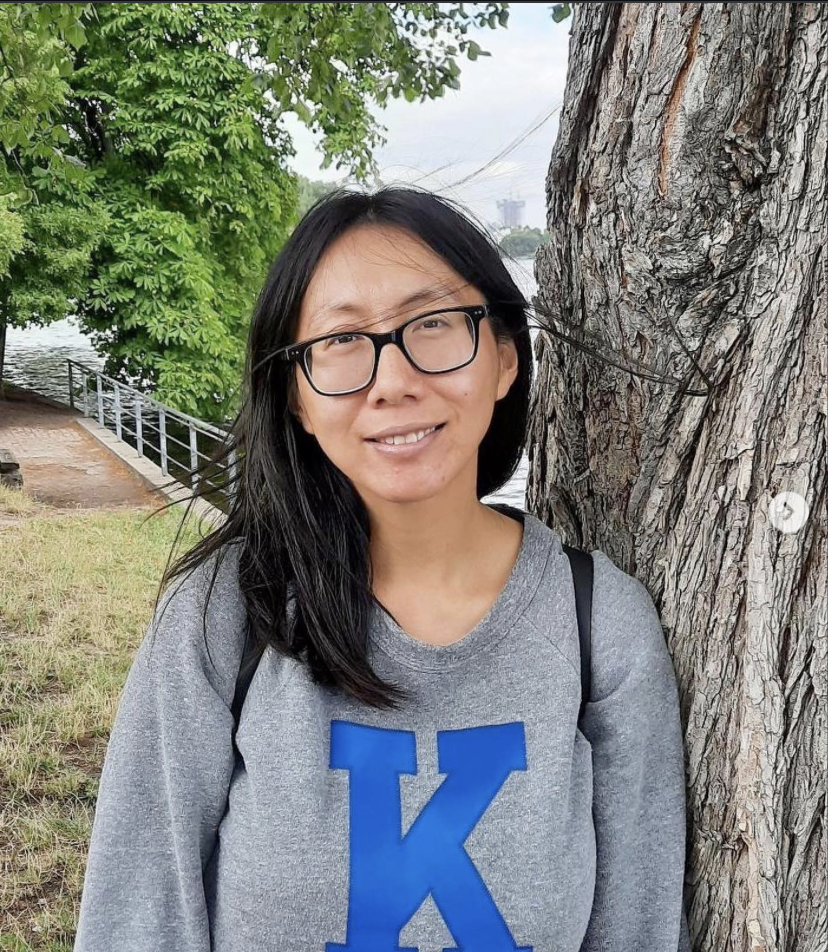
Dr. Sylvia J. Zhu has explained more about DAQ in the interview below. She is a postdoctoral researcher in DESY, Zeuthen who works as part of the H.E.S.S. collaboration. Her research focuses on high-energy and multimessenger astrophysics, with experience in gamma-ray and gravitational-wave data analysis. From 2019 to 2023, she led the H.E.S.S. Data Acquisition and Computing working group, helping ensure that data from the H.E.S.S. telescopes in Namibia are recorded reliably for science. She also led the gamma-ray burst programme and received the H.E.S.S. Prize in 2022 for her outstanding contribution to the collaboration. Since 2025, she has been co-convener of the H.E.S.S. Transients group.
If you explain data acquisition to someone who never heard of H.E.S.S. what would you tell them?
We call the data acquisition system the DAQ. If you think of the whole H.E.S.S. telescope array as a person, the DAQ is like the part of the brain that takes care of automated tasks. Humans in the collaboration still decide what to observe, when to turn things on or off, and when something is wrong. But once someone on shift says, “This is what we’re going to observe,” and pushes a button, something still has to tell every part of the system how to follow that instruction. It’s a bit like seeing a cute dog in the park; you decide to look at it and tell your friends about it later, but once you’ve made that decision, your brain automatically moves your head, keeps your eyes open, blinks when needed, and records what you see. The DAQ does that automatic part for the telescopes; people decide what to do, and the DAQ makes sure those instructions actually happen.
When a gamma ray hits the atmosphere above the telescopes, what does the telescope see, and what does the DAQ system do with that signal before scientists analyse it?
When a gamma-ray photon hits the top of the atmosphere, it sets off a chain reaction that ends in a flash of light. The telescopes record that flash, essentially a snapshot of what it looks like. Each flash creates its own shape and pattern in a camera; maybe brighter in one spot, or moving across the camera. From that shape, and from which telescopes saw it, we can learn more about the original gamma ray. Those camera images then need to be saved. Part of what the DAQ does is take in that information and store it on computer clusters. Later, when the night is over, the data can be processed, the information about the original photons retrieved, and everything analysed together.
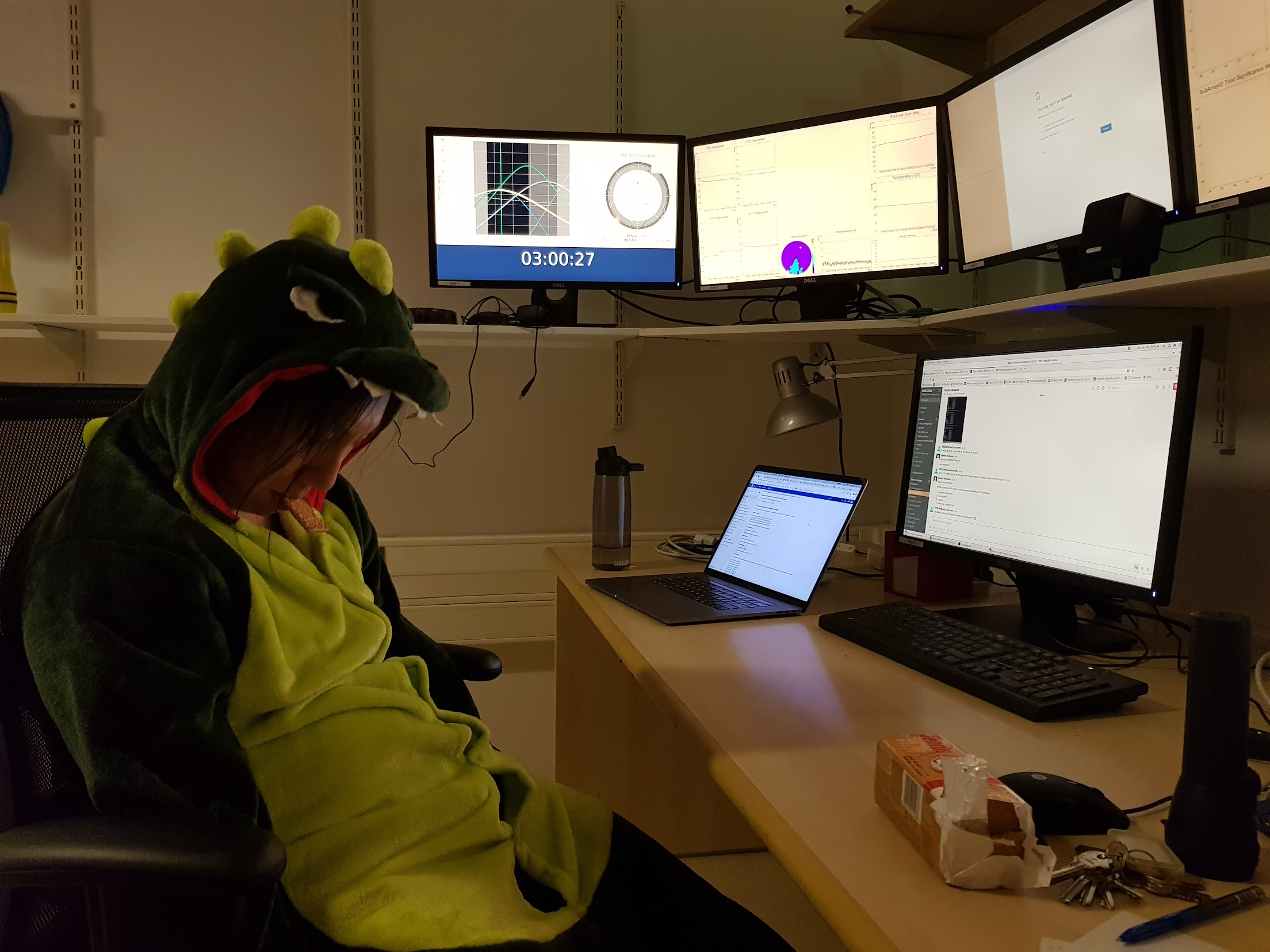
Sylvia Zhu after an exhausting night of DAQ trouble shooting, H.E.S.S control room, Namibia, photo credit: Dr. Sylvia J. Zhu
Can you tell us a bit more about what you have done for H.E.S.S?
When I was on the DAQ team, I saw my role a bit like customer service. The DAQ is there to make everyone’s life easier, so when you’re on shift, you don’t have to turn on every subsystem one by one or babysit them the entire time. In principle, you push one button and everything runs smoothly. When things didn’t work, as part of the DAQ team I had to figure out why, fix it, and either prevent it from happening again or make it easier for shifters to fix things or troubleshoot on their own. We were a kind of first line of support when things went wrong for the people on shift. We also responded to requests from the collaboration, for example, when people wanted special observations, like during moonlight, when background light is higher. Then we might need new settings or new run setups so observing stays safe and still works well. As DAQ lead, I also tried to keep communication clear. Otherwise the data-taking process can feel like a black box: shifters and the local crew run the telescopes, while people far away try to analyze the data without fully understanding the conditions it was taken under. We worked to make sure that information was shared and that everyone’s voice was heard.
What would go wrong for astronomy if the DAQ did not work well for one night?
A bad night with the DAQ can mean anything from a small fix to stopping observations entirely. While the telescopes are running, the shifters monitor that everything stays fine; nothing overheats and there is no risk from distant lightning. Status displays help with that. Sometimes one display stops working. That’s usually not critical and is easily fixed, because other safeguards are in place. A bigger problem might be a lost connection to one telescope. Sometimes, this can be fixed by unplugging and replugging something, sometimes it needs a hardware change. Then there are showstoppers. The telescope array is a network of computers that have to talk to each other very fast, linked through a device called a switch. If that switch fails, then communication stops and the whole system stops working.
Why does DAQ matter for H.E.S.S.?
H.E.S.S. is a very complex system. Like the human body, most of what keeps it running happens automatically, for example you don’t think about every breath or blink. The DAQ handles that side of things; not only sending commands to move the telescopes, but making sure everything works well and runs properly.
To provide the best experiences, we use technologies like cookies to store and/or access device information. Consenting to these technologies will allow us to process data such as browsing behavior or unique IDs on this site. Not consenting or withdrawing consent, may adversely affect certain features and functions.
Functional
Always active
The technical storage or access is strictly necessary for the legitimate purpose of enabling the use of a specific service explicitly requested by the subscriber or user, or for the sole purpose of carrying out the transmission of a communication over an electronic communications network.
Preferences
The technical storage or access is necessary for the legitimate purpose of storing preferences that are not requested by the subscriber or user.
Statistics
The technical storage or access that is used exclusively for statistical purposes.The technical storage or access that is used exclusively for anonymous statistical purposes. Without a subpoena, voluntary compliance on the part of your Internet Service Provider, or additional records from a third party, information stored or retrieved for this purpose alone cannot usually be used to identify you.
Marketing
The technical storage or access is required to create user profiles to send advertising, or to track the user on a website or across several websites for similar marketing purposes.