
What happens during a H.E.S.S. night shift
Gamma rays are a form of light that our eyes cannot see. They carry far more energy than ordinary visible light, which makes them rare and hard to catch. High in the atmosphere gamma rays create a brief flash of faint blue light, called Cherenkov light. The H.E.S.S. cameras can catch that light. Their pixels are photomultiplier tubes, much more sensitive than the pixels in an ordinary camera, because the light they are looking for is extremely faint. In this interview, Alessandro Montanari takes us through a typical observation night from sunset to sunrise. He describes how the crew keeps the telescopes running, watches the control room, and steps in when something goes wrong. He also explains why H.E.S.S. organises its observing time around the Moon cycles, and how the work is shared between permanent staff living on site in Namibia and visiting scientists from the collaboration who travel there to join the shifts.
Alessandro’s work in the H.E.S.S. collaboration.
Alessandro is a postdoctoral researcher at Laboratoire Leprince-Ringuet in Palaiseau. In the H.E.S.S. collaboration, he works on H.E.S.S. data to look for faint signals, like Dark Matter and diffuse emissions. The first is the invisible matter that seems to make up a large part of the Universe, even though we cannot see it directly. The second is gamma-ray glows that do not come from one bright object but spread across our Milky Way, like the Fermi Bubbles (two huge gamma rays lobes that are above and below the centre of our Galaxy).
That is why Alessandro’s second role matters as well. Since October 2022 he has led the H.E.S.S. Operations Department, helping to keep data taking steady, working with specialist teams across the collaboration, and coordinating these teams to react when something goes wrong. Since October 2025 he has shared these responsibilities with Dr Simon Steinmassl at MPIK in Heidelberg. He has also taken part in remote and on site shifts himself, so he knows H.E.S.S. observations not only from the data, but from the long nights of observation in the Namibian desert.
If you have ever wondered who stays up while H.E.S.S. watches the night sky, and how rare gamma ray flashes become scientific data, this interview is a good place to begin.
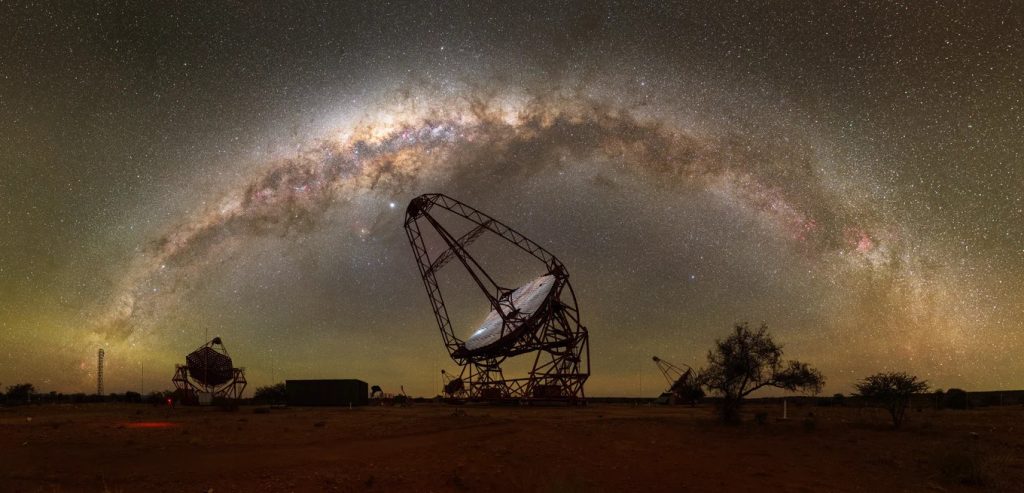
H.E.S.S. only observes at night. What does a typical shift look like from sunset to sunrise?
Indeed, we only observe at night with H.E.S.S. The night shift duration depends on how long the nights are, and on the moon phase. We can observe for fewer hours when the moon is too bright, as too much moonlight could damage the pixels in telescopes’ camera. A shift can last more than 10 hours during very long nights, but can drop to less than half an hour on short nights.
The standard routine for the shifters is to get to the control room near the H.E.S.S. telescopes around half an hour before the shift starts. Then they open the camera shelters that protect the cameras during the day. The central data acquisition system, called the DAQ, controls all the telescopes together. Before starting observations, the cameras are prepared by warming up their pixels with a special procedure to slowly switch on the high-voltage electronics inside the cameras. Finally, the cameras are moved out of their shelters and ready to observe. During this warm-up, the crew also checks the central DAQ system to ensure every part of each telescope is working as it should, including the cameras, the motors that move them, and the computers.
The shifters will start observations by pointing all telescopes toward the first target in the night sky. During the shift, the shifters will have to watch as the DAQ automatically moves the telescopes from one target in the sky to the next. On each target position, we usually collect around 28 minutes of observations. This duration was chosen to make it easier to transfer the data from the computers in Namibia to the computers in Europe, where the data are further processed for analysis. Nevertheless, for some particular needs, observations may last longer.
Some of the data taken during the night is not a look at a source in the sky. It is a check that the cameras and telescopes are responding as they should. Those checks are called calibration. They tell the team how the instrument is behaving that night, so the observations of real sources can be understood correctly. Both observation and calibration data can be collected during the shift. Sometimes an interesting target appears suddenly in the sky. That is an urgent observation, and the shifters may have to change the night schedule. This requires them to manually shift the schedule on the DAQ.
If a technical issue arises during observations, shifters may have to intervene. For instance, if a machine in the central DAQ system crashes, the shifters will promptly reboot so they do not lose too much of the observation time. More serious problems may require the shifters to temporarily stop observations and work directly on the telescopes and the cameras. At the end of the night, when there is no more time to observe, the shifters park the cameras, close the shelters, and finally stop all the ongoing observation pipelines on the DAQ. And, finally, they can enjoy a well-deserved day of sleep.
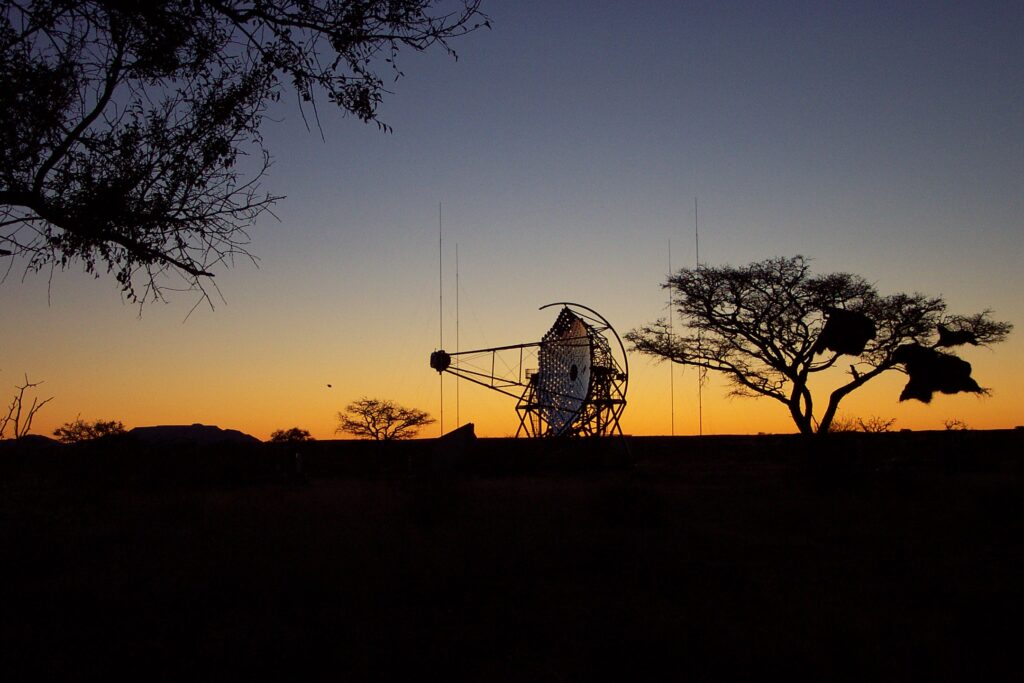
How many people are needed to run the telescopes on a typical night, and what does each person do?
A shift crew is composed of two/three people almost every night. This is usually enough to run the array of telescopes, given the significant automation of the entire observation procedure, via the DAQ, implemented over the years of operating H.E.S.S. The crew follows the steps I described earlier and monitors the telescopes during observations. Normally, the entire shift crew can handle all the steps. However, when technical problems arise, the most experienced members usually lead troubleshooting. This person will always be someone from the permanent crew working at the site. For instance, if the DAQ warns the shifters that some camera pixels are being deactivated, observations may have to stop. Permanent crew members are specifically trained to handle this kind of situation. External shifters who may have joined the crew will follow the lead.
A H.E.S.S. shift often lasts about a month, between two full moons. Why is it organised that way?
The photomultiplier tubes in the H.E.S.S. cameras (more or less like pixels in a standard camera, just built with much more complex technology) are typically designed for nighttime observations, as they detect the faint Cherenkov light produced by cosmic rays and gamma rays in the Earth’s atmosphere. The cameras are highly sensitive to low light levels. Even too bright moonlight could damage them. Therefore, we organise observations around the moon phases, and we schedule a few-day pause in observations around the full moon. Then, during the first nights of a shift we can observe only for a few hours, because the moon is still too bright. As the moon sets during the shift, the time we can dedicate to observations gets progressively longer. Around the new moon phase, we get the nights with the longest time dedicated to observations, which can be even more than 10 hours during the long winter nights in Namibia.
Some shifters live and work permanently at the site in Namibia, while others travel from Europe or elsewhere. How is the team put together?
Indeed, a local crew works permanently at the site in Namibia. It is composed mainly of engineers, who are experts in the telescope cameras, drive systems, the electronics and computing centre in the control room, and all the safety measures needed to operate H.E.S.S. They also know by heart how to collect data with the telescopes. Having a local crew constantly operating the telescopes ensures high efficiency, as we do not need to train every new shift crew. However, there is also the possibility to join night shifts as an external shifter, a wonderful opportunity to learn about the instrument and contribute to the data taking. You do not need experience working on the H.E.S.S. site to join as an external shifter; you just need to be part of the H.E.S.S. collaboration. Once you join as an external shifter, you will be taught about the telescopes’ subsystems and trained to operate the instrument. You can then participate in nightly observations as part of the mixed crew of permanent and external shifters.