H.E.S.S. detection of the PSR J0855−4644 nebula

Abstract

Context. HESS J0852−463 is a TeV γ-ray source located in the Galactic plane. The region consists of a supernova remnant (SNR, RX J0852.0−4622) with a shell-like morphology, commonly referred to as Vela Junior, and a pulsar named PSR J0855−4644. Pulsars are among the most efficient leptonic accelerators in our Galaxy, making this region particularly interesting to study.

Aims. We utilise the most recent data taken by the High Energy Stereoscopic System (H.E.S.S.) to investigate any γ-ray emission associated with the pulsar in this region, PSR J0855−4644.

Methods. We applied a full forward-folding method on the H.E.S.S. data. Utilising 3D modelling techniques, we evaluated the TeV γ-ray emission towards the various components of this complex system.

Results. The distinct energy-dependent morphology observed in our data motivates further investigation of this source. We resolved the emission in the Vela Junior region into various components, several of which correspond to the SNR itself. In particular, we find a new extended component coincident with the position of PSR J0855−4644. The spectrum follows a power-law distribution with a best-fit index of ΓE = 1.81 ± 0.07stat, which differs from the properties of the surrounding γ-ray emission of the Vela Junior SNR. A one-zone leptonic joint fit between the X-rays (from XMM-Newton) and γ-rays (from H.E.S.S.) leads to a lower limit on the magnetic field of 1.6 μG and a spectral index of α = 1.88 ± 0.01, in line with expectations of pulsar wind nebulae (PWNe).

Conclusions. In this paper, we report the first detection of the PWN of PSR J0855−4644 at TeV energies with the H.E.S.S. experiment, at a significance of 12.2σ. This is attributed to the advanced techniques of the 3D analysis. Based on the pulsar’s characteristics, its PWN is consistent with the known TeV PWNe population in the Galaxy.
Auxiliary informations

Introduction

Below the auxiliary information for all figures in the publication H.E.S.S. detection of the PSR J0855−4644 nebula (A&A 708, A6 (2026)) is provided. This includes the pdf versions of all figures and fits files for maps and fits files for any flux points.

Main Figures

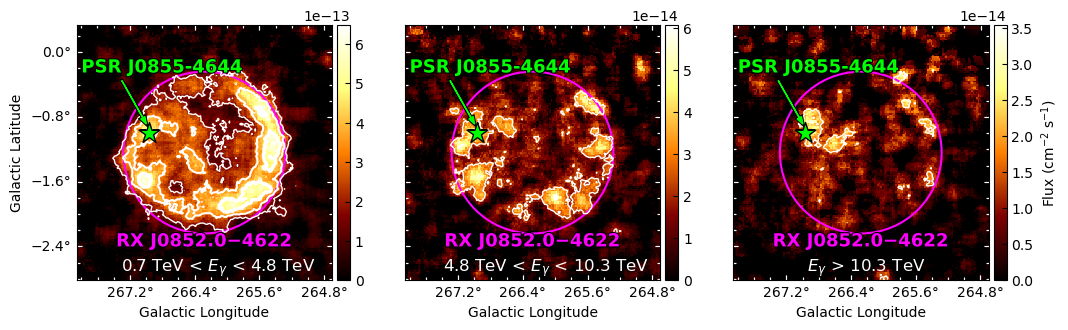
Figure 1 – Flux maps for different energy bins

Caption: TeV γ-ray flux map of the Vela Junior region in three different energy bands. A smoothing radius of 0.1° is used. The Vela Junior SNR is indicated by the magenta circle and PSR J0855−4644 is indicated by the green star. The significance contours of the TeV γ-ray emission at the 5, 10, and 20σ levels are shown in white, with increasing line width for increasing significance.


pdf
fits


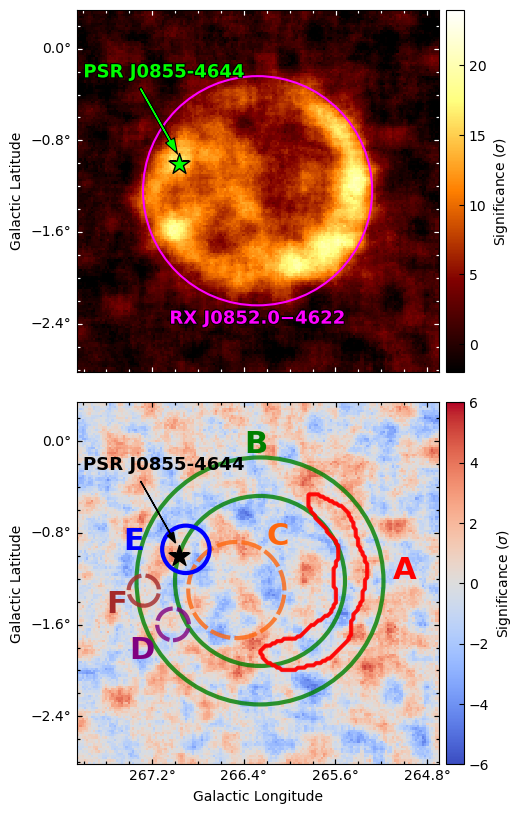
Figure 2 – Significance and residual significance maps

Caption: Significance γ-ray maps above 0.7 TeV. Top: Significance map with Vela Junior is indicated by the magenta circle and PSR J0855−4644 indicated by the green star. Bottom: Residual significance map with the best-fit models overlaid. The six model components are shown in different colours, together with their respective labels. The circles represent the 68% containment radii of the Gaussians.


pdf
fits

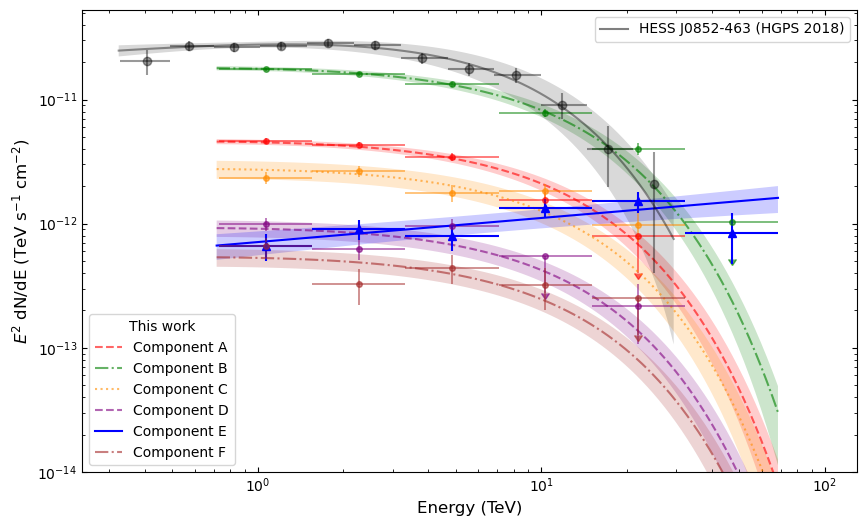
Figure 3 – Spectral energy distribution for each H.E.S.S. component, and the flux points available as individual fits files

Caption: Spectral energy distribution for each H.E.S.S. component. The components from this work are shown from “A” to “F”, in red (dashed), green (dot dashed), orange (dotted), purple (dashed), blue (solid) and maroon (dot dashed), respectively. The flux points are derived individually from each of the respective models. These spectra are compared to the result from HESS J0852-463 in solid black from H.E.S.S. Collaboration et al. (2018c).


pdf
fits_flux_points_A
fits_flux_points_B
fits_flux_points_C
fits_flux_points_D
fits_flux_points_E
fits_flux_points_F

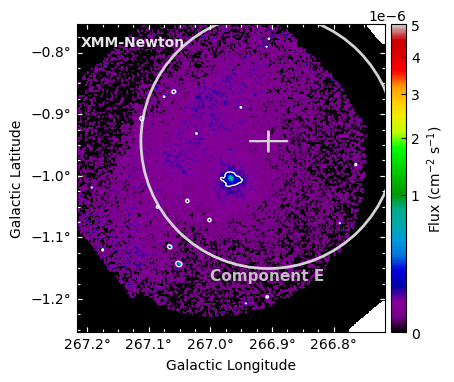
Figure 4 – XMM-Newton flux map

Caption: XMM-Newton flux image from the MOS+PN camera in the high-energy band from 2-8keV. The map is smoothed with a Gaussian width of 4”. The contour at 1.1e-7 cm−2s−1 indicates the inner nebula of the PWN. The grey plus and circle show the position and size of component E in γ-rays, respectively. The diffuse emission to the North of the PWN is the rim of the Vela Junior remnant. Image adapted from Acero et al 2013.


pdf
fits

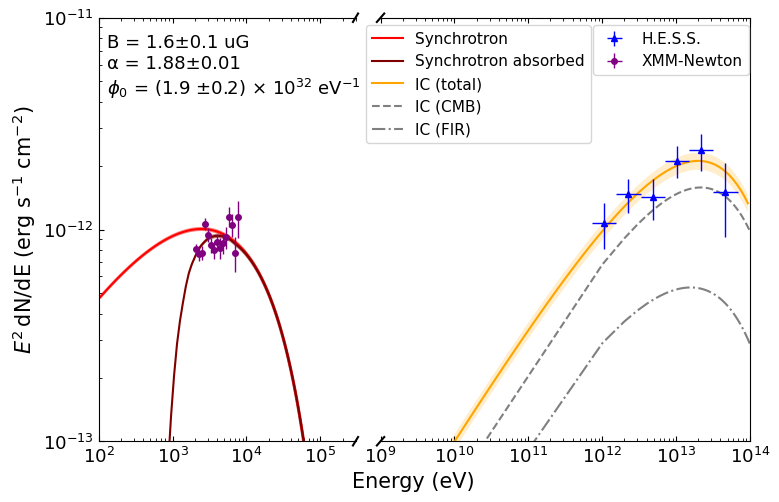
Figure 5 – Broadband spectral energy distribution of component E, and the flux points for both H.E.S.S. and XMM-Newton available as individual fits files

Caption: Broadband spectral energy distribution of component E in a simple one-zone leptonic scenario. The IC emission is shown for the CMB and FIR components in grey dashed and dot-dashed, respectively. The total IC emission is shown by the orange line. The NIR cannot be seen on this plot as it is a subdominant component. The red and maroon lines represent the synchrotron emission and synchrotron emission with absorption, respectively. An X-ray absorption column density of NH = 7.6 × 10^21cm−2 is assumed for this model. The XMM-Newton X-ray flux points are shown by the dark purple filled squares and the TeV γ-ray flux points from component E are indicated by the blue filled triangles. Both of these were calculated from the one-zone single model.


pdf
fig5_flux_points_xmm

fig5_flux_points_hess

Appendix

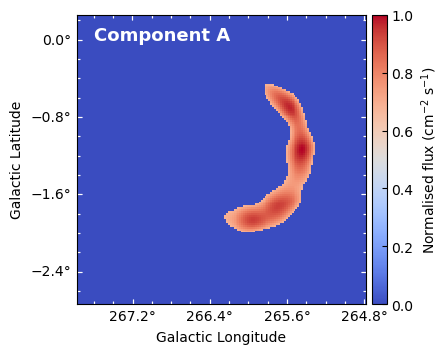
Figure A.1 – Template map for the emission of component A

Caption: Template for component A: the representation of the eastern shell.


pdf
fits

Figure A.2 – Predicted counts and residual significance maps for the iterative addition of models

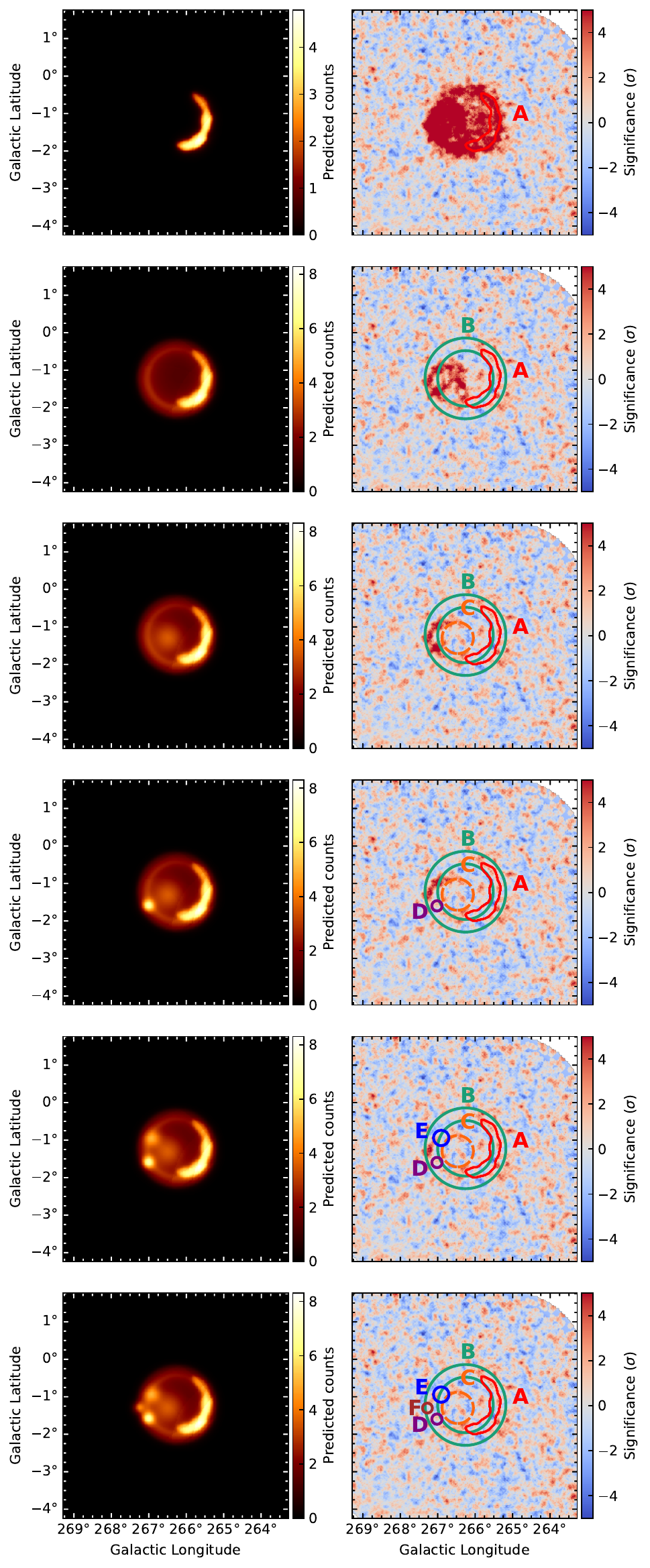
Caption: Iterative addition of the models outlined in Sect. 3.2 from “A” through to “F”, in red, green, orange, purple, blue and maroon, respectively. Left: the predicted counts for the models. Right: the residual significance maps.


pdf