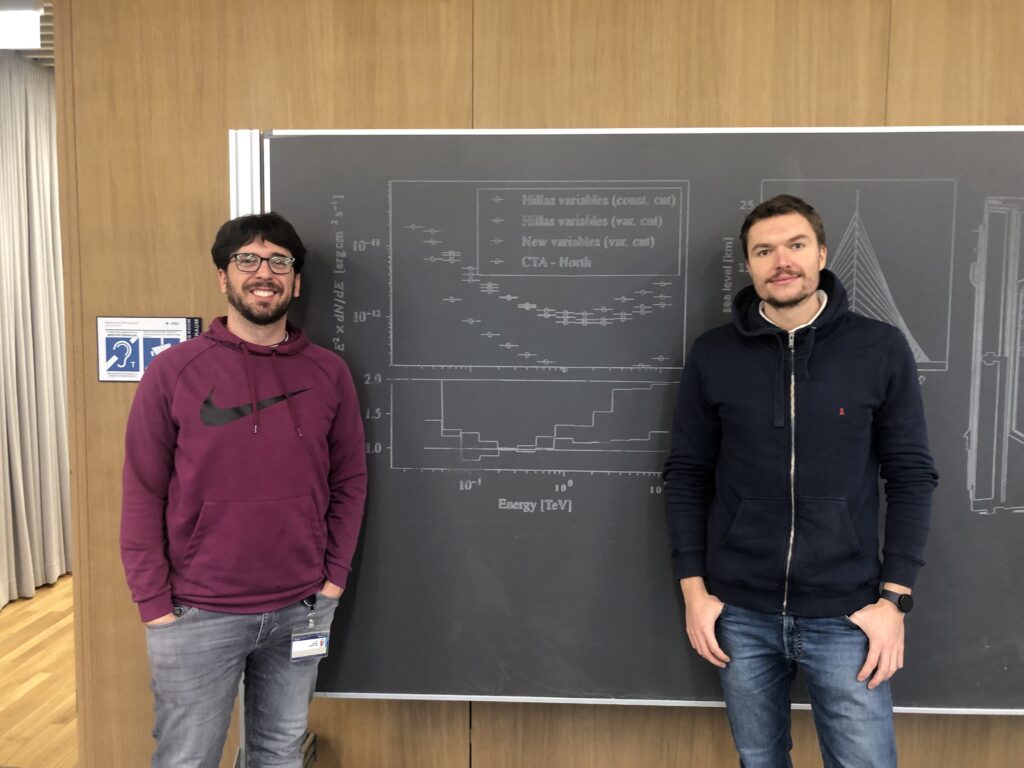
Rodrigo and Tim share the H.E.S.S. Prize awarded at the Fall 2025 Collaboration Meeting. Together, they made seminal contributions to the development of new analysis configurations for HAP, the H.E.S.S. Analysis Program. Tim focused on improvements to the analysis of monoscopic data from CT5, the largest H.E.S.S. telescope. To achieve this, he conceived of multiple new parameters to parametrise the telescope images and subsequently used these to enhance the rejection of background events, using machine-learning algorithms. Pushing for a lower energy threshold he encountered many difficulties but was able to overcome them and provide a new configuration that yields a much better sensitivity compared to the previous one. Rodrigo built on this work to develop the first analysis configuration in the HAP framework that properly takes into account data from all five H.E.S.S. telescopes. Furthermore, he pioneered and established the concept of event types, which are designed to deliver an optimal sensitivity across the full energy range covered by the telescopes – while it was usually necessary to make compromises at low or high energies with previous configuration. Because both projects were tied to each other and Rodrigo and Tim worked together on both, the H.E.S.S. Collaboration Board decided to award the H.E.S.S. Prize to both of them.