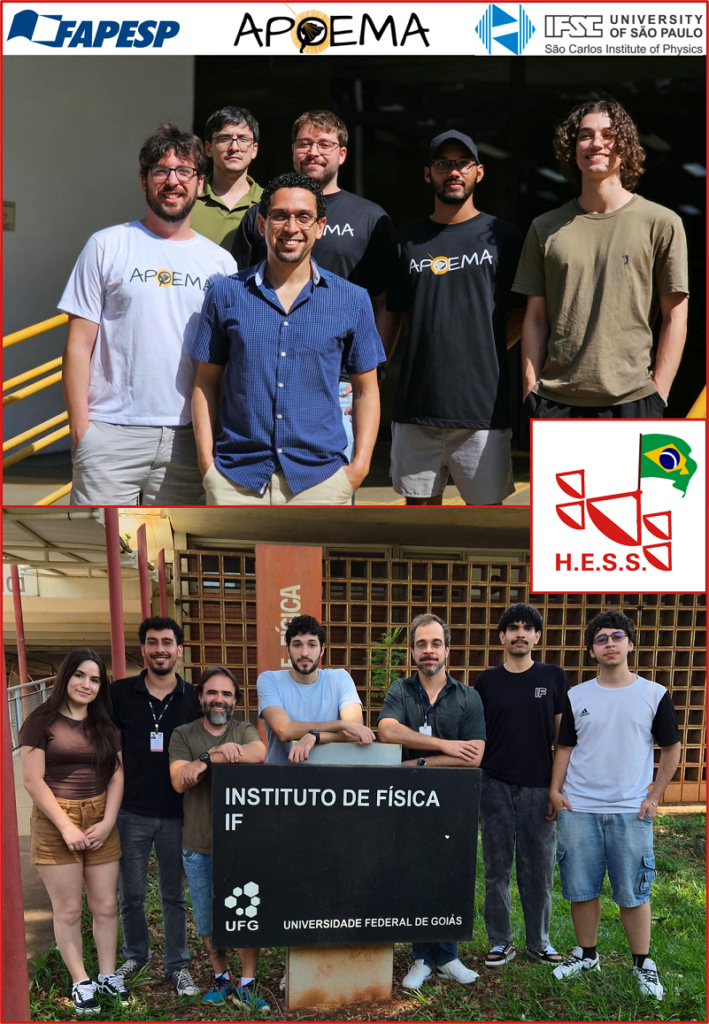
A Brazilian consortium comprising the APOEMA group at the São Carlos Physics Institute at University of São Paulo (IFSC/USP) and the Astrogyn group at Goiás Federal University (UFG) joins the H.E.S.S. Collaboration as full members, expanding the collaboration to the fifth continent. Combining the expertise of several former H.E.S.S. members, the newly joined groups expect to contribute to a vast range of topics, ranging from the development and implementation of the main HAP analysis pipelines, to scientific topics such as physics beyond the Standard Model, the search for dark matter, active galactic nuclei, Galactic center physics, cosmic rays and others.
The APOEMA group at USP is one of the leading astroparticle physics groups in Latin America, with important participation in several other experiments such as CTAO, SWGO, Pierre Auger, and GRAND. Its participation in H.E.S.S. will be led by Dr. Rodrigo Guedes Lang, group leader of a newly established Max Planck Tandem Research Group at IFSC/USP, and Prof. Aion Viana, associate professor of the institute, supervising a team of at least 1 postdoctoral researcher and 5-7 master’s and PhD students, who will get the unique opportunity to work with data from one of the most sensitive gamma-ray experiments running.
The recently established Astrogyn group at UFG expands astroparticle physics to central Brazil. The group is led by Prof. Victor Barbosa Martins, drawing on his research experience at IFSC/USP, DESY, and Ruhr-Universität Bochum. Astrogyn focuses on high-energy astrophysics, multi-messenger astronomy, and active galactic nuclei. At UFG, students will have a great opportunity by joining a successful international collaboration like H.E.S.S.
With this addition the H.E.S.S. collaboration finally spans over all five continents and is therefore truly an international organisation in addition to one of the leading experiments in gamma-ray astronomy. We welcome both groups and especially all former and new member (back) into the H.E.S.S. collaboration and look forward to a fruitful collaboration with lots of exciting science to come!