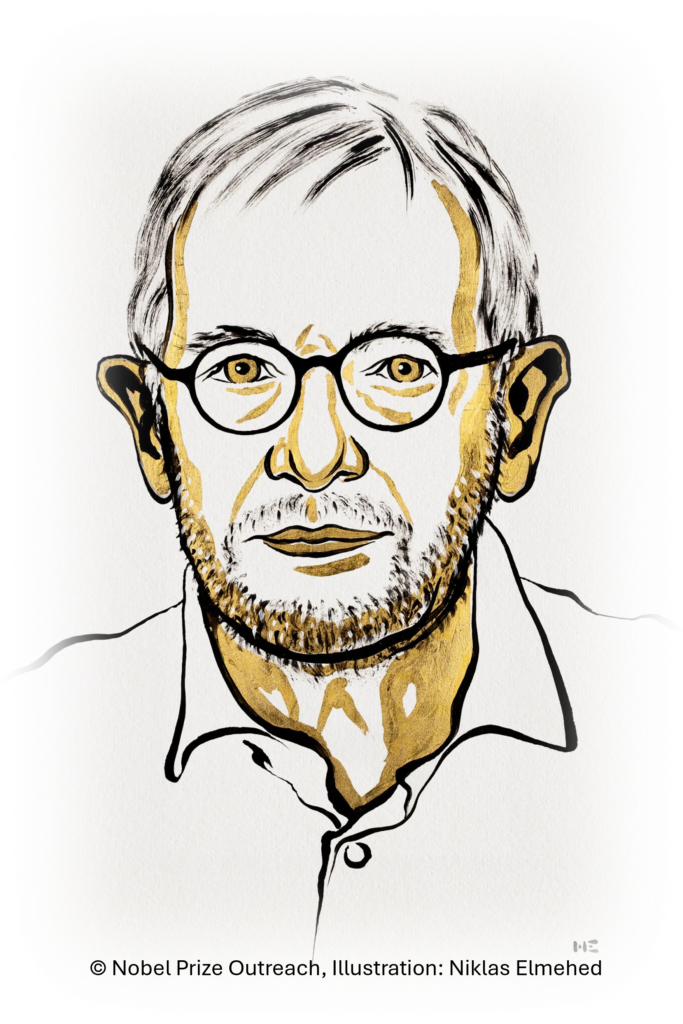
Francis Halzen from the University of Wisconsin-Madison, principal investigator of the IceCube Neutrino Observatory, is the recipient of the 2026 Nobel Prize in Physics! He was awarded the prize for his “decisive contributions to the IceCube Neutrino Observatory and the discovery of high-energy neutrinos of astrophysical origin”.
With his work, Francis paved the way for high-energy neutrino astronomy – a field that is closely related to the science of H.E.S.S., since high-energy neutrinos are often accompanied by high-energy gamma rays. In fact, H.E.S.S. scientists have joined forces with colleagues from the IceCube Collaboration multiple times, exploiting a multi-messenger approach.
A powerful advantage of the IceCube experiment is that it can continually monitor the entire sky for the arrival of high-energy neutrinos. When this happens, automated alerts are sent out, and H.E.S.S. is among the instruments that “listens” to these alerts and performs follow-up observations in the gamma-ray domain. This approach famously already led to the detection of a gamma-ray flare from an active galaxy, called TXS 0506+056, coincident with a high-energy neutrino (see https://ui.adsabs.harvard.edu/abs/2018Sci…361.1378I/abstract). More recently, together with the IceCube Collaboration and other partners, we have published a paper describing follow-up observations of many more neutrino alerts (see https://ui.adsabs.harvard.edu/abs/2026ApJ…997..141A/abstract). The alert program continues to be active, and it is only a question of time before it will pay off!
We are thrilled about the recognition of Francis’ achievements and wholeheartedly congratulate him and the entire IceCube Collaboration!
Official press release of the Nobel Foundation: https://www.nobelprize.org/prizes/physics/2026/press-release/
More information on IceCube: https://icecube.wisc.edu/