H.E.S.S. Gamma-Ray Astronomy Software School
Second edition, Windhoek, Namibia
After the following success of the first school held in December 2024. The H.E.S.S. Software school 2026 program aims to continue strengthening expertise in gamma-ray astronomy and data analysis among students and early-career researchers, particularly in Southern Africa.
Dates: 30th November – 4th December 2026
The school will provide participants with both theoretical background and practical training in high-energy astrophysics and gamma-ray data analysis. Lectures and hands-on sessions will guide participants from the foundations of gamma-ray astronomy through to the analysis of real observational data using modern software tools. Participants will attend lectures covering topics such as:
• Introduction to gamma-ray astronomy and astroparticle physics
• Multiwavelength perspectives in modern astronomy
• Gamma-ray production mechanisms in astrophysical sources
• Software tools used in gamma-ray data analysis
• Practical data analysis using Gammapy and Jupyter Notebook
A major component of the school will be a hands-on workshop in which participants will analyze publicly available gamma-ray data. After guided demonstrations, attendees will perform their own analysis of astrophysical sources with support from instructors and tutors. Participants are expected to:
• Have working knowledge of Python programming (loops, functions, and basic scripting).
• Bring a laptop computer for the practical sessions.
• Install Gammapy and Jupyter Notebook prior to the school where possible.
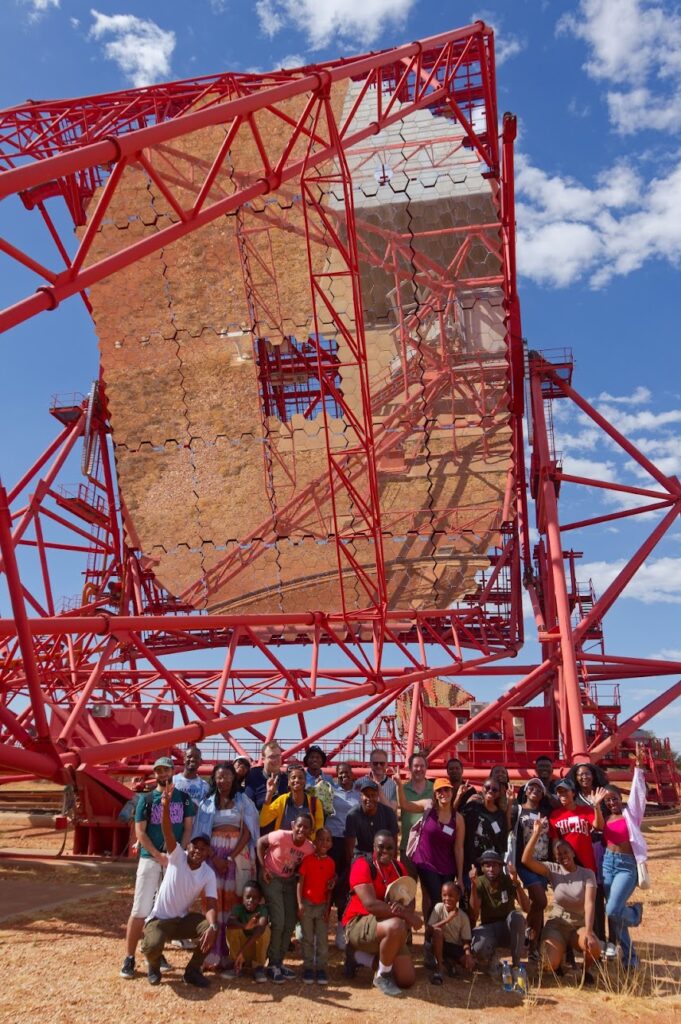
The program will run over five days and including lectures, software tutorials, and collaborative workshop sessions. In addition, participants will have the opportunity to visit the H.E.S.S. telescope site as part of the school activities.
Hotel accommodations and meals will be covered by the CNRS for all participants. Participants will need to get external funding to get to and from the venue and other expenses. More details in the Accomodation tab.
Program table
| 1 Dec | arrivals | ||||
|---|---|---|---|---|---|
| 2-6 Dec | Mon | Tue | Wed | Thu | Fri |
| 9:30 – 11:00 | Astroparticle Physics I Mathieu de Naurois | Gamma-ray Astronomy Theory of Showers Mathieu de Naurois | Installation Jimmy Shapopi | Workshop | Workshop |
| 11:00 – 11:30 | health break | health break | health break | health break | health break |
| 11:30 – 13:00 | Astroparticle Physics II Mathieu de Naurois | Gamma-ray Astronomy Data acquisition & analysis Mathieu de Naurois | GammaPy Nukri Komin | Workshop | Workshop |
| 13:00 – 14:30 | Lunch | H.E.S.S. Site excursion | Lunch | Lunch | Lunch |
| 14:30 – 15:00 | Multiwavelength Session Michael Backes | GammaPy Nukri Komin | Workshop | Workshop | |
| 15:00 – 15:30 | health break | health break | health break | health break | |
| 15:30 – 17:00 | Gamma-ray production in Astrophysical sources Anton Dmytriiev (NWU) (remote) | Workshop Instructions Session Jimmy Shapopi | Workshop | Workshop | |
| 18:00 – 20:00 | Dinner | Dinner | Dinner | Dinner | Dinner |
Organizers :
Mathieu de Naurois, Director of Research at CNRS, Laboratoire Leprince Ringuet (LLR), France
Michael Backes, Lecturer at University of Namibia (UNAM), Namibia
Jimmy Shapopi, PhD Student at University of Namibia (UNAM), Namibia
Wassim Abderalouf Si Said, PhD Student at Laboratoire Leprince Ringuet (LLR), CNRS, France
Speaker :
- Astrophysics : Mathieu de Naurois, Director of Research at CNRS, Laboratoire Leprince Ringuet (LLR), France.
- MWL and Observatory : Michael Backes, Lecturer at University of Namibia (UNAM), Namibia
- Analysis-tools : Nukri Komin, Professor at Université de Montpellier (LUPM), France.
- MWL Emissions : Anton Dmytriiev, Professor at North West University (NWU), South Africa.
Gammapy Workshop :
- Nukri Komin, Professor at Université de Montpellier (LUPM), France.
- Jimmy Shapopi, PhD Student at University of Namibia (UNAM), Namibia
- Wassim Abderalouf Si Said, PhD Student at Laboratoire Leprince Ringuet (LLR), CNRS, France
| Mathiba Masekamisha Andries | South African |
| Mona Elhalaby | Egyptian |
| Senate Pearl Lekomola | Motswana |
| Bramuel Nakholi | Kenyan |
| Denzel | South African |
| Stephen Sottie | Ghanaian |
| Enzo Peres Afonso | South African |
| Chantelle Oratile King | Motswana |
| Mohamed Dahmani Della | Algerian |
| Lister Vivian Kgwatalala | Motswana |
| Queen Namene | Namibian |
| Immanuel Shilumba Luis | Namibian |
| Mohamed Islam KHADIR | Algerian |
| Seipone Talama Sebina | Motswana |
| Amoah Kwame Adjei | Ghanaian |
| Domingos Barros | Namibian |
| Enas Mohamed | Sudanese |
| Lynne Wonder Kariuki | Kenyan |
| Bernhard Priskila | Namibian |
| Bokamoso Botho Masebu | Motswana |
| Dionysius Estiks | Kenyan |
| Eckem Mtandwa | Motswana |
| Fauziyya Muhammad Auwal | Nigerian |
Hotel Overview: Roof of Africa Hotel
Located at 124–126 Nelson Mandela Avenue in Windhoek, the Roof of Africa Hotel is a popular, relaxed boutique hotel situated roughly a 15-minute walk from the vibrant city center and close to local landmarks (such as the famous Joe’s Beerhouse). It serves as a comfortable, eco-conscious base balancing a tranquil garden ambience with functional amenities for travelers and corporate or academic groups.
Key Features & Amenities
Rooms: Well-appointed standard, deluxe, and luxury en-suite rooms, plus studios/apartments. Each features air conditioning, a private entrance, a mini-fridge, a workspace desk, and a view of the lush tropical gardens or the pool area.
Dining & Socializing: Features a signature thatched-roof, open-air restaurant serving a daily buffet breakfast and an à la carte menu, alongside a lively, sociable on-site bar and shaded beer garden (“The Roof Bar”).
Leisure & Wellness: Includes a sparkling outdoor swimming pool (heated during cooler periods), sun loungers, an outdoor lapa, a sauna, and available massage services.
Connectivity & Practicalities: Free property-wide Wi-Fi, a 24-hour front desk, secure parking, and an in-house airport shuttle service coordinated for arrivals.
Eco-Friendly Initiative: The hotel incorporates solar-heating water systems and graywater recycling practices.
1. Visa Requirements
Depending on your nationality, you may or may not need to apply for a visa in advance:
Visa Exemptions: Citizens of many countries (including South Africa, the EU/Schengen member states, the UK, the USA, Canada, Australia, and several others) do not require a visa for tourist/workshop stays under 90 days. You will receive a Visitor’s Entry Permit (VEP) stamp directly upon arrival at the port of entry.
Visa on Arrival (VoA): If your nationality is eligible for a visa on arrival, it can be obtained directly at Hosea Kutako International Airport (WDH).
Online Application / Advance Check: If you require an entry visa beforehand or want to verify your exact status, you can check requirements and apply online via the Official Namibian Ministry of Home Affairs, Immigration, Safety and Security (MHAISS) e-Services Portal.
Processing & Delays: If an advance eVisa is required for your passport type, ensure you apply at least 3 to 4 weeks prior to departure to account for processing times.
Passport Validity: Your passport must be valid for at least 6 months beyond your planned date of departure and must contain at least 3 completely blank pages for stamps. You must also carry proof of a valid return ticket.
2. Weather in December & How to Prepare
December marks the beginning of summer in Namibia, meaning conditions are generally warm to hot.
Temperatures: Daytime temperatures often range between 30°C to 35°C (86°F–95°F) or higher depending on the exact location, while evenings cool down to comfortable levels.
Rainfall: December is part of the early “intermediate” or rainy season. While many days are sunny, brief afternoon thunderstorms or passing showers can occur.
How to Prepare:
Pack lightweight, breathable clothing (linen or cotton) for daytime sessions.
Bring a light jacket or sweater for cooler evenings or air-conditioned indoor lecture halls.
Pack a sturdy sun hat, polarized sunglasses, and high-SPF sunscreen—the southern African sun is intensely strong.
A compact umbrella or light rain shell is handy for sudden afternoon downpours.
Bring a reusable water bottle to stay hydrated.
3. What to Bring
Laptop (Mandatory): A reliable laptop is essential for the hands-on coding and software sessions. Make sure your system has your preferred development environments (e.g., Python, C++, terminal tools) pre-configured or check pre-school instructions for containerized environments.
Power Adapters: Namibia primarily uses Type D (three large round pins) and Type M (large South African plug), as well as the standard 3-pin round South African plug (Mains power is 220–240V). Bring a compatible adapter/converter before you arrive.
Meds & Personal Items: Basic medications can be found in major towns, but bring any personal prescription medications in their original labeled packaging.
4. Connectivity: Phone SIMs, Airport & Hotel WiFi
WiFi Availability:
Airport: Free public WiFi at Hosea Kutako International Airport is typically limited or unreliable; do not rely on it for critical communications upon landing.
Hotel: Most hotels and lodges used for the school provide guest WiFi, though speeds and bandwidth can vary compared to European fiber networks, especially during heavy usage.
Mobile Network Operators & SIM Cards:
MTC Namibia is the primary and most reliable local carrier, offering extensive 4G/LTE coverage across the country. TN Mobile is an alternative, though mostly restricted to urban centers.
Where to buy: You can purchase a physical MTC SIM card directly at Hosea Kutako International Airport upon arrival. Tip: Avoid the very small kiosks right in the immediate baggage claim if they only offer marked-up tourist bundles; look for standard MTC storefronts or options in the main arrival concourses.
Registration Requirement: Namibian law requires mandatory KYC passport registration for all SIM cards. Bring your physical passport with you to the counter; registration takes about 10–15 minutes.
Data Packages: Look into MTC’s local prepaid options (such as Tango top-ups combined with Aweh data bundles) which offer affordable data volumes for local use.
eSIMs: If your device supports it, international eSIM providers (like Airalo or GigSky) offer regional or Namibia-specific data plans that can be activated before you fly, allowing you to bypass airport queues, though local physical SIMs are generally cheaper per gigabyte for longer stays.
The applications to the school stopped on 31st August 2026
The school is funded and organised by