MAXI J1820+070 is a low-mass X-ray binary with a black hole (BH) as a compact object. This binary underwent an exceptionally bright X-ray outburst from 2018 March to October, showing evidence of a non-thermal particle population through its radio emission during this whole period. The combined results of 59.5 h of observations of the MAXI J1820+070 outburst with the H.E.S.S., MAGIC and VERITAS experiments at energies above 200 GeV are presented, together with Fermi-LAT data between 0.1 and 500 GeV, and multiwavelength observations from radio to X-rays. Gamma-ray emission is not detected from MAXI J1820+070, but the obtained upper limits and the multiwavelength data allow us to put meaningful constraints on the source properties under reasonable assumptions regarding the non-thermal particle population and the jet synchrotron spectrum. In particular, it is possible to show that, if a high-energy (HE) gamma-ray emitting region is present during the hard state of the source, its predicted flux should be at most a factor of 20 below the obtained Fermi-LAT upper limits, and closer to them for magnetic fields significantly below equipartition. During the state transitions, under the plausible assumption that electrons are accelerated up to ∼500 GeV, the multiwavelength data and the gamma-ray upper limits lead consistently to the conclusion that a potential HE and very-HE gamma-ray emitting region should be located at a distance from the BH ranging between 1011 and 1013 cm. Similar outbursts from low-mass X-ray binaries might be detectable in the near future with upcoming instruments such as CTA.

MWL Context and Observations
Table 1
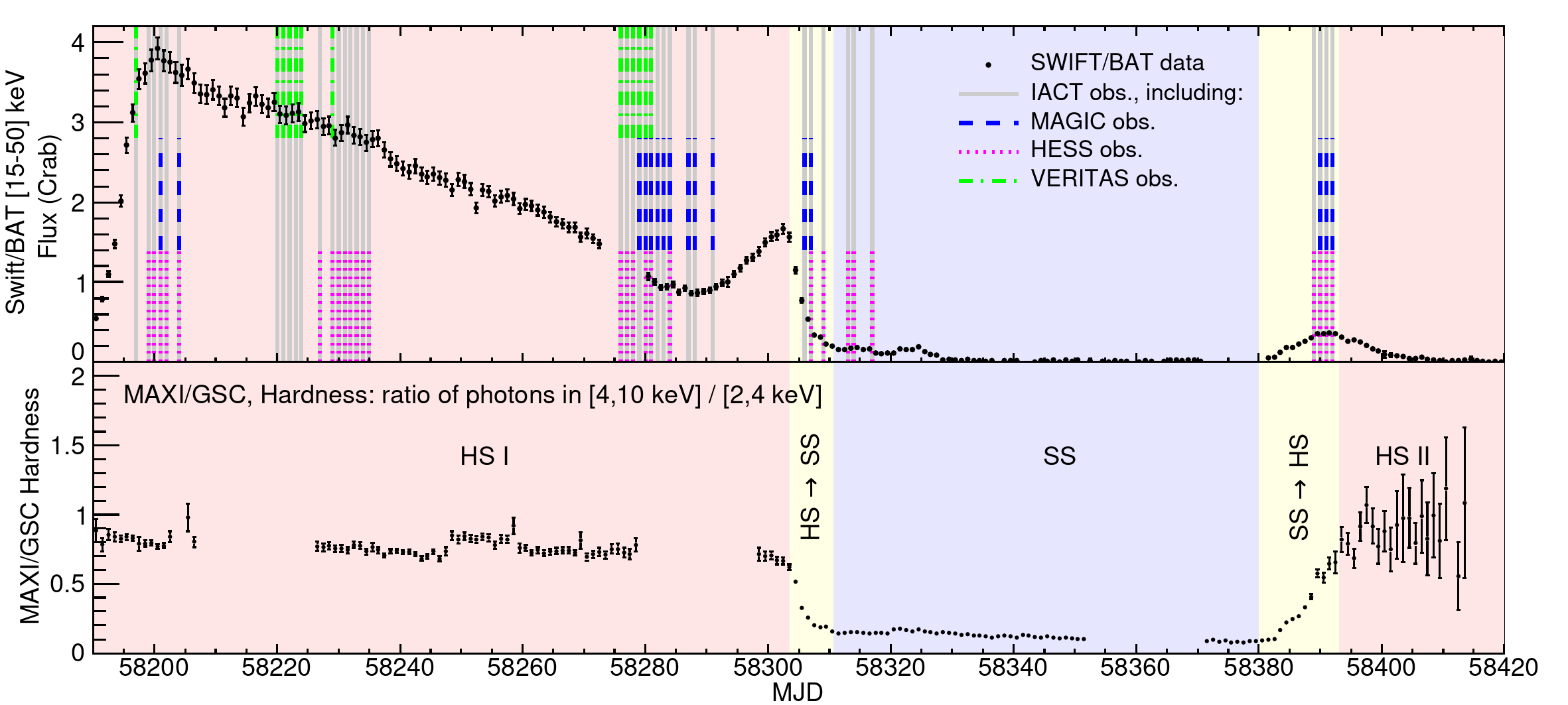
Starting and ending times used for each X-ray state of MAXI J1820+070, based on the results of Shidatsu et al. (2019). Hard State I and II refer, respectively, to the initial and final states of the source, as depicted in Figure 1.
| Source state | Start | End | Start | End |
|---|---|---|---|---|
| [MJD] | [MJD] | [Gregorian] | [Gregorian] | |
| Hard State I | 58189.0 | 58303.5 | 12 Mar. 2018 | 4 Jul. 2018 |
| HS → SS | 58303.5 | 58310.7 | 4 Jul. 2018 | 11 Jul. 2018 |
| Soft State | 58310.7 | 58380.0 | 11 Jul. 2018 | 19 Sep. 2018 |
| SS → HS | 58380.0 | 58393.0 | 19 Sep. 2018 | 2 Oct. 2018 |
| Hard State II | 58393.0 | 58420.0 | 2 Oct. 2018 | 29 Oct. 2018 |
Table 2
Summary of the observations of MAXI J1820+070 by the H.E.S.S.,MAGIC, and VERITAS collaborations, after data quality cuts. The effective observation time, the zenith angle range, and its median are shown for each source state and experiment.
| State | Experiment Time [h] Z.A.(median) [deg] | |||||||||
|---|---|---|---|---|---|---|---|---|---|---|
| Hard State |
|
|||||||||
| HS → SS |
|
|||||||||
| Soft State |
|
|||||||||
| SS → HS |
|
|||||||||
| TOTAL |
|
Figure 1
Top panel: X-ray flux in the 15-50 keV band as seen by Swift/BAT, with the VHE observation dates superimposed as vertical lines with different styles for each collaboration. Only the days with data after quality cuts are shown.
Bottom panel: Evolution of the MAXI J1820+070 hardness ratio of the 4-10 to 2-4 keV fluxes as seen by MAXI/GSC. The source states are superimposed as light red (HS), light blue (SS) and light yellow (HS-SS / SS-HS) background colours.
Bottom panel: Evolution of the MAXI J1820+070 hardness ratio of the 4-10 to 2-4 keV fluxes as seen by MAXI/GSC. The source states are superimposed as light red (HS), light blue (SS) and light yellow (HS-SS / SS-HS) background colours.
FERMI-LAT data and analysis
Table 3
Details of Fermi-LAT data analysis. From top to bottom, the parameters of the analysis are: type of response functions; event class and type; maximum zenith angle; spatial and energy bins widths for the likelihood analysis; number of energy dispersion bins; energy range used for the analysis; radius of the region of interest up to which the sources were included with free normalization (ROI (free)); radii range in which the sources were included with all parameters fixed to 4FGL-DR3 values (ROI(fixed)); used catalogue; Galactic diffuse and isotropic diffuse background templates; time range (in Fermi seconds) used for the analysis:
| Parameter | Value |
|---|---|
| Response functions | P8R3_V3 |
| evclass | 128 |
| evtype | 3 |
| zmax | 90° |
| Spatial bin width | 0.05° |
| Energy bins per decade | 5 |
| edisp_bins | -3 |
| Energy range | 0.1 – 500 GeV |
| ROI (free) | 14° |
| ROI (fixed) | 14° – 24° |
| Catalogue | 4FGL-DR3 |
| Background (galactic) | gll_iem_v07.fits |
| Background (isotropic) | iso_P8R3_SOURCE_V3_v1.txt |
| Likelihood analysis optimiser | NEWMINUIT |
| Time ranges | |
| TOTAL | 542505605 – 562464005 |
| Hard State I | 542505605 – 552398405 |
| HS → SS | 552398405 – 553020485 |
| Soft State | 553020485 – 559008005 |
| SS → HS | 559008005 – 560131205 |
| Hard State II | 560131205 – 562464005 |
Figure 2 left
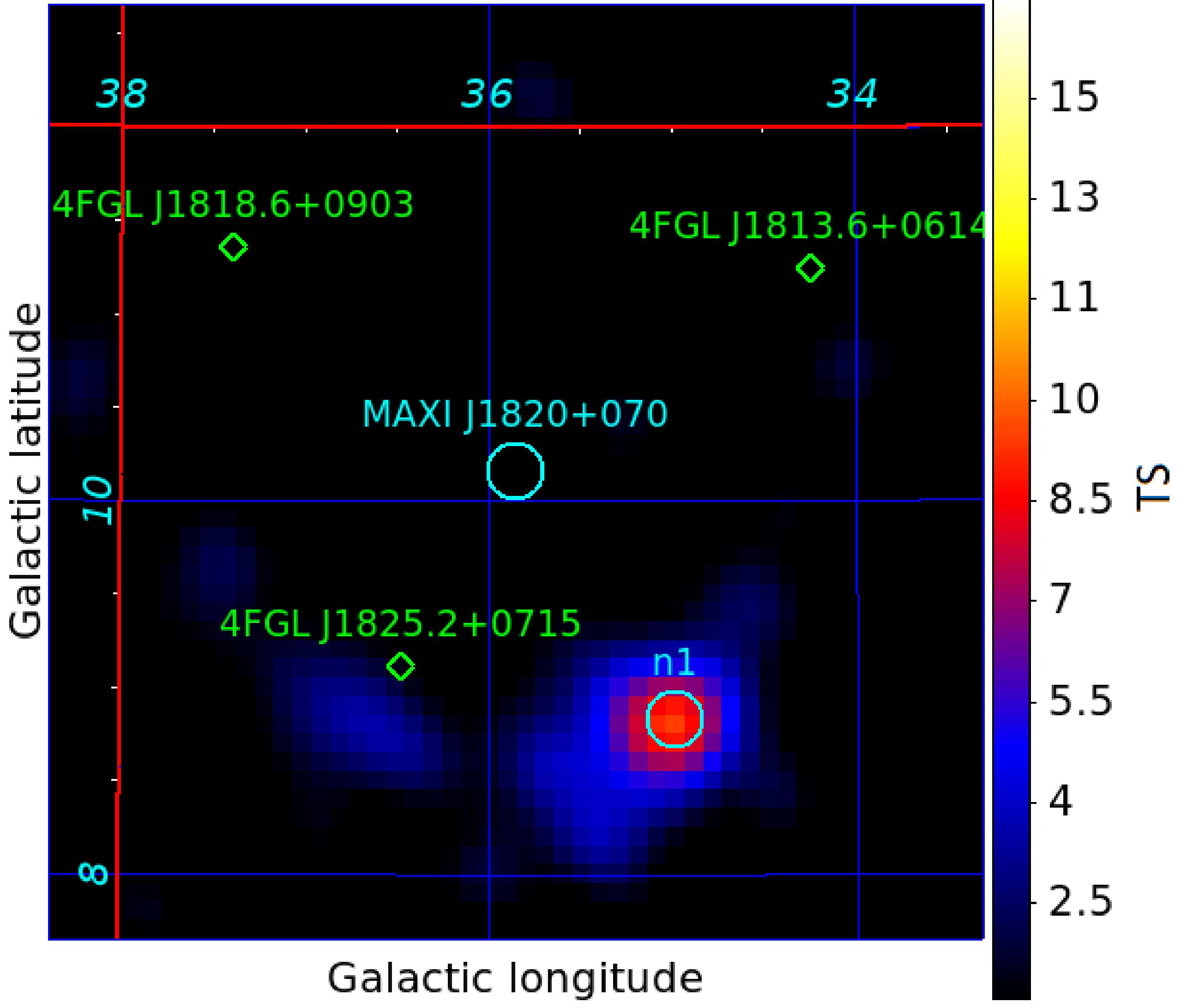
Test-statistics map in Galactic coordinates of a 5° × 5° region around MAXI J1820+070 (cyan circle at the centre) in the 0.1-500 GeV energy range, with a 0.1° pixel size. Green symbols show the 4FGL Fermi-LAT sources present in the region. The cyan circle marked as n1 shows a TS∼10 point-like residual positionally coincident with PSR J1823+0550.
Values in the TS map: fits file
Figure 2 right
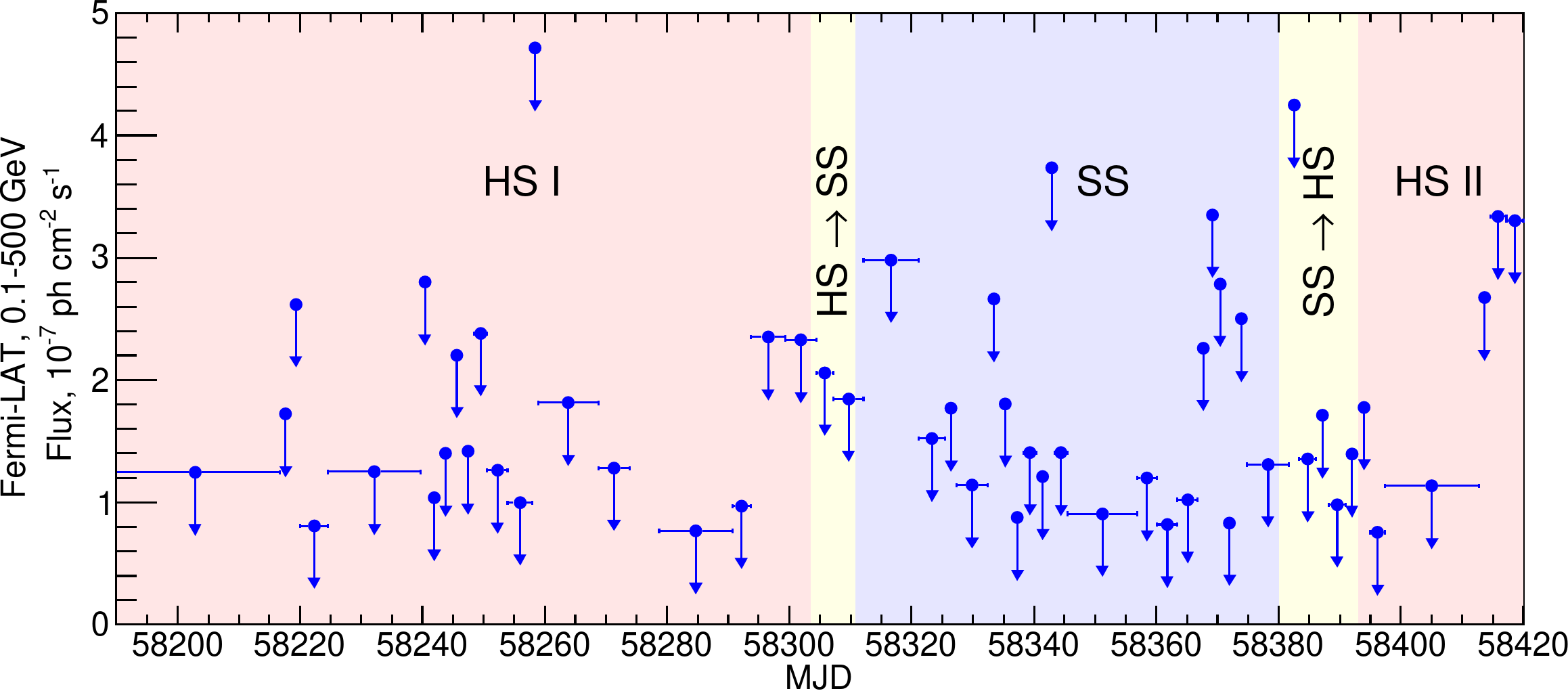
Fermi-LAT Light Curve of MAXI J1820+070 in the 0.1-500 GeV energy band with an adaptive time binning. The bin widths correspond to 16 photons arrived in a 1° radius around MAXI J1820+070. Source states are represented with light red (HS), light blue (SS), and light yellow (HS-SS / SS-HS) background colours.
Data points: text file for the points displayed on the figure
Upper limits
Table 4
Integral flux upper limits with a 0.95 C.L. during different source states, between 0.1 and 500 GeV from Fermi-LAT data, and above 200 GeV from the combined H.E.S.S., MAGIC and VERITAS data. For the SS-HS transition, the UL above 300 GeV is shown instead.
| Source state | ( 0.1-500 GeV) | ( >200/300 GeV) |
|---|---|---|
| [ph cm -2 s-1 ] | [ph cm -2 s-1 ] | |
| Hard State I | 3.1 × 10⁻⁸ | 9.5 × 10⁻¹³ |
| HS → SS | 1.6 × 10⁻⁷ | 9.5 × 10⁻¹³ |
| Soft State | 2.5 × 10⁻⁸ | 1.6 × 10⁻¹² |
| SS → HS | 5.2 × 10⁻⁸ | 2.2 × 10⁻¹² |
| Hard State II | 6.0 × 10⁻⁸ | – |
| TOTAL | 1.8 × 10⁻⁸ | 7.2 × 10⁻¹³ |
Figure 3
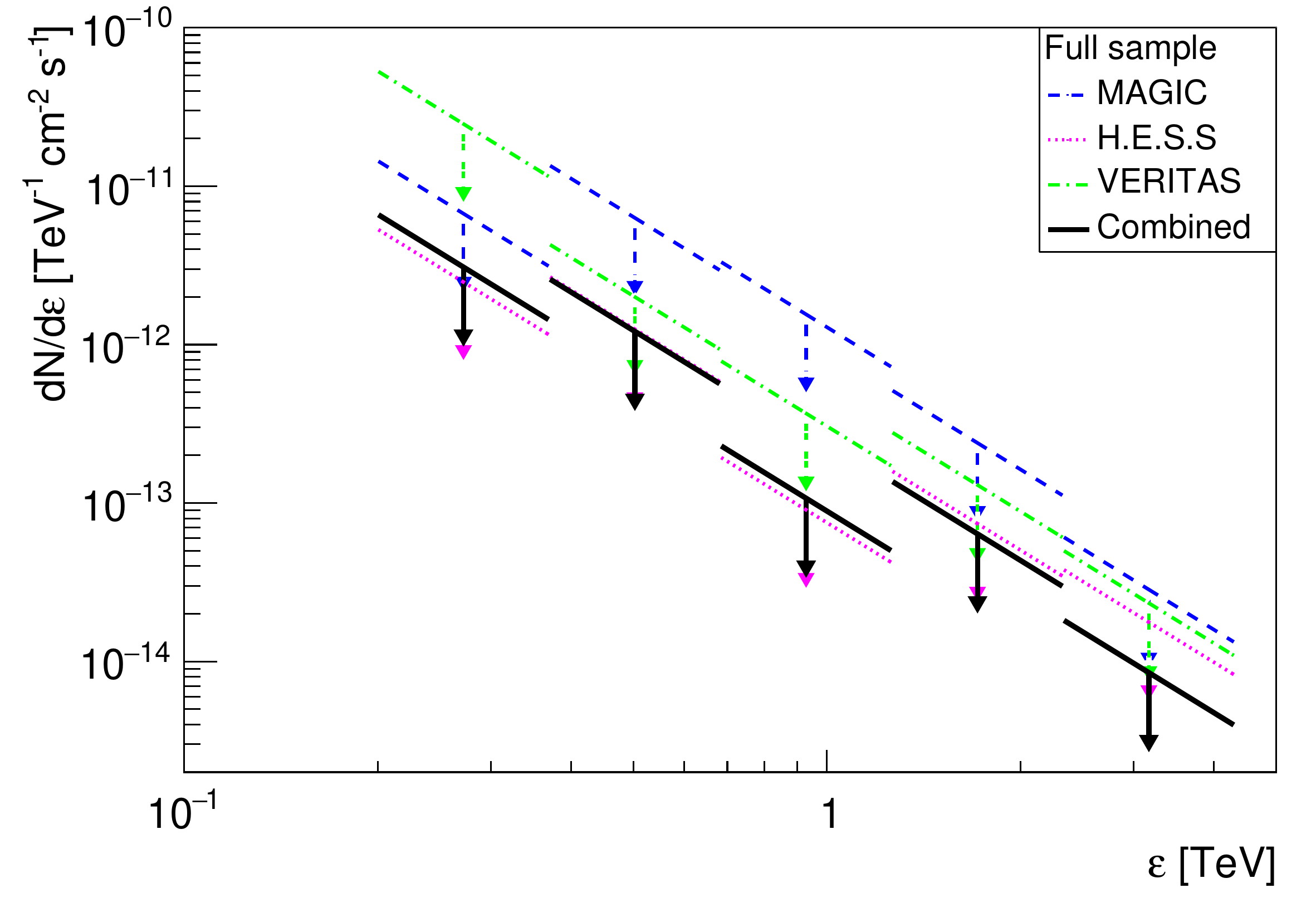
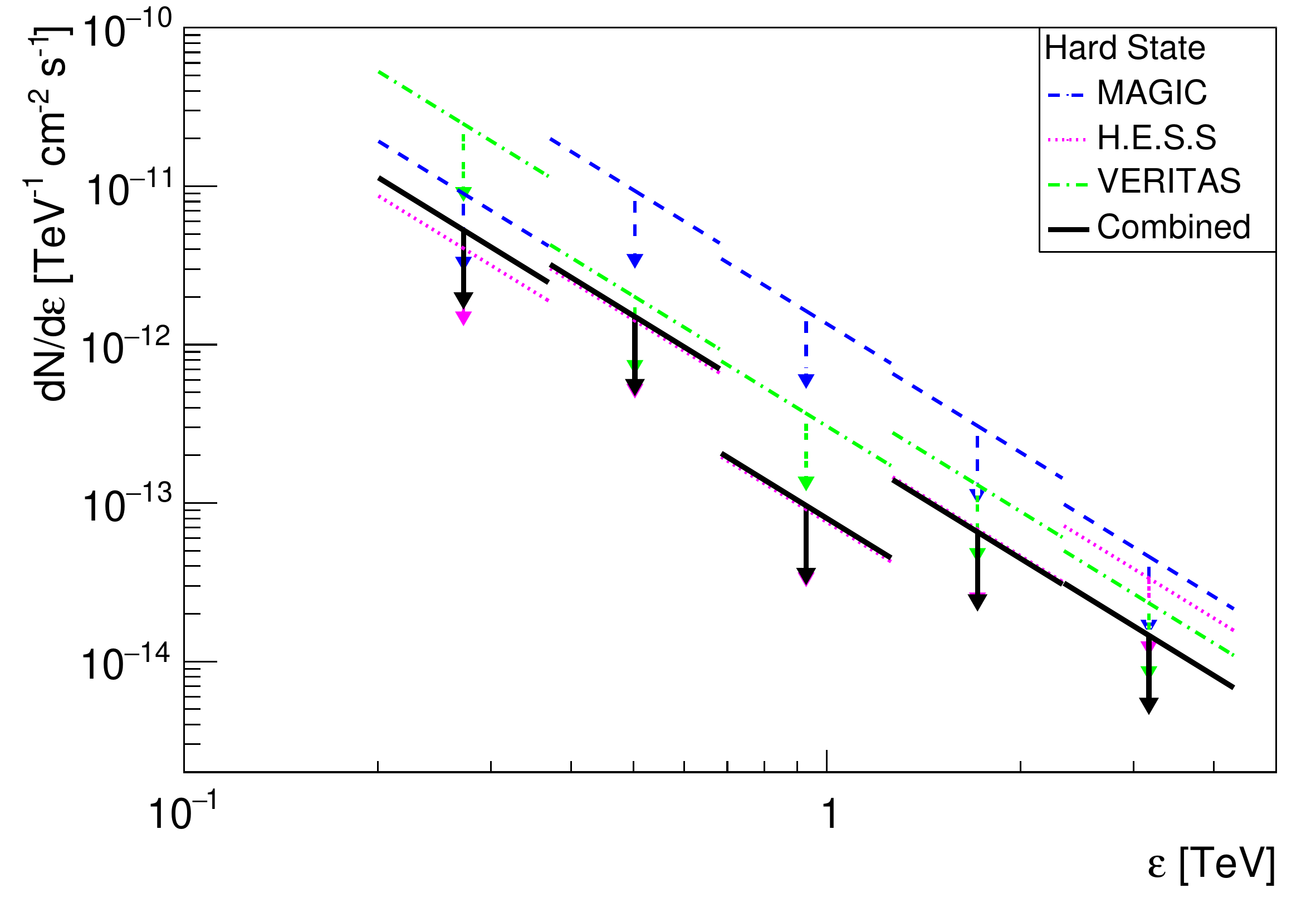
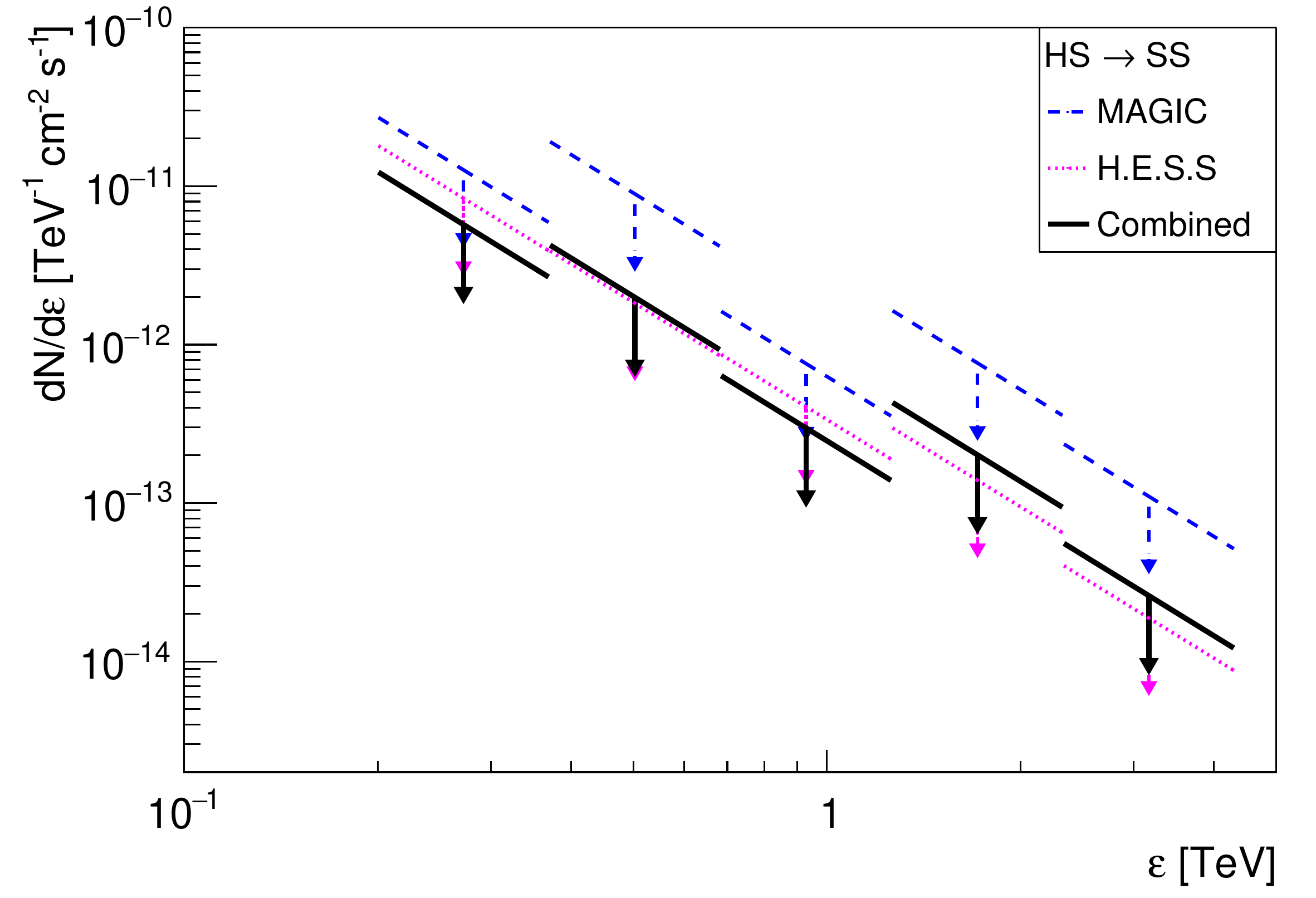
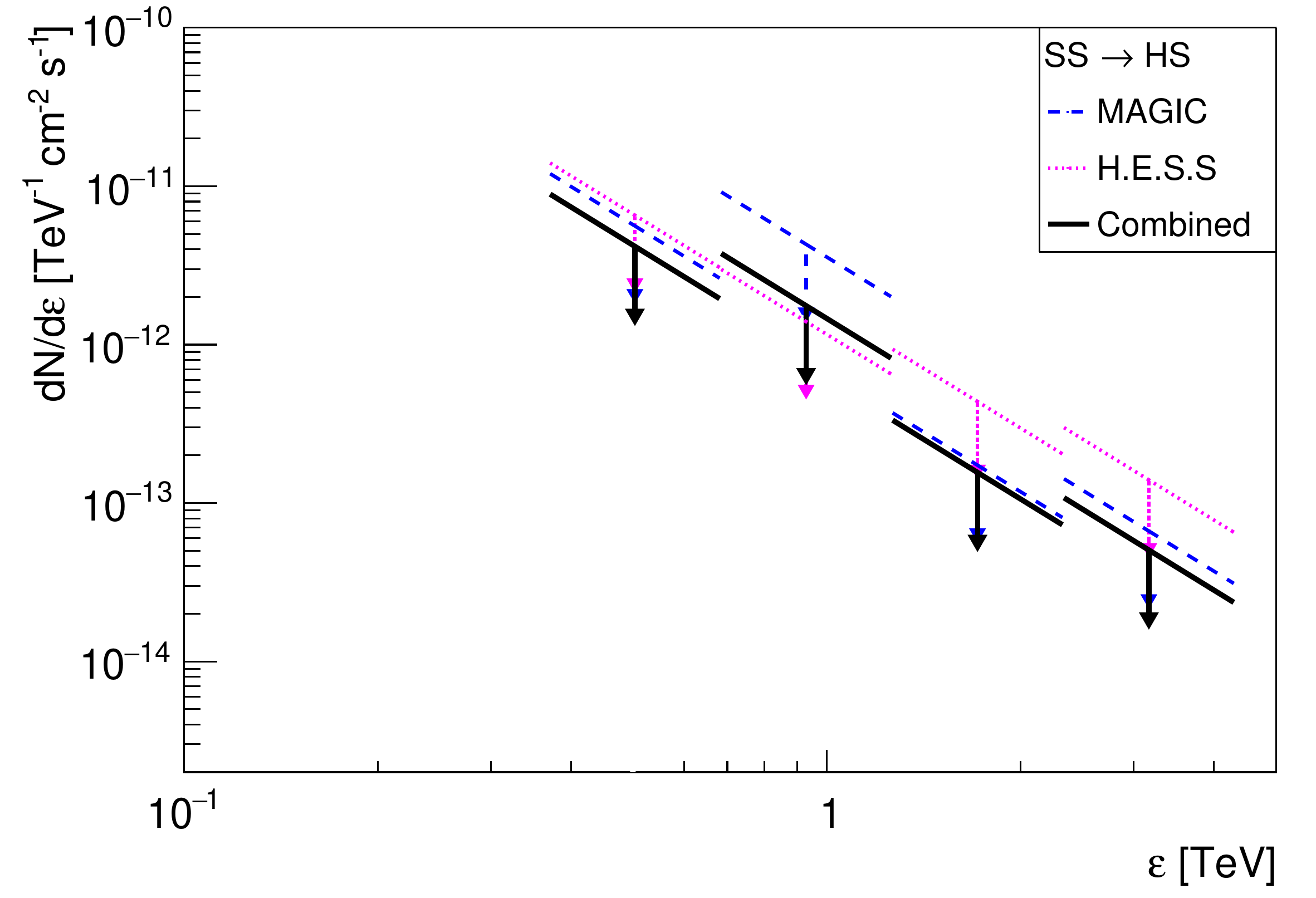
Differential flux upper limits of MAXI J1820+070 for different energy bins and source states. Coloured markers represent the results for the individual experiments, while black lines show the combined upper limits.
Light Curves
Figure 4
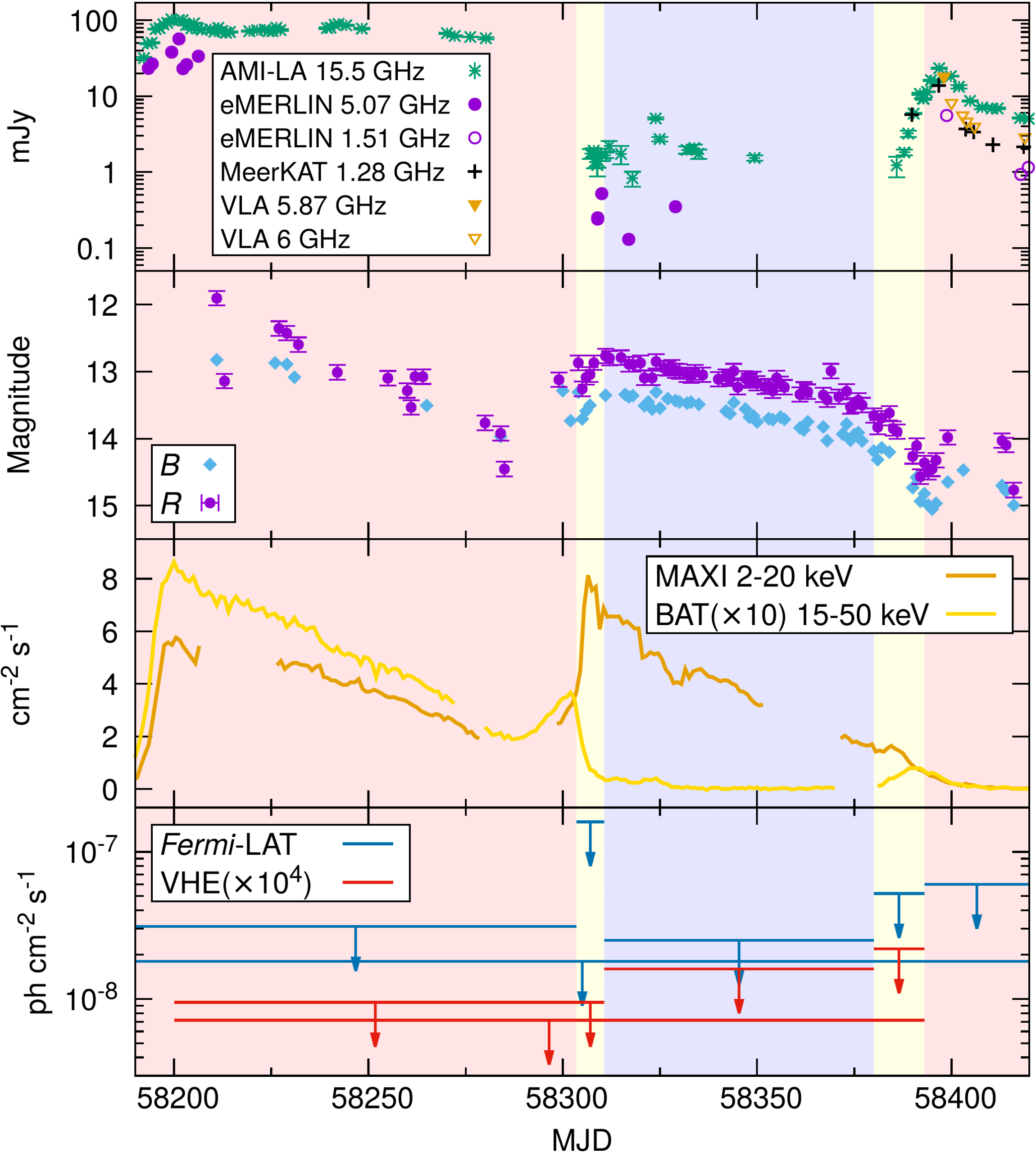
From the top to bottom panels: Radio, optical, X-ray, and gamma-ray Light Curves of MAXI J1820+070 during its 2018 outburst (MJD 58189.0-58420.0). The shaded areas correspond to the HS (light red), the HS-SS and SS-HS transitions (light yellow), and the SS (light blue). The units of the third panel are ph cm-2 s-1 for MAXI/GSC, and count cm-2 s-1 for Swift/BAT ; the latter fluxes are multiplied by 10 for a better visualization. The bottom panel shows the Fermi-LAT ULs above 100 MeV, and the H.E.S.S./MAGIC/VERITAS combined ULs (multiplied by 104 ) for each source state and transition for which data are available, as well as for the whole outburst. The VHE ULs are computed above 200 GeV, except for the SS-HS transition (MJD 58380.0-58393.0) for which 300 GeV ULs are shown.
Spectral Energy Distributions
Figure 5
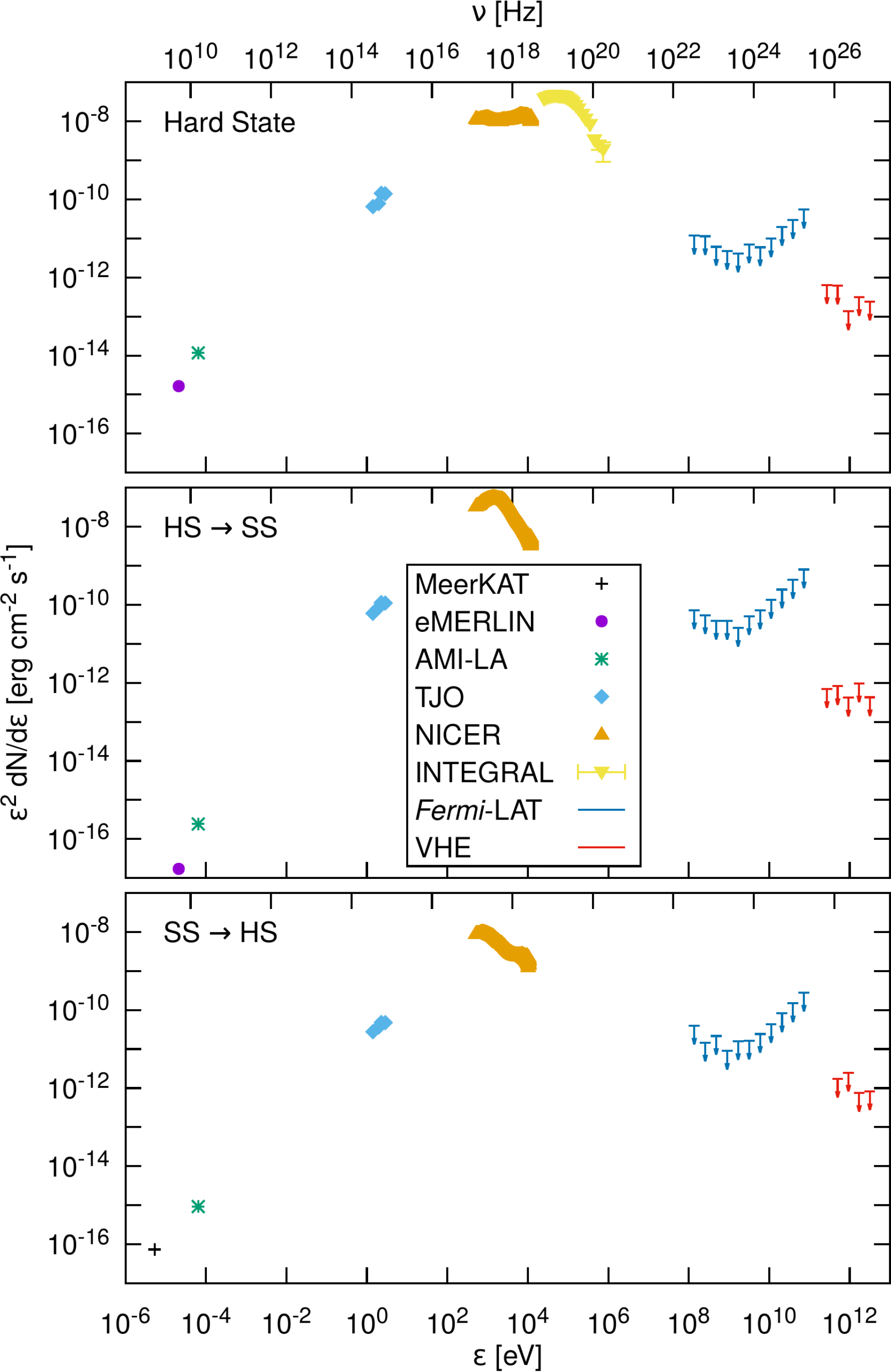
From top to bottom panels: SEDs of MAXI J1820+070 averaged over the HS, the HS-SS transition, and the SS-HS transition. Fermi-LAT points include the contribution from the two HSs of the source. The eMERLIN data shown are those at 5.07 GHz. MeerKAT data are used in the bottom panel instead of eMERLINs.
Appendix
Table A1
Dates when H.E.S.S., MAGIC and/or VERITAS observations of MAXI J1820+070 were performed. Only dates with surviving data after quality cuts are shown. These are also depicted in Figure 1.
| Date | Date | H.E.S.S. | MAGIC | VERITAS |
|---|---|---|---|---|
| [MJD] | [Gregorian] | |||
| 58197 | 20 Mar. 2018 | ✓ | ||
| 58199 | 22 Mar. 2018 | ✓ | ||
| 58200 | 23 Mar. 2018 | ✓ | ||
| 58201 | 24 Mar. 2018 | ✓ | ✓ | |
| 58202 | 25 Mar. 2018 | ✓ | ||
| 58204 | 27 Mar. 2018 | ✓ | ✓ | |
| 58220 | 12 Apr. 2018 | ✓ | ||
| 58221 | 13 Apr. 2018 | ✓ | ||
| 58222 | 14 Apr. 2018 | ✓ | ||
| 58223 | 15 Apr. 2018 | ✓ | ||
| 58224 | 16 Apr. 2018 | ✓ | ||
| 58227 | 19 Apr. 2018 | ✓ | ||
| 58229 | 21 Apr. 2018 | ✓ | ✓ | |
| 58230 | 22 Apr. 2018 | ✓ | ||
| 58231 | 23 Apr. 2018 | ✓ | ||
| 58232 | 24 Apr. 2018 | ✓ | ||
| 58233 | 25 Apr. 2018 | ✓ | ||
| 58234 | 26 Apr. 2018 | ✓ | ||
| 58235 | 27 Apr. 2018 | ✓ | ||
| 58276 | 7 Jun. 2018 | ✓ | ✓ | |
| 58277 | 8 Jun. 2018 | ✓ | ✓ | |
| 58278 | 9 Jun. 2018 | ✓ | ✓ | |
| 58279 | 10 Jun. 2018 | ✓ | ✓ | |
| 58280 | 11 Jun. 2018 | ✓ | ✓ | ✓ |
| 58281 | 12 Jun. 2018 | ✓ | ✓ | ✓ |
| 58282 | 13 Jun. 2018 | ✓ | ||
| 58283 | 14 Jun. 2018 | ✓ | ||
| 58284 | 15 Jun. 2018 | ✓ | ✓ | |
| 58287 | 18 Jun. 2018 | ✓ | ||
| 58288 | 19 Jun. 2018 | ✓ | ||
| 58291 | 22 Jun. 2018 | ✓ | ||
| 58306 | 7 Jul. 2018 | ✓ | ||
| 58307 | 8 Jul. 2018 | ✓ | ✓ | |
| 58309 | 10 Jul. 2018 | ✓ | ||
| 58313 | 14 Jul. 2018 | ✓ | ||
| 58314 | 15 Jul. 2018 | ✓ | ||
| 58317 | 18 Jul. 2018 | ✓ | ||
| 58389 | 28 Sep. 2018 | ✓ | ||
| 58390 | 29 Sep. 2018 | ✓ | ✓ | |
| 58391 | 30 Sep. 2018 | ✓ | ✓ | |
| 58392 | 1 Oct. 2018 | ✓ | ✓ |
