We report on a search for persistent radio emission from the one-off fast radio burst (FRB) 20190714A, as well as from two repeating FRBs, 20190711A and 20171019A, using the MeerKAT radio telescope. For FRB 20171019A, we also conducted simultaneous observations with the High-Energy Stereoscopic System (H.E.S.S.) in very high-energy gamma rays and searched for signals in the ultraviolet, optical, and X-ray bands. For this FRB, we obtain a UV flux upper limit of 1.39×10⁻¹⁶ erg cm-2 s-1 Å-1, X-ray limit of ~6.6×10⁻¹⁴ erg cm-2 s-1 and a limit on the very high energy gamma-ray flux Φ(E>120 GeV) < 1.7×10⁻¹² erg cm-2 s-1. We obtain a radio upper limit of ~15 μJy beam-1 for persistent emission at the locations of both FRBs 20190711A and 20171019A with MeerKAT. However, we detected an almost unresolved (ratio of integrated flux to peak flux is ~1.7 beam) radio emission, where the synthesized beam size was ~ 8 arcsec size with a peak brightness of ∼53μJy beam-1 at MeerKAT and ∼86μJy beam-1 at e-MERLIN, possibly associated with FRB 20190714A at z = 0.2365. This represents the first detection of persistent continuum radio emission potentially associated with a (as-yet) non-repeating FRB. If the association is confirmed, one of the strongest remaining distinction between repeaters and non-repeaters would no longer be applicable. A parallel search for repeat bursts from these FRBs revealed no new detections down to a fluence of 0.08 Jy ms for a 1 ms duration burst.

H.E.S.S. data
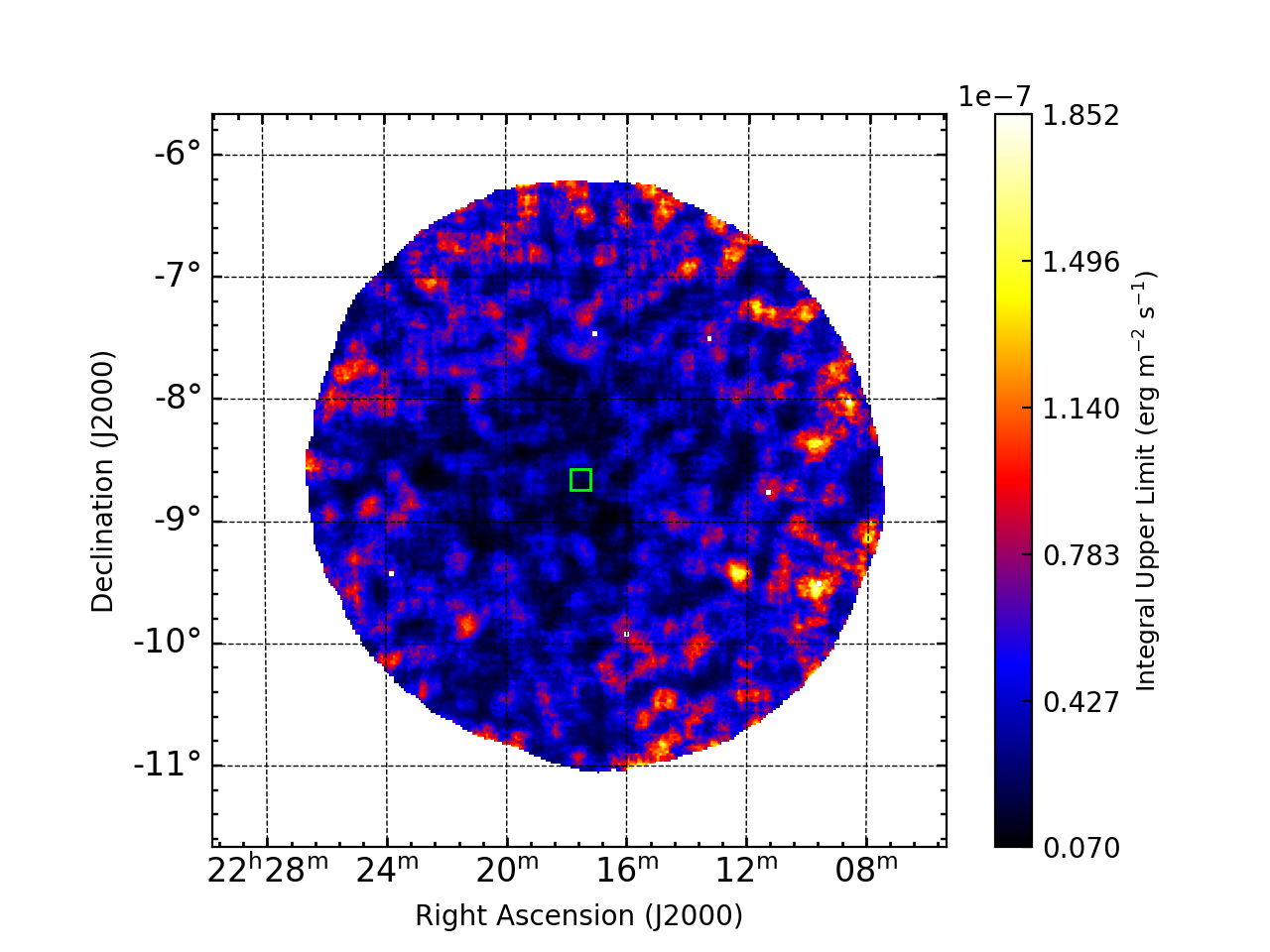
FRB171019 H.E.S.S. energy flux integral upper limit map
Swift XRT data

Swift UVOT data
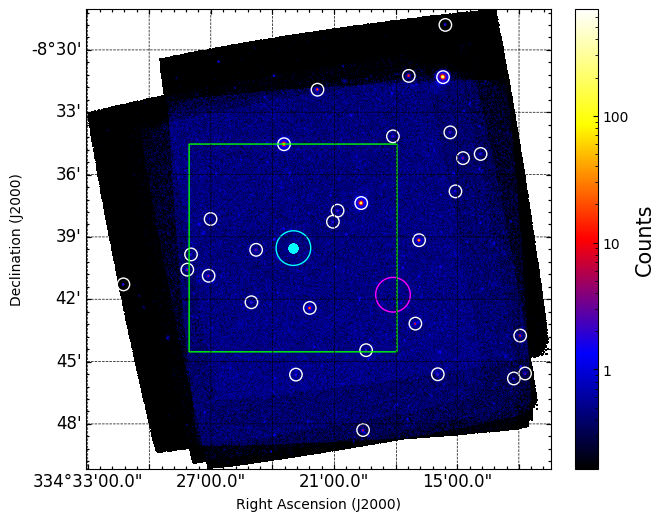
FRB171019 Swift UVOT 5 sigma detections
Acknowledgements
This paper makes use of the MeerKAT data (Project ID: SCI-20190418-VC-01). The MeerKAT telescope is operated by the South African Radio Astronomy Observatory, which is a facility of the National Research Foundation, an agency of the Department of Science and Innovation (DSI). This work made use of the InterUniversity Institute for Data Intensive Astronomy (IDIA) visualization lab https://vislab.idia.ac.za. IDIA is a partnership of the University of Cape Town, the University of Pretoria, the University of the Western Cape and the South African Radio astronomy Observatory. e-MERLIN is a National Facility operated by the University of Manchester at Jodrell Bank Observatory on behalf of STFC.
The authors acknowledge funding from the European Research Council (ERC) under the European Unionâs Horizon 2020 research and innovation programme (grant agreement No 694745). The support of the Namibian authorities and of the University of Namibia in facilitating the construction and operation of H.E.S.S. is gratefully acknowledged, as is the support by the German Ministry for Education and Research (BMBF), the Max Planck Society, the German Research Foundation (DFG), the Helmholtz Association, the Alexander von Humboldt Foundation, the French Ministry of Higher Education, Research and Innovation, the Centre National de la Recherche Scientifique (CNRS/IN2P3 and CNRS/INSU), the Commissariat aÌ lâeÌnergie atomique et aux eÌnergies alternatives (CEA), the U.K. Science and Technology Facilities Council (STFC), the Knut and Alice Wallenberg Foundation, the National Science Centre, Poland grant no. 2016/22/M/ST9/00382, the South African Department of Science and Technology and National Research Foundation, the University of Namibia, the National Commission on Research, Science & Technology of Namibia (NCRST), the Austrian Federal Ministry of Education, Science and Research and the Austrian Science Fund (FWF), the Australian Research Council (ARC), the Japan Society for the Promotion of Science and by the University of Amsterdam. We appreciate the excellent work of the technical support staff in Berlin, Zeuthen, Heidelberg, Palaiseau, Paris, Saclay, TuÌbingen and in Namibia in the construction and operation of the equipment. This work benefited from services provided by the H.E.S.S. Virtual Organisation, supported by the national resource providers of the EGI Federation.
Manage Consent
Functional
Always active
The technical storage or access is strictly necessary for the legitimate purpose of enabling the use of a specific service explicitly requested by the subscriber or user, or for the sole purpose of carrying out the transmission of a communication over an electronic communications network.
Preferences
The technical storage or access is necessary for the legitimate purpose of storing preferences that are not requested by the subscriber or user.
Statistics
The technical storage or access that is used exclusively for statistical purposes.
The technical storage or access that is used exclusively for anonymous statistical purposes. Without a subpoena, voluntary compliance on the part of your Internet Service Provider, or additional records from a third party, information stored or retrieved for this purpose alone cannot usually be used to identify you.
Marketing
The technical storage or access is required to create user profiles to send advertising, or to track the user on a website or across several websites for similar marketing purposes.